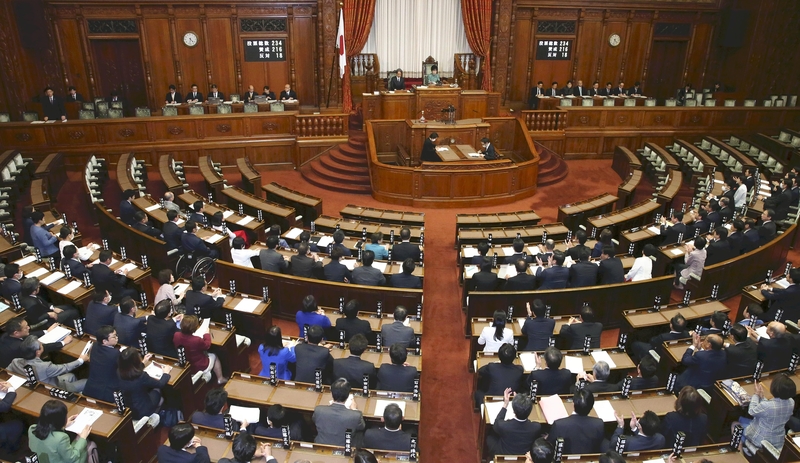
With the revision of a special measures law on new types of influenza Friday, Prime Minister Shinzo Abe is now able to declare an emergency.
This would grant prefectural governors strong powers, including the ability to limit private rights. The government has emphasized it would be prudent and consider the opinions of experts when using the law.
Under the revised law, if the health, labor and welfare minister reports to the prime minister that the new coronavirus is "highly likely to spread" within Japan, the government would establish a task force based on the special measures law and formulate a basic response policy.
If the infection spreads further and the prime minister determines there is a risk of an emergency situation, he would consult an advisory panel that includes infectious disease experts to determine if the requirements for an emergency are met.
If the advisory panel recognizes an emergency, the prime minister could declare a state of emergency for a certain period of time or area.
State Minister for Economic and Fiscal Policy Yasutoshi Nishimura told the House of Councilors Cabinet Committee that "the [basic] response policy clearly states that we must listen closely to the opinions of experts, respect human rights, and minimize restrictions on private rights."
At a press conference, Chief Cabinet Secretary Yoshihide Suga said, "We are not currently in a situation to immediately" declare an emergency.
Praise, demands
Governors and others in areas with many infected people have mostly praised the passage of the amendment, though many have warned the central government that the time has not yet come to declare an emergency.
Osaka Gov. Hirofumi Yoshimura praised the revision, saying Friday that, "What until now the prime minister has called for in the form of 'requests' will from now have legal grounds. It's the way it should be."
However, he said Osaka "is not yet an area to target for an emergency declaration" because the infection routes for most patients in the prefecture have been identified.
Yoshimura previously said that "declarations have some positive aspects, but some negative aspects."
Pointing to false rumors that have sparked a shortage of toilet paper and other goods, he said, "If a declaration is made, it could be difficult to curb confusion in society."
Aichi Gov. Hideaki Omura told reporters, "[The revised law] is a dangerous drug that involves significantly limiting private rights. I don't think it will get to that point."
Kanagawa Gov. Yuji Kuroiwa stated that he believed the central government should provide fiscal support for compensation if a prefecture exercises its authority.
Tokyo Gov. Yuriko Koike said, "I am conveying my concerns about the special measures law to the central government."
At the Prime Minister's Office on Thursday, Koike asked Abe to clearly state the basis for designating areas and what measures prefectures should take. A senior metropolitan government official expressed puzzlement that "what constitutes an emergency situation and what the requirements are for lifting it haven't been made clear yet."
Requests that people refrain from going out under the special measures law would be limited to residents in the target area.
Envisioning being unable to stop people from entering the Tokyo metropolitan area, Koike called for strengthening ties with the central government and neighboring prefectures, as "problems will occur if we don't think about things in terms of a large area."
Hokkaido, which has the largest number of infections in the country, announced a non-binding "emergency declaration" on February 28, urging locals to refrain from going out on weekends.
Hokkaido Gov. Naomichi Suzuki said, "I can imagine an emergency declaration based on the special measures law would have a major impact on people's lives. I want the central government to do everything it can to avoid a situation that would call for the government to declare an emergency."
Read more from The Japan News at https://japannews.yomiuri.co.jp/