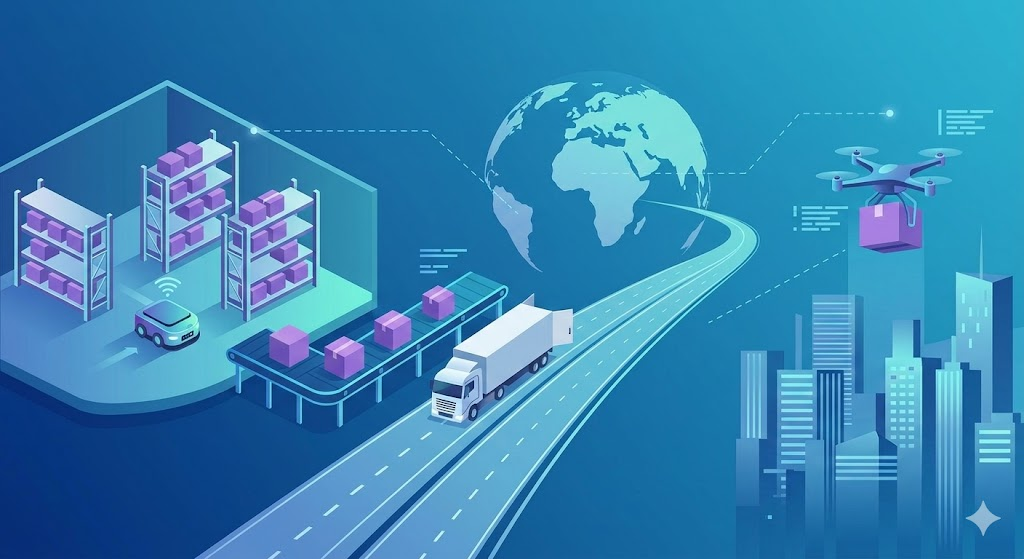
AI is no longer a futuristic nice-to-have in the logistics sector. By 2026, it will have become the fundamental operating system for the global supply chain. In an era defined by instant gratification and volatile global markets, AI provides the predictive power and operational agility required to stay solvent.
Shifting from reactive firefighting to a proactive, data-driven strategy, modern logistics providers are leveraging machine learning to slash costs by 15% to 20% while simultaneously improving delivery precision to near-perfect levels.
The Rise of AI in Modern Logistics Operations
The global logistics landscape is undergoing its most significant transformation since the invention of the shipping container. Today, the cargo is data as much as it is physical goods. As e-commerce volumes continue to shatter records, the human ability to manage the resulting complexity has reached its limit.
AI has stepped into this gap, acting as a digital nervous system that connects warehouses, fleets, and customers in a seamless loop of information. This integration allows companies to navigate disruptions, from sudden port closures to extreme weather, with a level of resilience that was previously impossible.
Evolution of Logistics in the Digital Era
Logistics has evolved through several distinct stages, moving from manual ledgers to basic computerization and now to autonomous intelligence. In the early 2000s, the digital era mostly meant replacing paper with PDFs.
However, the sheer volume of data generated by modern IoT sensors and global trade networks eventually made traditional software obsolete. We have entered the age of "Anticipatory Logistics," where the goal is no longer just to move a box from point A to point B, but to predict the need for that box before the customer even places the order.
This evolution is driven by the necessity of speed. In a world where "next-day delivery" is the baseline, manual coordination is a liability. Digital twins, virtual replicas of entire supply chains, now allow managers to simulate thousands of "what-if" scenarios in seconds, ensuring that the physical operation is always running on the most optimized path possible.
What Is Artificial Intelligence in Logistics?
When we talk about AI in this industry, we are referring to a suite of technologies including machine learning (ML), natural language processing (NLP), and computer vision.
Unlike standard software that follows a rigid set of "if-then" rules, AI learns from experience. It identifies patterns in massive datasets that are invisible to the human eye.
For instance, an AI might notice that every time a specific regional holiday occurs in Southeast Asia, shipping delays at a specific European port increase by 12% three weeks later due to ripple effects in container availability.
"AI helps teams spot patterns across global networks before disruptions escalate, turning massive data streams into faster, smarter decisions," explains Rachel Sinclair, Acquisitions Director at US Gold and Coin.
AI-Powered Demand Forecasting
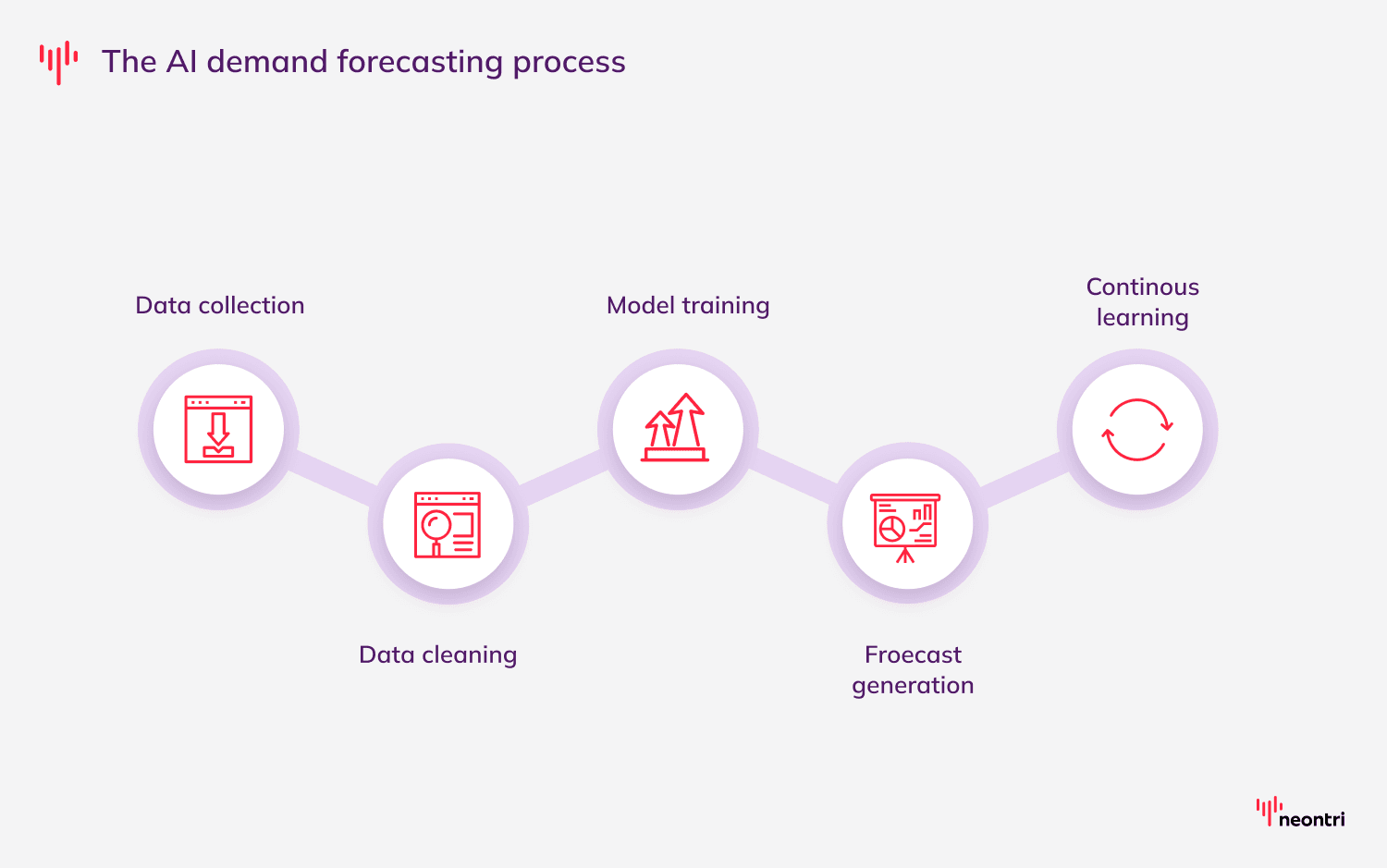
One of the most expensive problems in logistics is the "Bullwhip Effect," where small fluctuations in consumer demand cause massive, wasteful swings in inventory further up the supply chain. Traditional forecasting was a rearview-mirror exercise, looking at what happened last year to guess what will happen next month. AI has flipped this script.
By analyzing real-time data from Point-of-Sale (POS) systems, social media trends, and even local weather patterns, AI models can reduce demand forecasting errors by 20% to 50%.
Source: Neontri
For a major retailer, this means the difference between a warehouse full of unsold winter coats during a record-breaking warm spell and having exactly the right amount of inventory to meet a sudden surge in demand for rain gear. A practical example of this is seen in high-fashion logistics, where AI monitors viral trends on platforms like TikTok to adjust manufacturing and shipping schedules in real-time, ensuring that trending items reach local hubs before the hype fades.
Dynamic Inventory Management and Slotting
Beyond just forecasting, AI is revolutionizing how inventory is physically organized within a facility. Traditional "slotting"—the process of deciding where to put specific items—was often a seasonal or annual manual task. Today, AI-driven dynamic slotting analyzes real-time picking data to reorganize warehouse layouts on the fly. By placing high-velocity items closer to packing stations and grouping frequently bought-together products, AI minimizes "travel time" for workers and robots alike.
Beni Avni, Founder of New York Gates, says, "A logical, data-backed layout improves efficiency and keeps operations moving smoothly."
In a logistics context, this means that if a sudden social media trend spikes the demand for a specific SKU, the AI identifies the trend and instructs the morning shift to move those pallets to the front of the warehouse.
Smart Route Optimization and Fleet Management
Route optimization used to be a simple math problem: find the shortest distance. Today, it is a complex, multi-variable equation that changes by the minute. AI-powered Transportation Management Systems (TMS) now account for live traffic, bridge heights, fuel prices, and even driver fatigue levels.
“Real-time data acts as a digital nervous system for the supply chain, allowing companies to respond immediately when disruptions occur, whether a cargo ship is delayed by severe weather or a port faces unexpected congestion,” says David Tang, CEO of KPI Depot.
The results are staggering. Industry leaders like UPS have used AI systems like ORION (On-Road Integrated Optimization and Navigation) to save over 100 million miles driven per year.
By avoiding left-hand turns against traffic, which causes idling and increases accident risk, these algorithms save millions of gallons of fuel annually. This isn't just about the big players, either. Small delivery fleets are now using AI-driven apps that automatically re-sequence stops if a driver falls behind schedule or if a customer requests a different delivery window mid-route.
Warehouse Automation and Robotics
The modern warehouse has become a high-tech hive of activity where humans and robots work in a choreographed dance. AI is the brain behind this coordination. Computer vision systems now scan pallets for damage or missing items with 99.9% accuracy, far exceeding human capability.
Recent data shows that warehouses implementing AI-driven robotics see an average increase in picking speed of 300% and a 25% to 30% reduction in overall labor costs.
Autonomous Mobile Robots (AMRs) are a prime example. Unlike older dumb robots that followed magnetic strips on the floor, AMRs use AI to navigate dynamic environments, avoiding obstacles and finding the most efficient path to the next pick face.
This "goods-to-person" model means human workers spend less time walking miles of aisles and more time on high-value tasks like quality control and complex packing.
AI in Supply Chain Visibility
In the past, a shipment entering the black hole of international transit was a major source of anxiety. Today, AI provides what is known as "End-to-End Visibility." It’s not just about knowing where a truck is; it’s about knowing what that location means for the rest of the chain.
Raphael Yu, CMO at EaseSourcing, explains, “Real-time data acts as a digital nervous system for the supply chain, allowing companies to respond immediately when disruptions occur, whether a cargo ship is delayed by severe weather or a port faces unexpected congestion.”
If an AI detects a delay in a shipment of raw materials, it can automatically trigger an order from a secondary supplier or alert the manufacturing plant to shift its production schedule, preventing a total shutdown.

Source: Quantzig
Predictive Maintenance and Risk Management
A truck breaking down on the highway is a logistical nightmare that ripples through the entire schedule. AI prevents this through predictive maintenance. By monitoring thousands of sensor readings from engines and transmissions, AI can identify the signs of a failing part weeks before it actually breaks.
Consider a fleet of refrigerated trucks carrying sensitive pharmaceuticals. If an AI detects a microscopic change in the cooling unit's power draw, it can flag that vehicle for a $50 sensor replacement during its scheduled downtime.
This prevents a catastrophic failure on the road that would result in the loss of $500,000 worth of temperature-sensitive medication. This shift from "fix it when it breaks" to "fix it before it fails" has been shown to reduce unplanned machine downtime by up to 40%.
AI-Driven Customer Service in Logistics
Customer expectations have reached an all-time high. People don't just want their packages; they want to know exactly when they will arrive, down to the minute. AI-driven control towers now provide customers with hyper-accurate ETAs that update in real-time.
Furthermore, Generative AI is revolutionizing how logistics companies handle inquiries. Instead of waiting on hold for a human agent, customers can interact with sophisticated AI assistants that can process complex requests, such as "Change my delivery address to my office" or "Tell me why my shipment from Shanghai is delayed."
Because these bots have access to the entire logistics database, they provide instant, accurate answers, which has led to a significant boost in customer satisfaction scores across the board.
Sustainability and Green Logistics Through AI
Sustainability is n a regulatory and financial necessity. AI is the primary tool for achieving "Green Logistics." By optimizing routes to eliminate empty miles, where a truck returns from a delivery without a load, AI drastically reduces carbon emissions.
Industry research indicates that AI-optimized routing can lead to a 15% reduction in total fuel consumption for long-haul freight operations.
Beyond fuel, AI helps companies choose more sustainable shipping modes. An AI might analyze a shipment's urgency and cost and suggest a rail-and-road combination rather than air freight, significantly lowering the carbon footprint while still meeting the delivery deadline. This level of optimization ensures that going green also means saving green.
Benefits of AI in Modern Logistics
The integration of AI offers a triple treat of benefits:
- Cost Efficiency: By reducing fuel waste, optimizing labor, and preventing inventory overstock, AI significantly improves the bottom line.
- Unmatched Speed: Automated sorting and smart routing allow for the rapid delivery times that modern consumers demand.
- Enhanced Reliability: Predictive analytics and real-time monitoring mean that when things go wrong, the system can automatically adjust, ensuring that promises to customers are still kept.
Challenges of Implementing AI in Logistics
Despite the clear advantages, the road to AI integration isn't without its bumps. One of the most significant barriers is the quality of data. If a company’s historical records are incomplete or messy, the AI will produce garbage insights.
There is also the challenge of Data Silos, where different departments (like shipping and sales) use systems that don't talk to each other.
Sharon Amos, Director at Air Ambulance 1, says, "AI is only as reliable as the operational data behind it. In fast-moving logistics environments, fragmented data can limit how effectively predictive tools support real-time decision making.”
Overcoming this cultural resistance requires significant investment in training and a human-in-the-loop approach where AI is presented as a tool to empower workers, not replace them.
Future of AI in Logistics
Looking toward the end of the decade, we are moving toward Autonomous Orchestration. This involves a world where the AI doesn't just suggest a route but manages the entire lifecycle of a shipment independently. We are already seeing the early stages of this with "Truck Platooning."
In this scenario, a human-led truck is followed by several autonomous trucks that draft behind it, much like professional cyclists. This reduces wind resistance, saves fuel, and allows the following trucks to travel safely with minimal human oversight.
Similarly, the last mile is being conquered by AI-powered drones and sidewalk robots that can navigate busy city streets to drop off small parcels, bypassing traffic altogether. This multi-agent future will see different AI systems, from warehouse robots to delivery drones, communicating with each other in real-time to ensure the most efficient possible delivery.
Bottom Line
The transformation of modern logistics through AI is a one-way street. There is no going back to the manual, reactive methods of the past. By turning massive amounts of data into actionable intelligence, AI is enabling a supply chain that is faster, cheaper, and more resilient than ever before. For businesses, the choice is simple: adapt to this new AI-driven reality or risk becoming a footnote in the history of global trade. The future of moving the world is officially powered by algorithms.