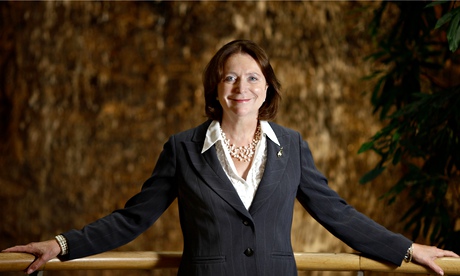
Angela Knight has admitted she will leave her job as boss of the power industry’s lobby group next week with the sector’s reputation still badly tarnished.
She also accepted that many of the measures Ofgem has imposed in the teeth of opposition from the energy firms had turned out to be beneficial for the industry and for consumers.
Knight, a former minister and later chief executive of the British Bankers Association, will hand over the Energy UK job to an interim successor, the former chief operating officer Lawrence Slade, but no new chief executive will be appointed before the general election in May.
“We have certainly improved [our reputation] a bit. Not a lot. But we carry on improving a bit every year – that is our target,” she said. “You lose confidence very quickly and takes a long time to get it back. You get it back by doing your job really well. You don’t get it back with any razzmatazz. There is no silver bullet … If the industry was at three [out of 10 during the height of the criticism in the winter of 2013] we are now at four and rising. We have a long way [to go].”
Some of the big six suppliers such as British Gas have reported they are beginning to win back customers after price rises last year and accusations of profiteering triggered an ongoing investigation by the Competition and Markets Authority.
But in recent months Ofgem has continued to hit big firms such as E.ON with penalties for failing to meet their licence obligations, while consumer debt and disconnections have risen over the past year.
Some critics argue that Knight – whose leadership of the bankers’ lobby group coincided with that industry coming under attack after the financial crisis of 2008 – has too direct a style, which has made her part of the problem rather than the solution.
Knight insisted she was only doing her job – to present the case when government policy or regulatory change would harm her members or investment.
But she said there had been a remarkable turnaround in internal industry thinking and many of those demands, which have led for instance to three million consumers changing their supplier this year alone, had proved helpful.
“The number of big suppliers has increased and they [independent companies such as First Utility and Ovo Energy]are serious challengers now. In fact although their percentage share of customers is still relatively small, the impact that they are having is much bigger. They are close to customers, easy with customers. And that not only provides another alternative [for customers] but a wider catalytic effect on the industry.
“They don’t bring with them legacy systems and legacy issues, and they tend to be run by those who have a lot of experience in customer relationships. You are not someone who is an engineer who is running a retail arm. You are a retailer running a retail arm.”
Knight, who is hoping to land a non-executive directorship of a large listed company in 2015, added: “If you have that many people switching, moving around, getting the best deal, then they are able to take control. I think that is good, sensible change that the industry has made. Equally everyone talked about tariff complexity, rightly so. We had too many.
“They [energy companies] are much more open about cost, about things that get added to the bill, the green levies, the social levies, the distribution.”
She almost made it sound as if the energy sector wanted these changes all along, even as far as accepting that the now-banned doorstep selling was wrong.
“No I am not trying to rewrite history but I am saying there has been a very big attitudinal change and that is flowing through. It does not mean that everything is going to be perfect. It does not mean that mistakes won’t be made and it does not mean there are not still legacy issues left as a result, but attitudinally it’s in a very different place.”
So was her industry’s past opposition to change ill-founded in retrospect? “No. I am not saying that. You can all look back and say maybe I should have handled that differently but at the time it did not look like that.
“And where I would very much agree with the industry is that a proper discussion about what should sit on the bill and what should not has yet to take place.”