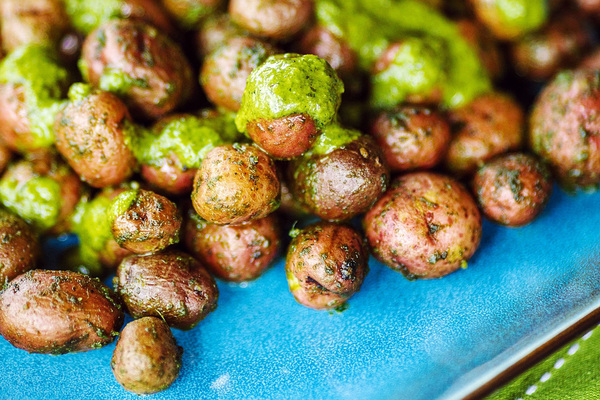
Potatoes never go out of style, and nor do herbs. So when they are combined, you get au courant yet down-to-earth balancing flavors.
Whether the potatoes are baked, roasted, stuffed, fried, boiled and buttered, and mashed or smashed, herbs are fantastic team players, and they don't even have to be fresh and verdant. Dried thyme, rosemary and oregano can be roasted with new white potatoes and dried dill or parsley work just fine in casseroles.
Split open a baked potato and fill it with a handful of chives, a dollop of sour cream, crumbled goat cheese and pecans, or perfume a potato-leek gratin with sprigs of thyme and parsley or take crisp latkes on a sage spin and add the fresh herb to grated potatoes and onions and mix them with flour and eggs.
"Potatoes and herbs are two amazing mediums that anything and everything goes," says cookbook author/chef Raghavan Iyer. "The potato is like a painter's empty canvas, and can absorb it all."
Kevin Appel, culinary director at Sterling-Rice Group, an arm of Potatoes USA, says the neutral nature of potatoes not only makes them a versatile carrier for delicate or strong-flavored herbs but also it enables the potatoes to absorb herbal aromas and flavors well.
Potatoes are believed to have been first domesticated in South America as early as 500 B.C, but they were not widely grown in the United States until 1719, when they were planted by Scottish-Irish immigrants in Derry, N.H.
When cooking potatoes, it all starts with picking the right kind as there are more than 600 varieties sold in the United States.
Potatoes USA categorizes by the color of their skin and size _ russet, red, white, yellow, purple/blue, fingerling and petite. Pennsylvania predominantly grows whites, reds and yellows, says Roger Springer, general manager of PA Co-operative Potato Growers Inc., who is not a fan of fingerlings or petites. "They are for a chef's eye appeal and are kind of tasteless."
Iyer says he chooses potatoes depending on the technique he adopts. He opts for the starchy, floury russet, 'Yukon gold' or 'Kennebec' when he bakes, fries or mashes them. For a potato salad or stew or for dishes that require the spuds to retain their shape, he goes with the waxy fingerlings, reds and purples.
When it comes to pairing potatoes and herbs, both the chefs believe in mixing and matching them. Potato has a tendency to work with almost all green herbs _ dill, chives, tarragon, thyme, rosemary, cilantro, oregano and mint. While Appel says the three classics are chives, parsley and rosemary, Iyer says he gravitates toward tarragon and cilantro. "Tarragon has a haunting perfume and I love the taste. It's also so under utilized," he says. And cilantro was a natural because of his Indian roots.
In his latest cookbook, "Smashed, Mashed, Boiled and Baked _ And Fried, Too!" (Workman Publishing; November 2016),. Iyer has a recipe for Cheesy Tarragon Tots, in which fresh tarragon leaves are added with Yukon Gold potatoes, onion, cheese curds and potato starch, and fried to make crispy tots.
"Tarragon does well when it is cooked. Its presence is maintained even after it is deep-fried," he says.
Herbs are assertive depending on which stage they are added. They are mellow when they are mixed in early in the cooking process and contrastingly sharper in the end.
In another of Iyer's recipes, Purple Potato Focaccia, flatbread is topped with thin slices of purple potato, cracked black peppercorns, red pepper flakes and two headstrong herbs _ mint and rosemary. "The herbs nullify their individual assertiveness," he says, "and the focaccia showcases the beauty of the herbs and the potential of the potato."
His Russian potato salad is made with new red potatoes, dill and chives along with radishes, celery and cucumbers. "The dill gives the salad an intense grassiness while the chives cuts it down, and so there is contrasting balance," he says.
He uses a quintessential Italian herb in his 'Yukon Gold' potato lasagna, basil, which is incorporated in the ricotta filling. "I wanted the lemon and ricotta cheese to shine through, and the basil helps to do that."
Inspired when listening to Simon & Garfunkel's "Parsley, Sage, Rosemary & Thyme," Iyer decided to push the boundaries of the classic Swiss rosti by pairing tarragon, thyme and chives with shredded russet potatoes to make a crisp pan-fried version.
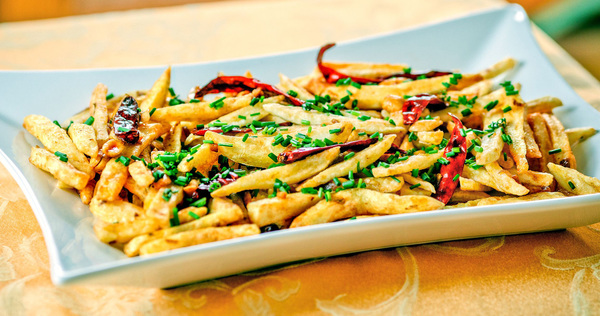
Often a sour or citrus element sneaks into herb-heavy sauces that are drizzled over roasted new white or red potatoes or fingerlings. For the Canary Island native, mojo, white wine vinegar is blended with olive oil, ground cumin and cilantro; and fresh tarragon, cilantro, chives, parsley and white balsamic vinegar are blended together for a chimichurri. Iyer adds orange juice along with basil, cilantro and coriander seeds in a fingerling potato salad and Appel likes fried potato planks with fresh parsley, sea salt and malt vinegar.
That is because "citrus rounds it up better; there's a better mouth feel. You need to balance multiple taste elements," Iyer says. Appel adds that acids and salt tend to cut fatty elements of a dish while accentuating the potatoes and herbs.
Although the potato also can be gussied up with cheeses, creams and dairy sauces, herbs have a down-to-earth way of adding a chic flavor.
"When you add ingredients that might seem to make no sense and are diametrically opposite, the potato pulls it all together," Iyer says. "That's the brilliance of the potato."