
If every cloud has a silver lining, then in the case of the UK labour market it appears that every bright spot has a shadow. That’s the suggestion in new research from the Resolution Foundation into how a rise in job stability over the last two decades has stymied the careers of young people.
Rather than being merely cause for celebration, the drop in the rate at which people move between jobs since the financial crisis in 2008 is likely to reduce the prospects for promotion, pay rises and productivity gains, the thinktank says. It warns of a “promotion blockage that risks permanently scarring the earnings of a generation of young workers”.
Earning potential hit
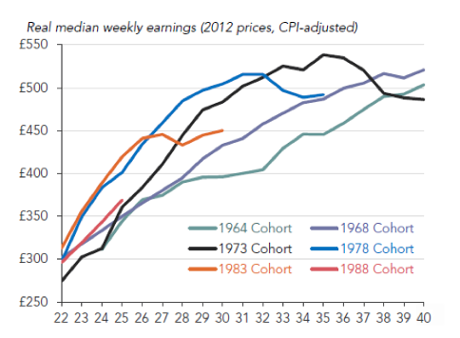
The typical earnings of 30-year-olds born in 1983 – whose early careers were hit by the downturn, when the rate of job-to-job moves dropped sharply – were around £2,800 a year lower than those born five years earlier, according to the foundation’s analysis.
As part of its work on what full employment might look like in the UK, the thinktank has analysed job stability, or the average amount of time in the same job, and job mobility, the rate at which people move between jobs.
Job stability rises
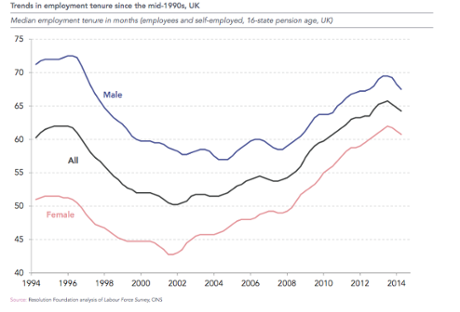
Job stability has risen steadily over the last two decades, driven partly by “welcome trends such as more women returning to the same employer after having children, and a greater number of older people being in work”, according to the report by Laura Gardiner, Resolution’s senior policy analyst, and Paul Gregg, economics professor at the University of Bath.
Mobility below pre-crisis level
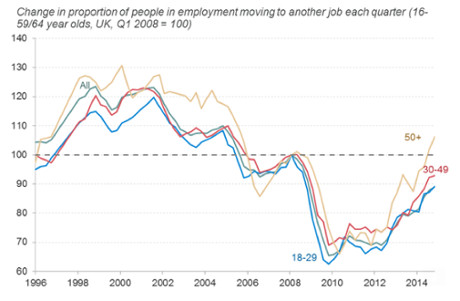
But they found that job mobility was still well below its pre-crisis level, despite the strength of the recent employment surge. “Moreover, the fall started several years before the crash,” the report says.
Gregg comments:
“Job security is crucial to the pursuit of full employment as it will make work more attractive to those facing the biggest barriers to work. But we should also be mindful about the falling rate of job moves, which are a vital way for young workers to build their careers.”