There is “no doubt” that five racehorses that failed drug testing were injected with the banned performance-enhancing substance cobalt chloride, according to the racing integrity commissioner in the state of Victoria..
While Racing Victoria was still investigating what happened to the horses trained by Peter Moody, Mark Kavanagh and Danny O’Brien, the commissioner, Sal Perna, said the focus would not be on whether the horses were doped but “how, by whom, and when”.
Cobalt occurs naturally in horses, but only trace levels were usually detected, Perna said.
The threshold for a positive test – more than 200 micrograms per litre of urine – was generous, he said, leaving “no doubt” the levels detected in the horses could have been the result of an injection only.
“That’s why I’ll be monitoring this investigation closely,” Perna said. “Racing Victoria must now examine very carefully every aspect of the life of these horses, including what their dietary programs are like, where they’ve been, and who has access to them.”
Internationally, the threshold for a positive cobalt test is 100 micrograms per litre. Racing Victoria has declined to disclose the levels recorded in the horses that failed drug tests.
Excess levels are considered performance-enhancing because cobalt stimulates red blood cell production, much like EPO, the banned substance that has frequently been used by professional cyclists. Because cells can carry oxygen through the body more readily, a horse can perform at peak level for longer before getting tired.
Perna said he was concerned the findings would harm the reputation of racing in Australia. But it was positive that racing bodies in Australia had banned the substance so quickly following international concerns about its abuse, he said, showing the industry was committed to fighting doping.
Harness Racing NSW was the first body to introduce a ban, in December 2013. Cobalt is particularly effective in improving the performance of harness racing horses because they run continuously at a pace. Racing Victoria followed in April last year, and from 1 January the cobalt threshold was introduced into the Australian rules of racing.
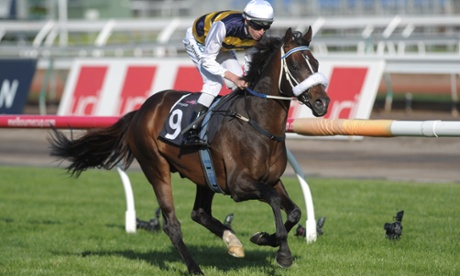
Five horses had returned positive samples, Racing Victoria said. Lidari, prepared by Moody, the trainer of legendary sprinter Black Caviar, failed a test after finishing second in the Turnbull Stakes at Melbourne’s Flemington track in October.
Magicool returned a positive sample following victory in the UCI Stakes at the same meeting. It was trained by Kavanagh, a Melbourne Cup-winning trainer in 2009 with Shocking. Three of O’Brien’s horses – Caravan Rolls On, Bondeiger and De Little Engine – tested positive after three separate races in November, Racing Victoria said.
Trainers in Victoria face bans of up to three years if found to have deliberately doped their horses. All three trainers have released statements expressing their shock and denying any wrongdoing.
Racing Victoria’s chairman of stewards, Terry Bailey, said he would not be putting a timeline on the completion of the investigation and would not comment on the specifics of each case.
“They have the presumption of innocence and are free to continue racing at this time,” he said.