Retail stores and food outlets across Japan have been forced to temporarily close after employees tested positive for the novel coronavirus amid a nationwide surge in infections.
In some cases, entire department stores and shopping complexes have closed to deep clean facilities.
The growing number of store closures accompanying the spike in coronavirus cases across the nation has poured salt in the wounds of businesses already reeling from restrictions imposed under the state of emergency.
Hanshin Department Store's Umeda flagship outpost near JR Osaka Station was closed on July 31 and Aug. 1 following several positive tests among employees.
Most of the store's floors reopened for business on Aug. 2 after an extensive clean, but the basement food court and the first floor, where many employees who tested positive work, remained closed.
According to the store, about 130 employees have tested positive.
Employees are required to check their temperature before work and wear a mask while on duty, and the store urged them to avoid business trips and refrain from dining out. However, these steps do not appear to have prevented infections among the staff.
"We've implemented every countermeasure we could think of, so we don't know why so many employees caught the virus," said a representative of the department store's parent company, H2O Retailing Corp. "Perhaps it's the impact of the delta variant."
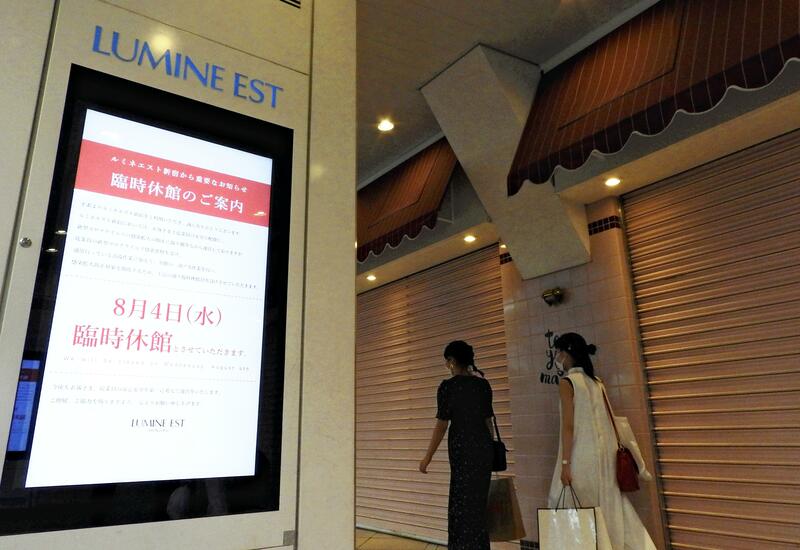
The Lumine Est commercial complex adjoining JR Shinjuku Station in Shinjuku Ward, Tokyo, was shut Wednesday following the confirmation of positive tests among employees. The Isetan Shinjuku department store in the same ward confirmed 73 employees tested positive from July 28 to Aug. 3. Fifteen food concessions at the department store were closed on Wednesday.
"Suspending operations will have a massive impact on sales, but if businesses stay open while customers are anxious about shopping they are likely to go under," an industry insider said.
Starbucks Coffee Japan Ltd. said 16 outlets, mostly in Tokyo and Kanagawa Prefecture, were temporarily closed as of Wednesday. Under the coffee store operator's guidelines, any employee who worked with an employee who tested positive for coronavirus must self-isolate at home for two weeks.
The company has reportedly decided to shutter stores even if local public health centers have determined that they do not need to close. "We swiftly take steps to prevent infections from spreading because we want to give our customers peace of mind," a company representative said.
The operator of Lawson convenience stores said 28 of its outlets had closed for periods in July. Several Seven-Eleven Japan Co. stores have also temporarily closed.
Many workers at commercial complexes operated by Aeon Co. have tested positive for coronavirus, but the company has opted to clean each shop where infected employees work rather than close complexes.
"We're implementing thorough preventive measures in break rooms and ensuring our facilities are well ventilated," an Aeon spokesperson said. "We want to prevent clusters from occurring."
Read more from The Japan News at https://japannews.yomiuri.co.jp/