Wireless charging, batteries that charge in minutes not hours, and a new pan-European network of easy-to-use charging points could usher in a new era for electric cars.
Currently, transport is estimated to be responsible for around a quarter of the world’s CO2 emissions, exacerbating climate change, polluting cities and threatening the health of those who live there.
According to the pan-European energy association, Eurelectric, a typical electric vehicle with a consumption of 20kWh produces 66g CO2/km, while traditional petrol driven vehicles come in at around 124g CO2/km, although this is a figure that has been falling year-on-year, as new cars become more efficient and less polluting.
“EVs not only have zero-emissions at the tailpipe but they also emit less CO2 than conventional cars, even when the emissions from the power sector are included,” says Aura Caramizaru, Eurelectric’s retail customer advisor. And that situation should keep improving, she adds, given the energy sector’s ongoing commitment to decarbonise electricity generation.
The desire to live among such cleaner vehicles seems understandably strong in cities. “The combination of traffic and smog has led to city-dwellers all over the world demanding pedestrian areas, efficient public transport and sustainable mobility for the sustainable growth of urban centres,” says Federico Caleno, head of end customer application and new technologies at energy multinational Enel, now a major player in electric mobility.
“With the chaos and pollution affecting cities, Enel has chosen to push electric mobility, developing it for both privately owned vehicles, fleets and public transport both in small towns and major urban areas,” he says.
Many car manufacturers are also playing their part in developing EVs. Mercedes recently announced the launch of ten new hybrid plug-in vehicles, while BMW is working on its hybrid i3 compact urban vehicle, and i8 sports car. In Japan, where Nissan, Mitsubishi and Honda dominate the EV market, car charging points have recently surpassed the number of traditional petrol stations in the country.
However, despite all this, global ownership of electric cars is still frustratingly low. Indeed, electric vehicles only made up around 0.6% of the 85 million new vehicles sold in 2014. And, while technology innovators will drive growth, governments and regulators must also do their bit to support electric mobility, argues Caramizaru. “The successful rollout of EVs cannot happen without continuous and united commitment by the industry and policy makers,” she says.
Caleno agrees: “The problem is that many countries have yet to enforce legislation that will encourage the development of an electric vehicle charging infrastructure.
“We need to create the conditions so that people who decide to invest in electric cars are not forced to just drive around the city, but can also go on highways and freeways without fearing that their vehicles will go flat.”
Under its Enel Drive banner, his company has set out to make EVs a more attractive option – and over the past few years it has launched a number of projects to promote EVs in Italy. These include E-mobility Italy, which involved more than 100 volunteers in Rome, Pisa and Milan testing EVs that used Enel smart grid technology to recharge their electric cars. The project provided valuable feedback about what it’s really like to run and own an EV.
Enel has also developed a partnership with Piaggio to develop electric scooters for corporate fleets, and new technology link-ups with both Renault-Nissan and BMW.
The company is also involved in a number of EU-financed initiatives such as Green eMotion, a four year European project which finished earlier this year that set out to remove obstacles to the take up of EVs.
“One of the greatest achievements of Green eMotion was to demonstrate the interoperability of EVs and allowing drivers to charge up their EV at any point across Europe, regardless of the operator,” explains Caramizaru.
So called “e-roaming” where electric cars can cross borders, and barrier-free access to public charging points, will have a dramatic effect on the use of EVs, says Caleno. To support this, Enel has teamed up with Hubject, a German joint venture of car manufacturers and energy and technology companies.
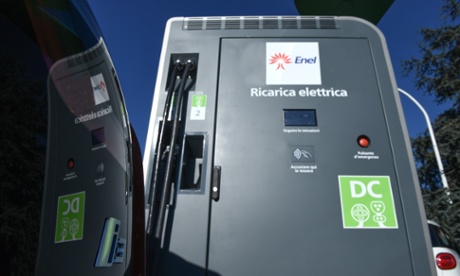
Using Enel’s Electric Mobility Management (EMM) system, the project brings together around 2,000 Enel charging points with the 3,000 run by Hubject, meaning that EV owners will soon be able to drive from Sicily to Lapland using a huge network of charging stations, regardless of whether they’re a customer of a particular utility company or not. Many charging points can also be booked in advance.
A major stumbling block for EVs has been the speed with which they can be charged. But that too is changing. In Spain, Enel subsidiary Endesa has developed a wireless 50kW fast charger which can recharge 80% of a battery in 15 minutes.
Close to Rome, Enel has launched a pilot project to install charging stations on the expressway between Rome and Pomezia. There are already 10 stations installed in Barcelona and Mallorca.
Alongside ‘static’ wired charging, Enel is also investigating induction technology, when cars can be charged at specially equipped stations that make a wireless connection when they sense a car’s presence.
Such wireless charging technology is also playing a role in helping to create a greener public transport system.
In Malaga, Enel’s Project Victoria is trialling a bus lane with a 200m dynamic inductive charging infrastructure that charges the bus while it’s moving. This is backed up by a fast charger at the depot. The project has also seen Endesa develop the first electric car battery recycling system, deploying the batteries as a storage system for the charger.
“The aim is to give car batteries a second life in which they are used for public transport charging points,” says Caleno.
“E-buses are becoming increasingly attractive for municipalities due to their reduced local emissions of air particulates, noise levels and GHG [greenhouse gas] emissions,” says Caramizaru, again stressing that legislation from the EU is the best way to further encourage their take up.
Meanwhile projects such as ZeEUS (Zero emission urban bus system) are promoting electric buses in European cities and testing high-capacity vehicles with different charging solutions. Unplugged, another EU-backed consortium, has developed a wireless recharging system that helps electric cars and buses to use the urban road system.
Enel is also supporting e-mobility through corporate e-car fleets, car sharing programmes and electric bicycles for its employees all over the world
In many Latin American countries, the company is promoting technologies that have already been successfully tested in Europe and it was the first company to instal a charging infrastructure and introduce zero-emission vehicles in Peru, Chile and Colombia.
In the Usaquen and Chapinero areas of Bogotá, Colombia, Enel is developing a pilot project looking at electric car sharing which, in tandem with rental bikes, could help to alleviate traffic jams. Enel is also working on the introduction of an electric public transport system in Bogotá and in Santiago in Chile.
Electric cars are even making an impact in the world of motor racing. Formula E, run by international motor sport body the Fédération Internationale de l’Automobile (FIA), is the equivalent of Formula One for single-seater electrically powered racing cars.
Alejandro Agag, chief executive officer of Formula E, says: “From the very beginning, the concept of the FIA Formula E Championship has been to promote the electric car industry and to change people’s perceptions of these vehicles. People don’t view electric cars as ‘cool’ or ‘exciting’ and they don’t believe they can work for their needs. This is one of the main barriers preventing the growth of the industry. But through entertainment, sporting competition and investment in R&D, Formula E can help change this.
“Motorsport can help show people that EVs don’t have to be slow or boring or uncool. What’s more, we can help accelerate the advancements in EV technology and aspects such as battery life, infrastructure and pricing. Obviously we can’t do this alone. We want Formula E to act as a catalyst between companies, leaders, experts, cities and policy makers and together to drive the change towards the greater use of sustainable mobility.”
Looking to the future, says Caleno: “The next step is the paradigm change in swapping from traditional cars to EVs, which could make a huge difference to what it’s like to live and work in the city.
“EVs are the sustainable solution for moving people and goods around but now governments and legislators need to step forward and pass the laws that will support the work that is already being done.”
Content on this page is paid for and produced to a brief agreed with Enel, sponsor of the energy access hub at the Guardian Global Development Professionals Network.