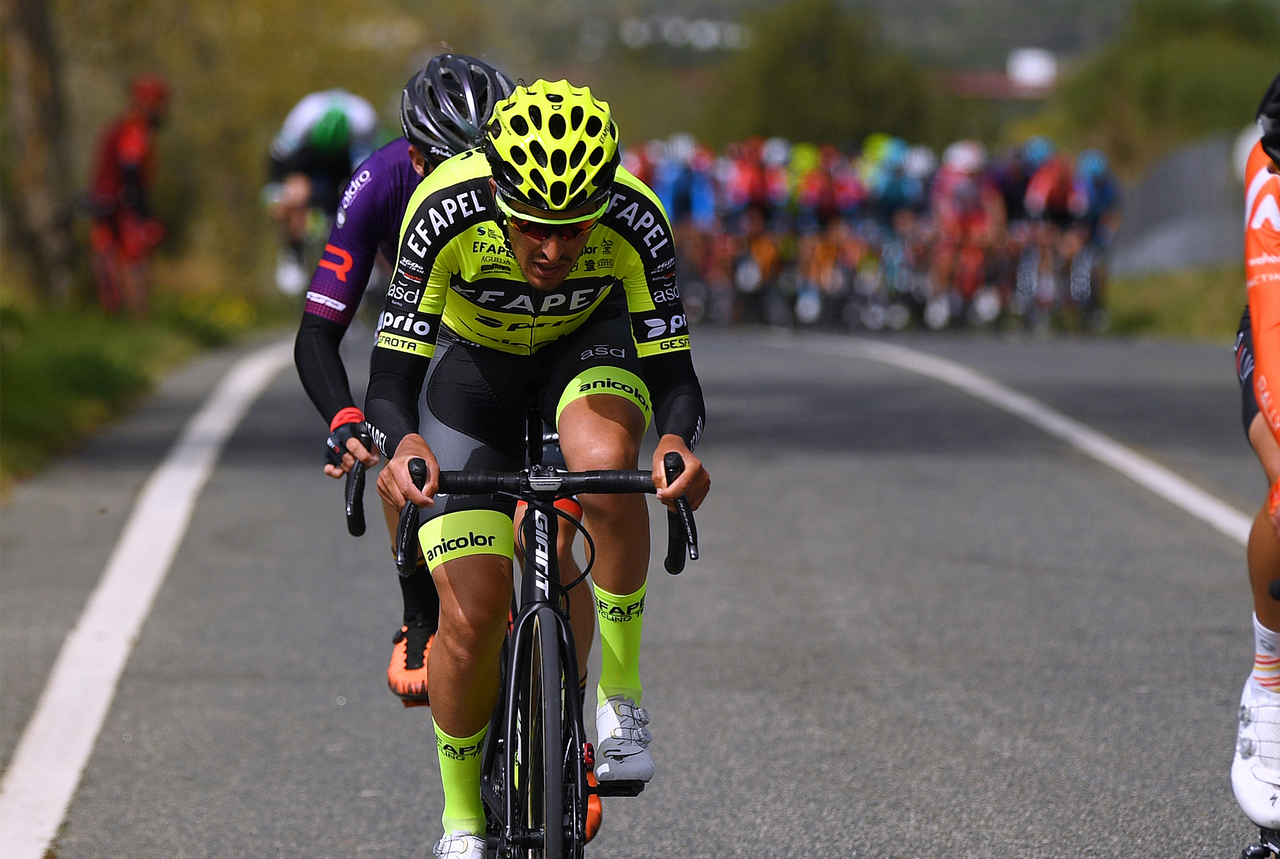
A Portuguese rider has been banned from pro cycling for four years by the UCI after unexplained abnormalities were found in his biological passport.
António Carvalho Ferreira, 36, was provisionally suspended in November following the discovery of the abnormalities, and on Wednesday it was revealed that he had been handed a lengthy ban.
The abnormalities occurred in 2018, when he raced for W52/FC Porto, and 2023 and 2024, when he raced for ABTF Betão-Feirense, with the latter being the team he raced for this season, when it was called Feirense-Beeceler.
A UCI spokesperson said: "The Union Cycliste Internationale (UCI) announces that the Portuguese rider António Carvalho Ferreira has been sanctioned with a four-year period of ineligibility following an Anti-Doping Rule Violation for use of a prohibited substance and/or a prohibited method due to unexplained abnormalities in his Athlete Biological Passport in 2018, 2023 and 2024.
"In accordance with the World Anti-Doping Code (Code) and the UCI Anti-Doping Rules (UCI ADR), the period of ineligibility started on 4 November 2025 and is effective until 3 November 2029.
"The case has been resolved by way of an acceptance of consequences as provided for by the Code and the UCI ADR.
"The UCI will not comment any further."
Carvalho Ferreira is not alone in being provisionally suspended over biological passport abnormalities this year. At the end of October, former Spanish champion Oier Lazkano suffered the same fate over abnormalities relating to his time at Movistar, and left Red Bull-Bora-Hansgrohe as a result. In September, Italian rider Giovanni Carboni, then riding for Unibet Tietema Rockets, was provisionally for abnormalities during his time at JCL Team UKYO; he has now been dismissed by his current employers.
There has not yet been a decision on this pair. When the news emerged around Lazkano, he said: "I have never used doping substances or prohibited methods. I am a clean athlete and a person of integrity."
In August, former French cyclist Franck Bonnamour was also handed a four-year ban for biological passport issues.
All WorldTour and ProTour riders have a biological passport, an electronic record of all of their doping tests. The measure was introduced in 2008 and is run by an independent entity, the International Testing Agency (ITA), who complete blood and urine tests in and out of competition.