

As one of the most expansive pornography sites in the world, Pornhub has been hit with criticism from just about every angle in its nearly decade-and-a-half of video hosting. Most of that criticism has been reserved for the actual videos hosted on Pornhub — but, because this is the internet we’re talking about, there are plenty of backend layers to worry over, too.
Here’s one facet we don’t talk about very much: the myriad of information Pornhub is collecting every time you access those videos. Like most websites, Pornhub tracks users’ identities through the decisions they make on the website. If you watch a lot of gay porn, for example, Pornhub probably considers you a member of the LGBTQ community.
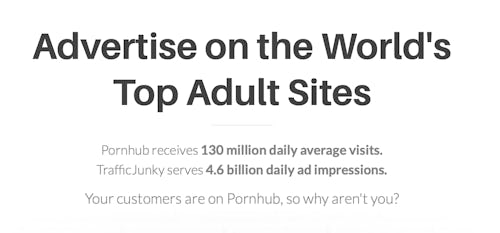
Though it doesn’t receive as much attention as the advertising platforms created by bigwigs like Google and Facebook, Pornhub’s parent company, MindGeek, does own its own advertising platform called TrafficJunky. Because MindGeek owns many of the world’s most-trafficked porn sites, TrafficJunky knows a lot about your sexual preferences. And did we mention TrafficJunky’s network gets billions of impressions every single day?
Collecting your most personal preferences —
TrafficJunky’s website is, for the most part, very typical for an internet advertising company: data about how many customers you could be reaching, a standard media kit, a few abstract testimonials. The company isn’t explicitly selling sex advertising, though it is up-front about its associations with Pornhub.
Where TrafficJunky strays from the norm is in its page dedicated to detailed audience targeting. Yes, there’s the standard ability to target by geolocation, time of day, and keyword, but there’s also a section here for targeting by “sexual preference.”
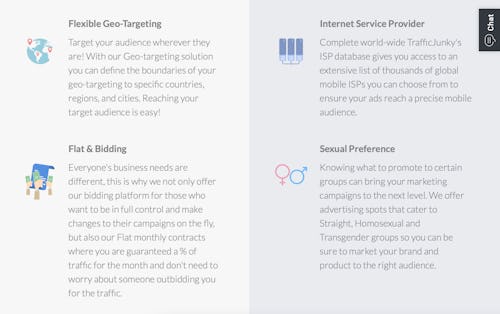
“We offer advertising spots that cater to Straight, Homosexual and Transgender groups so you can be sure to market your brand and product to the right audience,” the page reads (h/t @swodinsky).
Identity crisis —
The harsh realities of living on an internet fueled by personalized advertising revenue have become increasingly clear in the past couple of years, prompting our biggest tech companies to re-evaluate how they can serve up targeted ads without so much discomfort.
TrafficJunky’s allowance of tracking by “transgender groups” is, at best, cringey as all hell. There is no feasible way to understand whether or not a person identifies as transgender by their browsing preferences, not even when that browsing is of an explicitly sexual nature. Why even bother trying? And considering that being transgender has nothing to do with sexual preference, its inclusion here doesn’t even make sense.
At worst, the attempt to categorize users as transgender or cisgender can be legitimately harmful. As this 2019 Vice investigation points out, it’s not all that difficult to track an individual through cyberspace based on their browser identity, even when cookies are cleared and private browsing modes are turned on. It doesn’t take much imagination to consider the harm that might be done by combining such a database with a company that’s unfriendly to trans and nonbinary people.
As the discourse around targeted ads continues, it’s important that we consider the nuances of which information, exactly, is being collected and sold by companies like TrafficJunky. Not all identifying data is created equally.