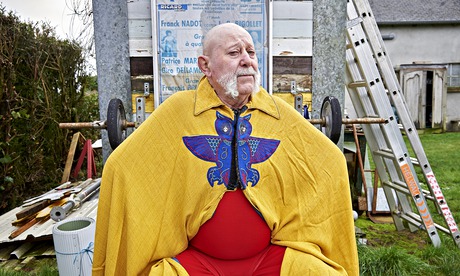
His stage name was “Popoff the Gypsy”. If you’re under 30, chances are you’ve never heard of him. But for anyone who remembers the golden age of wrestling in France, the name is as evocative as Proust’s madeleine. Between the end of the second world war and the 1980s, fabled Paris venues such as the Elysée-Montmartre, the Wagram and the Cirque d’hiver featured some extraordinary practitioners of le catch, as the French call it. They were athletes with actor’s chops and names that could light up a crowd: Bethune the Executioner, The White Angel, Dearest Bibi. All long ago left the ring and its circus-like atmosphere behind – but not Popoff.
Now 72, his shaved head and handlebar moustache as formidable as ever, Jean-Pierre Pouzade (to use his real name) is living testimony to a bygone era of sports entertainment. A hearty young fellow from the Auvergne, he was only 15 when he stepped into the ring for the first time and became French wrestling’s youngest – and, it turned out, longest-lasting – star. He was there for the first broadcasts of the sport on TV. Twenty years ago, he was named European senior champion and posed for a campaign photo with presidential hopeful Jacques Chirac, then mayor of Paris. Only in 2009, long past the age of retirement, did he finally hang up his cape.
Officially, that is – for the great Popoff still trains, in secret. Pass by the home he’s lived in since 2008 with his wife, Monique, in La Motte, a village of 2,000 inhabitants in the Côtes-d’Armor region of north-west Brittany, and you just might catch a candid glimpse of the man in all his faded glory. Half-naked in a bright red wrestler’s bodysuit (“my favourite piece of clothing”), set up in a rustic little outdoor gym in a corner of the garden, the ageing athlete lifts weights and racks up the kilometres on his rusty old exercise bike. “It’s been a few years now that I’ve been out of the ring. It bugs me, you know. But people always tell me, ‘You haven’t changed, Popoff. How do you do it?’ Bah! I say – the important thing is I keep up my training, and my gym is in the open air.”
In winter, when the cold gets too much to bear, he moves his improvised fitness centre into the living room. Between two chairs, under the watchful eye of his dog, Junior, he does multiple sets of push-ups and sit-ups. The house, which sits on the edge of the forest of Loudéac, is full of mementos. Old posters scream his name from matches long past.
Hauled from a bedroom closet, cardboard boxes overflow with old press clippings and photos. In a frame on the wall, a much younger Popoff sits astride a white horse, looking dashing and in the prime of life for a man in his 30s, his moustache not yet grey, his pate not yet shiny. “It was my hairy period, my hippie style,” he says with a grin before getting up to strike a pose. Jaw clenched, crouched for battle, he lets out an unholy yell. “That’s my speciality. I loved playing the baddie.Actually, before I got my stage name, when I was still Pouzade, people used to throw tomatoes at me because they thought I was the son of [Pierre] Poujade,” the 1950s French far-right politician.
Growing up, Pouzade was a rather unruly lad. Born in 1943 in Juvisy, a suburb south of Paris, he got into fights and defied authority. “I was expelled twice from school. The first time, I threw an ink bottle at a teacher who was getting on my nerves. The second time, I was caught in the act with the girl next to me, the teacher’s daughter.”
On the football pitch, young Pouzade had the habit of going for his opponents’ ankles rather than the ball. One day, impressed by his propensity to pick a fight, a hustler told him: “You know, kid, I know a school where you can learn to box and wrestle. If you want to try …” Before long, without his parents knowing, Pouzade started cycling every Tuesday to the wrestling school 8km away.
He was 12 when he saw his first professional match, spying through the broken window of a covered market at the ring set up in the middle. “It was the Masked Man v Bethune the Executioner. I saw this colossus with huge arms who made the ring bounce 20 or 25 centimetres with each hold, and I was hooked,” he says, still amazed by the sight 60 years later.
In those days, wrestling was still highly popular in France; there was a big match in every town and the halls were always full. With the advent of the first TV broadcasts in 1952, hosted by well-known sports journalist Roger Couderc, the sport entered a new era. “People watched wrestling at the cafe, they watched it at their neighbour who had a TV,” Pouzade recalls. “Farmers who today you see on [reality TV show] Farmer Wants a Wife, in those days they came down off their tractors” and watched wrestling. “We were more popular than Johnny Hallyday, we were stars, we did stunts in movies with Eddie Constantine and Lino Ventura.”
Besides performing in wrestling shows and bit-parts in films, Pouzade as a young man started appearing in travelling fairs like the enormous Foire du Trône in Paris’s Bois de Vincennes and another in Pigalle. There, fake “volunteers” were plucked from the carnival crowd to step into the ring and fight so-called professionals. Right up until the age of 50, Popoff was one of the star attractions at the famed wrestling show run by Jacques Scherrer (aka “Jackson”) of the Foire du Trône. It’s where he got his stage name. “When I lifted my opponent in the air, I’d yell ‘Hop! Pof!’” he recalls. “After that, Jackson, who was a funny fellow, started calling me Popoff the Gypsy, or sometimes the Russian, or at one point Téo Popoffh. After I was asked to shave my head for a part in a film, Jackson told me I could continue playing the role with a shaved head.”
The glory days couldn’t last. At the Elysée-Montmartre, a Paris venue owned at the time by the wrestler Roger Delaporte, Pouzade started to realise his sport was dying a slow death. He got to know the Famous French comedian Coluche there, who had been brought in to programme the entertainment with other stars. “When there was no work for us, Delaporte made us repaint the hall,” the wrestler recalls. “The only sports the media were interested in were football and rugby. Our veterans were retiring and there was nobody to take their place. Wrestling was becoming passé.”
In the 1980s, Pouzade was reduced to doing only the odd wrestling show here and there. Between jobs as a truck driver, he appeared on TV in sketches by “Le Professeur Choron” (aka Georges Bernier, co-founder of the satirical magazine Hari-Kiri, now Charlie Hebdo) and played opposite Arielle Dombasle (married to the philosopher Bernard Henri-Lévy) in the Choron war operetta Ivre mort pour la patrie. “I have no regrets,” Pouzade says. “Boy, did we have fun!”
His passion for wrestling never left him, however. He opened a training school in the Paris suburb of Nanterre, became one of France’s best referees, and in 2006 helped revive the Fédération Française de Catch Professionel, a venerable institution founded in the 1930s that had been moribund since 1989.
The sport still floundered, however. Its centre of gravity shifted to the United States. “The French passed the torch to the Americans – particularly, in the 1980s, André the Giant.” The World Wrestling Federation champion was actually born André René Roussimoff, in Coulommiers, an hour east of Paris. Today his successors are all-American stars such as John Cena and Big Show, names French grapple fans are more familiar with today. “They aren’t nearly as good as we were,” Pouzade sniffs. “You don’t believe them for one minute. There’s no tripping anymore, no cuffing.”
In his seminal work on popular culture, Mythologies, the great French philosopher Roland Barthes dismissed wrestling as a “spectacle of excess”, not a sport. He obviously never got in the clutches of Popoff. “In the old days, we’d cuff our opponent so hard over the head, you could hear it clear to the back of the hall. We had to know how to fall and how to hit. We had our little tricks, of course, but the last thing we wanted people to think was that it was all a sham. Ours was really a school of hard knocks.”
Though it is enjoying something of a renaissance these days, wrestling in France remains but a shadow of its former self. Only the great Flesh Gordon – whose real name is Gérard Hervé and who hails from the Parisian suburb of Villeneuve-le-Roi – still draws crowds nationally and abroad. But the 61-year-old’s efforts are hardly enough to keep the tradition alive, Pouzade says. Donning his old costume, its magnificent gold cape embroidered over the chest with a stylised owl, Popoff deals the final blow: “There aren’t any real wrestlers left,” he scoffs. “They’re all a bunch of weaklings now. Whenever I stop in at that little school they’ve opened in Paimpol,” an oceanside village an hour’s drive north of his home in Brittany, “the kids there can see it right away. ‘Look at that,’ they say. ‘When the old man lands a blow, it’s like poison.’”
This article appeared in Guardian Weekly, which incorporates material from Le Monde