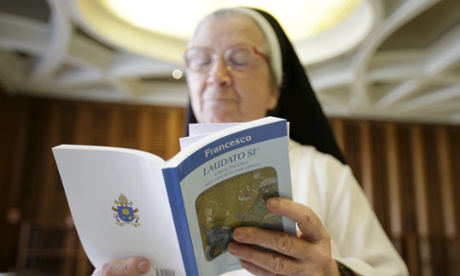
The first thing that strikes you about the pope’s latest slim volume is that there’s virtually no sex in it. And that is not to be facetious.
Ever since the publication of another milestone encyclical, Paul VI’s Humanae Vitae, the Catholic leadership has become progressively more obsessed with sex: contraception, abortion, IVF, surrogate parenthood, homosexuality and, reluctantly, clerical sex abuse. The effect has been to sideline other, hugely important matters. To read 184 pages written by – though, in reality, approved by – a pope that deal almost solely with the fate of humanity, rather than what humans get up to in private, makes an immensely refreshing change.
The part where sex does creep in will be, for many, the least convincing. It is the part where Francis addresses those who maintain that the Vatican cannot credibly deplore the desecration of the environment without recognising the effects of its aversion to birth control. In a passage that defines the term “Jesuitical”, Francis, the first Jesuit pope, tries to convince us that the proponents of reproductive health are, unwittingly, working for the environmental bad guys.
“To blame population growth instead of extreme and selective consumerism on the part of some is one way of refusing to face the issues,” he writes. “It is an attempt to legitimise the present model of distribution, where a minority believes that it has the right to consume in a way which can never be universalised, since the planet could not even contain the waste products of such consumption.”
The International Planned Parenthood Federation as a tool of the rich? That really won’t wash, particularly since Francis goes on to acknowledge that “attention needs to be paid to imbalances in population density, on both national and global levels”. Apparently, then, it is not a surplus of babies that is the real problem, but where they are born.
The pope’s effort to sever the link between population growth and environmental deterioration should not, however, detract from the importance of what else he has to say. This is the first encyclical to be devoted entirely to environmental issues, though it is certainly not the first time a pope has spoken out on the destruction of the environment.
As the encyclical notes, Paul VI first raised the issue as long ago as 1971, describing it as a “tragic consequence” of uncontrolled human activity. Saint John Paul II and his successor, Benedict XVI, inveighed against mankind’s ill-treatment of nature – or as they viewed it, creation.
Far more explicitly than his predecessors, however, Francis heaps the blame on to the part of humanity that is rich. He accepts that the poorer nations should “acknowledge the scandalous level of consumption in some privileged sectors of their population and … combat corruption more effectively.” They ought also to develop less polluting sources of energy.
But his real target – as in his apostolic exhortation Evangelii Gaudium two years ago – is the rich world and the global economic order it has forged, which he argues tolerates vast differences in the wellbeing of nations and individuals – a system characterised by “speculation and the pursuit of financial gain”, which ignores “the effects on human dignity and the natural environment”. Thus, says Francis, environmental degradation is intimately linked to an erosion of human and ethical values.
That is the connection he needs to support the true originality of this encyclical. He writes that it is addressed not just to the Roman Catholic ecclesiastical hierarchy (as were the earliest encyclicals) or to the faithful as well (as more recent ones have been), but to all of mankind. “Faced as we are with global environmental deterioration, I wish to address every person living on this planet,” he writes.
It is in the passages addressed to his own flock that Francis really breaks new ground. Using a phrase first coined by John Paul II, he says that Catholics, if they have not already done so, need to undergo an “ecological conversion”. This is not just because “green is good” but because, he declares, green is central to their faith. “Living our vocation to be protectors of God’s handiwork is essential to a life of virtue; it is not an optional or a secondary aspect of our Christian experience.”
It is a call – no, an instruction – to the world’s Catholics to work for the protection of the environment and to save the planet. The potential effect hardly needs to be spelled out. One in every six human beings is baptised a Catholic.
The question that has yet to be answered is whether Francis’s flock, especially in the United States, will pay any more attention to Laudato Si than it paid to the ban on artificial methods of contraception in Humanae Vitae.