The Pope has begged for God's forgiveness for the “open wound” of church abuse in Ireland as he addressed pilgrims at a Catholic shrine on the second day of his historic visit to the country.
Calling for “firm and decisive” action to secure “truth and justice” at his address in Knock, Co Mayo, Pope Francis said no one could be failed to be moved by stories of young abuse victims who were “robbed of their innocence”.
“This open wound challenges us to be firm and decisive in the pursuit of truth and justice. I beg the Lord's forgiveness for these sins and for the scandal and betrayal felt by so many others in God's family," the Pontiff said.
“I ask our Blessed Mother to intercede for the healing of the survivors and to confirm every member of our Christian family in the resolve never again to permit these situations to occur.”
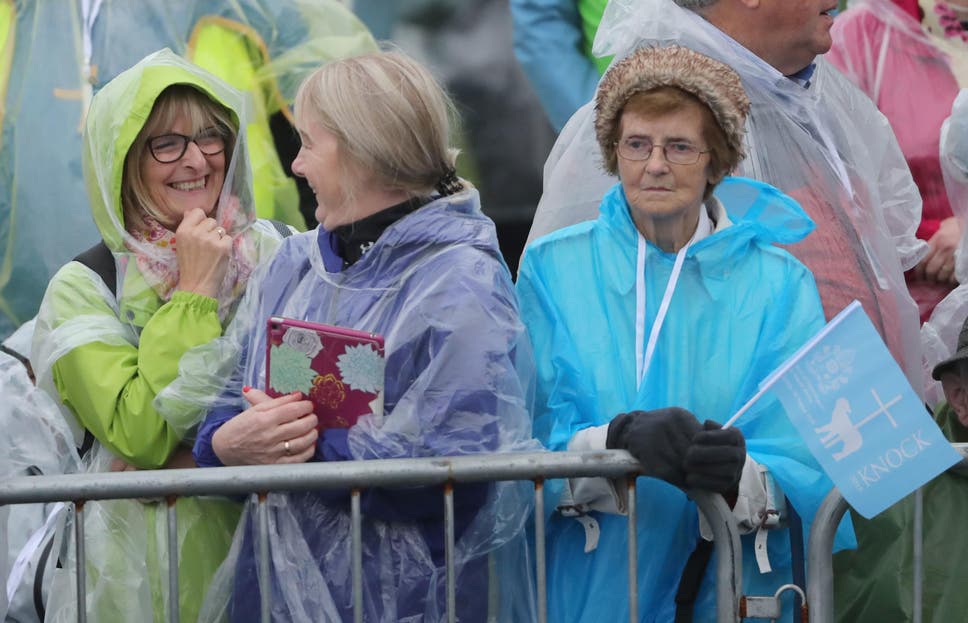
Hundreds of people, some of whom arrived as early as 6am, could be seen wearing waterproof ponchos and holding umbrellas at Knock in Co Mayo, which is said to be the site of an apparition in 1879.
After the Holy Shrine visit, the Pontiff will address a huge outdoor Mass in Dublin's Phoenix Park, where around half a million people are expected to gather.
The religious engagements come after a day dominated by the bitter legacy of historic scandals linked to church abuse and mistreatment in Ireland.
On Saturday, the Pope spoke of his “pain and shame” at the failure of church authorities to tackle what he described as the “grave scandal” of clerical sex abuse in Ireland.
Speaking at Dublin Castle, he acknowledged that bishops, priests and other figures in the Catholic Church had failed to adequately address the “repellent” crimes that had been inflicted on young people.
The Pope then met a number of victims of criminality and cruelty inflicted by church members, and prayed for them at a candle perpetually lit in tribute to victims of abuse at Dublin cathedral.
His decision to address the dark legacy of abuse in a speech in Dublin Castle drew praise in some quarters, but others criticised Francis for not saying enough or offering a public apology.
While Pope Francis received a warm reception from thousands of people, his visit has sparked a number of protests over the church’s handling of various clerical abuse scandals, as well as its attitude towards women and the LGBT+ community.
One protest took place near Dublin Castle shortly after the pontiff arrived in the city on Saturday morning. It was organised by Margaret McGuckin, a survivor of historic child abuse who spent years in Nazareth House children’s home and helped campaign for the introduction of the Historical Institutional Abuse Inquiry.
Ms McGuckin said the protest was a symbolic gesture to the Pope and the church that victims have not gone away.
“The Pope now needs to stand up to the plate and do something for the survivors. We need redress, we need the church held to account,” she said.
“We want the bishops, Christian Brothers, nuns and anyone else who was involved in the abuse of children or covering up the abuse of children brought before the courts.”
Some people are also abstaining from attending events to see the pontiff in a bid to leave seats empty as a form of silent protest against the Catholic Church’s “stranglehold” on culture and government in Ireland.
During the first day of his whistle-stop tour, the Pope also visited homeless people who receive support from a centre run by the Capuchin Fathers' religious order.
In his Dublin Castle speech, the pontiff also expressed hope that remaining obstacles to reconciliation in Northern Ireland could be overcome.
Ireland has undergone seismic social changes in the four decades since the last papal visit in 1979, when John Paul II was lauded by a nation shaped by its relationship with an all-powerful Catholic Church.