Pope Francis at the UN, 9/11 memorial, and a Madison Square Garden mass
Not a second of breathing room today for the pontiff, who marked his last day in New York with the biggest day yet on what has been an action-packed tour:
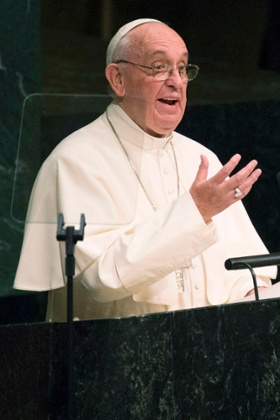
- Pope Francis demands UN respect rights of environment over the “thirst for power” in a wide-ranging speech to the General Assembly in which he also called for a ban on nuclear weapons.
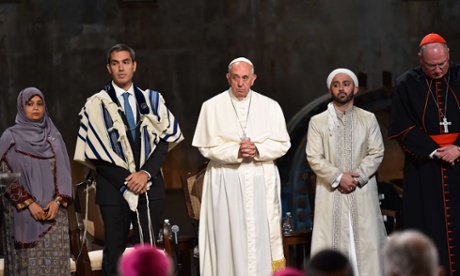
- At an inter-faith service at the 9/11 memorial, the pope hoped that good would come from suffering and condemned “wrongful and senseless loss of innocent lives”. He embraced clerics and members from many faiths, including an Imam and a Rabbi.
- Pope Francis visited an East Harlem school, where he spoke to children, parents and teachers, and received gifts made by immigrant workers.
- Thousands saw the pope parade through Central Park, with scalpers doing a fine trade in tickets to enter. Many missed the 3.30pm deadline to enter the park and were turned away.
- At a mass for 20,000 people at New York’s iconic Madison Square Garden, the pope prayed that New Yorkers would reach out to those who have “no right” to be in the city – the homeless, elderly and immigrants – so they are no longer merely part of the urban landscape.
Tomorrow the pope will depart for Philadelphia, where he’ll deliver yet another mass at the Cathedral of St Peter and Paul.
Updated
Vatican spokesman Federico Lombardi says that yes, the pope hasn’t enjoyed the security at these huge events:
I think it is very clear that the pope personally does not like a lot of security around him. This is very clear. But he has accepted and he was aware that coming to the US there was also this aspect he would take into account. That the security is very strong and that he had to pay a price for coming here.
And on the pope’s health:
Yes we can see that he is a little tired maybe, in working eh? And in doing steps [Lombardi here made a little walking motion with his hand] ... he has regular physiotherapy for this, and this can not happen during the visit.
Maybe he feels a little… the weight of these days. It’s not a particular problem. He has still energy for the last two days.

A journalist asks Vatican spokesman Federico Lombardi whether the pope knew Speaker John Boehner would be resigning. His reply: no.
To be honest I have not spoken with the pope about this, and in this sense I can not say something very particular. Obviously he is informed about this, and he was impressed how the speaker was emotionally moved yesterday during the meeting with him ... The pope has said to me that he was impressed by the profound participation and emotion of the speaker yesterday.
Archbishop Joseph Kurtz adds that all those present had no foreknowledge of Boehner’s resignation, adding “he was very emotional and he spoke about how important it was for him that our holy father came and that it was agreed he would address Congress”.
Updated

Vatican spokesman Fr Federico Lombardi is giving a press briefing. He reminds reporters that when Pope Francis mentioned “lodging, labor and land” during his UN address this morning, he was repeating the slogan of the popular movements. Francis attended their meeting in July this year, when he visited Bolivia. Here’s an excerpt from the speech he gave:
What can I do, as collector of paper, old clothes or used metal, a recycler, about all these problems if I barely make enough money to put food on the table?
What can I do as a craftsman, a street vendor, a trucker, a downtrodden worker, if I don’t even enjoy workers’ rights?
What can I do, a farmwife, a native woman, a fisher who can hardly fight the domination of the big corporations?
What can I do from my little home, my shanty, my hamlet, my settlement, when I daily meet with discrimination and marginalization?
What can be done by those students, those young people, those activists, those missionaries who come to my neighborhood with their hearts full of hopes and dreams, but without any real solution for my problems?
A lot! They can do a lot. You, the lowly, the exploited, the poor and underprivileged, can do, and are doing, a lot.
I would even say that the future of humanity is in great measure in your own hands, through your ability to organize and carry out creative alternatives, through your daily efforts to ensure the three “L’s” (labor, lodging, land) and through your proactive participation in the great processes of change on the national, regional and global levels. Don’t lose heart!
Fr Lombardi says Pope's meeting with popular movements in Bolivia gave him list of points to raise at UN #PopeinNYC
— Christopher Lamb (@ctrlamb) September 26, 2015
Updated
It’s evening here in New York, it’s Friday night, and who knows, maybe you’re thinking of going out. Maybe you need some music to get you in the mood for a responsible evening out on the tiles? Why not let Pope Francis lead the way:
It’s a bit too prog for my tastes, but I’m sure the pontiff has his reasons for resurrecting this ancient style of music in his forthcoming album, Wake Up!, which you can read more about on Pitchfork.
Updated

In case you missed it, Chris Lehmann wrote earlier today for Comment is Free, on Speaker John Boehner’s resignation. If the speaker was in tears during the pope’s address, it may have been because “over the past five years, Boehner himself has presided over a far less decorous and infinitely more fractious show of ardent faith” – the Tea Party gospel.
The only problem with this particular religion, of course, is that it leaves anyone still clinging to a residual impulse to do the actual work of governing – the people’s business, as the DC leadership class used to quaintly call it
If you’re into papal intrigue, which I am, the traditionalist blog Rorate Caeli has translated an article by Marco Tosatti, an Italian journalist at La Stampa, which alleges Pope Francis (at the time Cardinal Jorge Bergoglio) was part of a so-called mafia club of cardinals and bishops who opposed Pope Emeritus Benedict XVI.
The reports come after the publication of a biography of Belgian Cardinal Godfried Danneels, who was part of the group.
Danneels, according to the authors, had worked for years in preparation for the election of Pope Francis, which happened in 2013. He himself, however, in a video recorded during the presentation of the book, admits that he had taken part in a secret club of cardinals that were in opposition to Joseph Ratzinger.
While laughing he calls it “a Mafia club whose name was St. Gall” … The group wanted a drastic reform of the church, much more modern and up to date, with Jorge Bergoglio as Pope Francis at the head. And this is just as things turned out.
If you’ve suddenly got a rush of Da Vinci Code-style conspiracy vibes, let New York Times columnist Ross Douthat calm you down:
There's buyer's remorse from some. But conservative RCs who think only a small cabal wanted (some of) these shifts are kidding themselves.
— Ross Douthat (@DouthatNYT) September 25, 2015
Updated
Here’s another interesting detail from tonight’s mass at Madison Square Garden.
Pretty awesome to see openly gay @MoRocca, who's mother is Columbian do the first reading for the Mass at MSG with Pope Francis. 👏🏽👏🏽👏🏽
— Wilson Cruz (@wcruz73) September 25, 2015
Before we wind up the blog for tonight, here’s some new information about Sophie, the 5-year-old girl who handed the pope a letter on immigration. It turns out, she is well-organised too:
For nearly a year [an immigration] group had been preparing the young girl from suburban Los Angeles to make a dash for the popemobile to deliver a message about the plight of immigrant parents living in the country illegally.
“We planned to do this from the moment we learned he was coming to the States,” Juan Jose Gutierrez of the Full Rights for Immigrants Coalition told the Associated Press.
“We have been working for a while now trying to sensitize the American public that dealing with immigration is not just dealing with the people who came in without proper documents but that we also have ... countless children whose parents are undocumented.”
The mass has ended. The crowd are cheering for the pope. “Please, I ask you, don’t forget to pray for me,” he says in English.
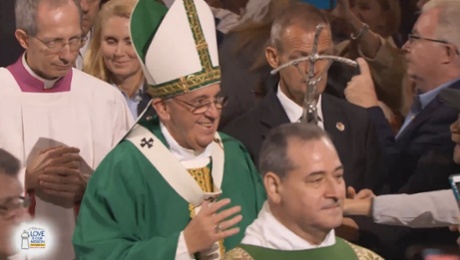
To give you an ideal of scale:
Over 200 deacons assist in the distribution of communion to over 20,000 present at the Mass held by @Pontifex at MSG pic.twitter.com/P7iI7A0OZW
— MSG (@TheGarden) September 25, 2015
Cardinal Timothy Dolan’s booming New York accent rings out across Madison Square Garden: “At every single mass, every single day, we pray for and with Francis our pope … and now, here you are!”
The crowd leaps to their feet in a rapturous standing ovation.
“It is clear how much you welcome you, how much we love you, how much we need you, how much we thank you for your visit. You have seen our cathedral …”
Dolan mentions “our priests, our seminarians, our deacons, our charitable works” and so on.
The pope seems a bit uncomfortable. As he told Catholic News Service, “I know that I am a sinner, so I speak with Jesus and tell him, ‘People are so good to think this of me.’ But the good that is in me, I owe to him. It is a gift from God.”
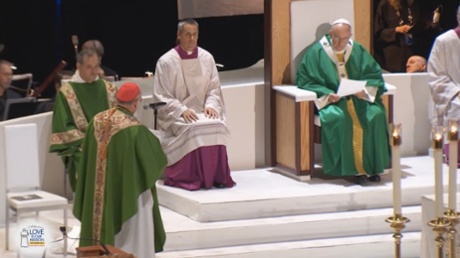
A few other short observations about language while the communion rite is completed and the hymns are sung (do tune in to the live stream at the top of the blog, the music is sublime).
As it says in the Epistle of James, language matters:
[L]ook at ships: though they are so large that it takes strong winds to drive them, yet they are guided by a very small rudder wherever the will of the pilot directs. So also the tongue is a small member, yet it boasts of great exploits.
And you get the feeling the pope agrees. He’s told his bishops to avoid “harsh language” and reproaches, squabbling over doctrine and the like on this trip. And many traditionalist Catholics have rebuked the pope for not speaking more strongly on this issue or that, or omitting certain words from his homilies and prayers.
But I think you can understand where the pope is coming from with this quote from his namesake, St Francis: “Preach the Gospel at all times and when necessary use words.”
And now Gregorian chant for communion. Francis is bringing a lot of things into unity during this mass: modern and ancient languages; modern and ancient music (remember Jennifer Hudson provided the pre-show entertainment); the person in their dignity and the city in its anonymity.
There is a lot here to please both traditionally-minded Catholics and those interested in reform. As has been the case in so many other areas of his pontificate, Pope Francis is trying to mend the tears in the “seamless garment” of the church.
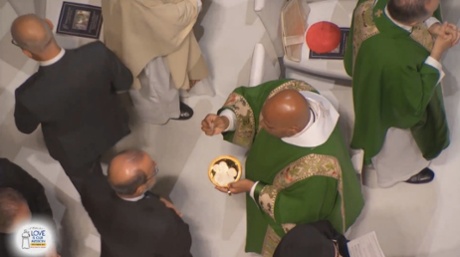
And the Lord’s Prayer is also in Latin. Some of the congregation are mumbling a little.
For many Catholics, Latin is a kind of distasteful old relic that only conservative priests like. For the reforming Pope Francis to have used it so extensively during this service will be a talking point.
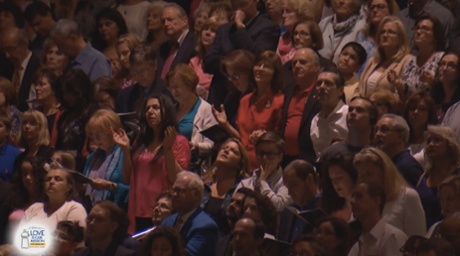
For example:
I'm actually quite happy the Pope is saying Mass in latin right now. Unthinkable for a prelate to do so 15 years ago.
— Andrew Walsh (@MonsieurOrgon) September 25, 2015
Old School Catholic Church: Listening to the Mass in Latin. #PopeinNYC #PopeFrancis
— Donna Brazile (@donnabrazile) September 25, 2015
Updated
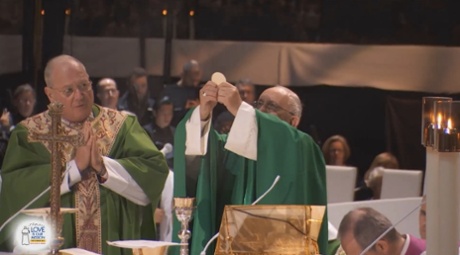
Perhaps I spoke too soon: Pope Francis has switched to Latin for the communion rite. Punditry never stays right for long, does it?
This mass will be closely scrutinized and emulated. Is it the new “best practice” mass then? Keeping the first section – the Liturgy of the Word, with its readings and prayers – for the people; then switching to a more clerical, universal expression of the liturgy for the Eucharistic Rite?
Updated
Now to the communion rite. And a reminder that the communion hosts don’t bake themselves.
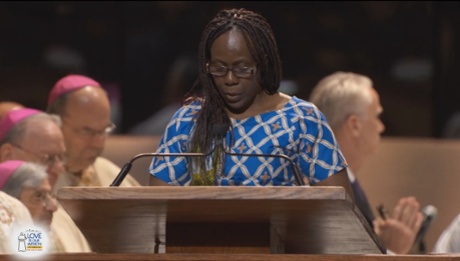
Prayers of petition are made in a variety of languages – Gaelic, Mandarin, English, French and Italian – followed by “we pray to the Lord” in English.
What Pope Francis has done with language on this tour is remarkable and I’d like to make a short observation:
One of the fruits of the reforming Second Vatican Council of the 1960s was the revision of the liturgy: rather than clerical Latin, the mass was said in the vernacular language of the people.
But what do you do in a multilingual immigrant society? Here, some priests secretly long for the return of the Latin mass as a sign of unity. But Francis says: Go! Move forward! Just let people offer their languages as a gift.
It’s an inversion of the old cleric-congregation relationship. In the past many Catholics would snooze or say the rosary while the priest spoke in Latin. Now it’s the priests who have to keep up with their parishioners’ languages.
Updated
Francis finishes his homily with some simple reflections on God in the city:
He moves us from the fray of competition and self-absorption and opens before us a path of peace. That peace which is born of accepting others; that peace which fills our hearts whenever we look upon those in need as our brothers and sisters.
God is living in our cities. The church is living in our cities. And God and the church who live in our cities want to be leaven in the dough, and relate to everyone, to stand at everyone’s side while they proclaim the wonders of the mighty counsellor … the prince of peace.
The people who walked in the darkness have seen a great light, and we Christians, are witnesses of that light.
We should go out, Francis says, like the father who goes out looking for his son, and when he returns, embraces him.
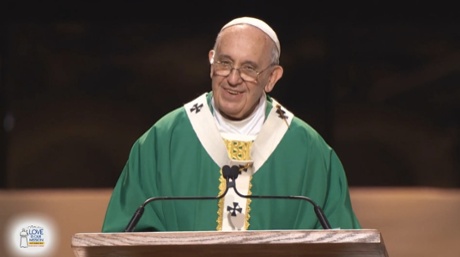
“This is nice,” the pope says, smiling.
Francis reminds the congregation that Jesus tells his disciples to “go out, to go out and meet the people where they really are, not where we think they should be”.
He talks about Emmanuel, the “God with us” who gets “involved in our pots and pans, as St Teresa of Avila said”.
#PopeinNYC Mass: Christ gives us the light that lets us see his presence even in the midst of big, busy city life pic.twitter.com/HjZLa38sss
— Cindy Wooden (@Cindy_Wooden) September 25, 2015
Pope Francis speaks of the cities' dispossessed and forgotten
Big cities bring together all the different ways in which we human beings have discovered to express the meaning of life, wherever we may be. But big cities also conceal the faces of all those who don’t appear to belong, or are second-class citizens. In big cities, beneath the roar of traffic, beneath the rapid pace of change, so many faces pass by unnoticed because they have no right to be there; no right to be part of the city.
There are the foreigners, their children who go without schooling, those deprived of medical insurance, the homeless, the forgotten elderly. These people stand at the edges of our avenues, of our streets, in deafening anonymity. They become part of an urban landscape which is more and more taken for granted in our eyes and in our hearts.
He says “God continues to walk the streets of our city, because God is in our city”.
The pope begins his homily. He says the characteristic of God’s people is their ability to see:
The people have seen a great light. The people who walked with all their dreams and hopes, their disappointments and regrets, the people have seen a great light. The people of God are called in every age to contemplate this light, a light for the nations. This is what elderly Simeon joyfully expressed: a light meant to shine on every corner of this city, on our fellow citizens, on every part of our lives. The people who walked in darkness have seen a great light. One special quality of God’s people is their ability to see. To contemplate., even in moments of darkness, the light that Christ brings.
The people who live in smog have seen a great light, have experienced a breath of fresh air.
Your gifts are welcomed here: From the hands and labor of Harlem's immigrant women to God's altar. #PopeinUS pic.twitter.com/MCiQqx1e4x
— Fr. Manuel Dorantes (@TweetingPriest) September 25, 2015
A lot of peace themes during this mass. Here’s some excerpts from the readings:
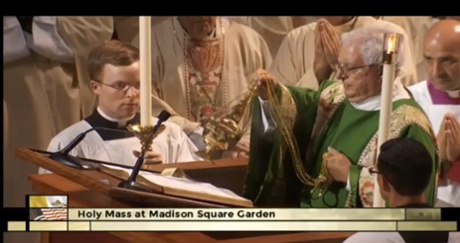
From Isaiah, Chapter 9:
For a child is born to us, a son is given to us;
upon his shoulder dominion rests.
They name him Wonder-Counselor, God-Hero,
Father-Forever, Prince of Peace.
From the Gospel of Matthew, Chapter 5:
“You have heard that it was said, ‘An eye for an eye and a tooth for a tooth.’ But I say to you, Do not resist an evildoer. But if anyone strikes you on the right cheek, turn the other also.
Pope Francis has been wearing the liturgical garments and carrying the effects of past popes during this tour. He’s very careful to cast himself as in continuity with his predecessors.
At this visit's liturgies, Pope has the original pastorale (cross-topped staff) of Bl Paul VI, likewise used at Paul's Yankee Mass in 1965
— Rocco Palmo (@roccopalmo) September 25, 2015
If liturgy isn’t your thing, and you’d like something to read, the New Yorker’s Adam Gopnik has written an interesting post on the pope so many see as radical:
Francis’s allegiance is to the continuity of his Church, not to its disruption on even a point of liberal law. He appears to be genuinely and, on his own terms, understandably more concerned about protecting the continuities of his organization than with getting absolute justice for its victims. And he remains anti-liberal in the colloquial sense of American politics—opposed to dissent that might run against the whole grain of stability and continuity of the Church.
The pope prays the collect: “let the Lord make us instruments of his peace”, and calls the congregation to recite the Confiteor (I confess).
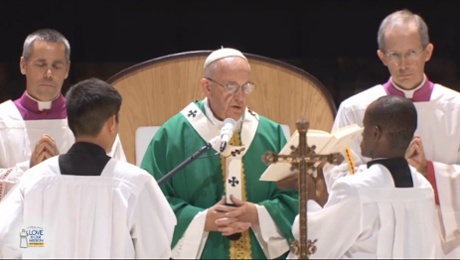
There is something very endearing about the pope’s halting English as he recites prayers that must be so familiar to him. He is providing an example to his clergy, too: this is what it’s like for migrants in your congregations whose English is the same standard.
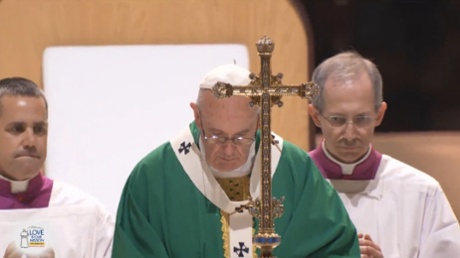
The music at this mass is the grandest yet. Turn on the livestream at the top of the blog to listen – just sublime.
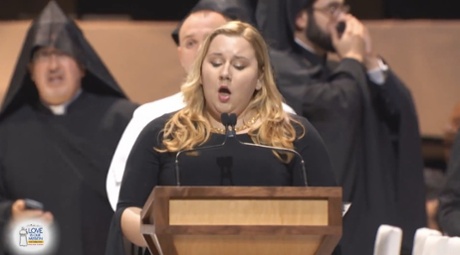
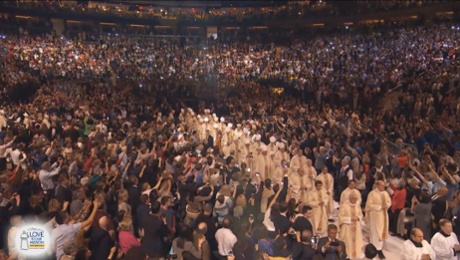
Pope Francis celebrates mass at Madison Square Garden
And we’re off. This is special type of mass, a mass for the preservation of peace and justice. So expect that theme in the prayers and antiphons. The overture is All People That On Earth Do Dwell.
In his first act of forgiveness in Madison Square Garden, the Pope has entered in a Volkswagon golf cart.
— Paula Poundstone (@paulapoundstone) September 25, 2015
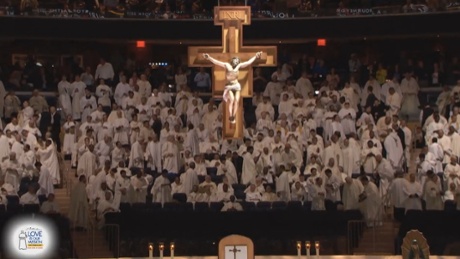
Behind the crucifix are the priests who will celebrate the mass with Pope Francis. Around 20,000 people in total are present in the stadium for this mass.
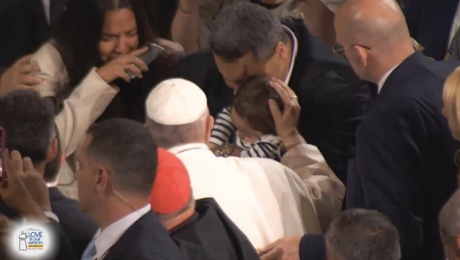
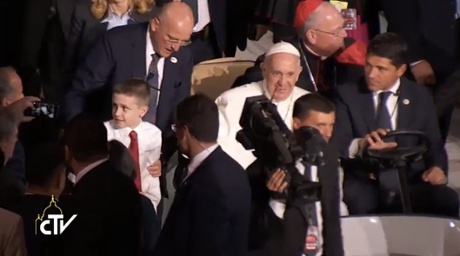
Again, there are dozens of security agents near the pope. They are jostling the crowd quite aggressively. Families with children, who appear to be sick and disabled, call the pope over. He blesses the children and the parents, who burst into tears.
The pope, and Cardinal Timothy Dolan, arrive at Madison Square Garden in a golf cart and greet some children.
Updated
People in Central Park running after #PopeinNYC https://t.co/VgJM1KyyDM
— Amanda Holpuch (@holpuch) September 25, 2015
Others, like Mashable’s Colin Daileda, were less satisfied by the experience:
Rome correspondent for The Tablet says the pope has been unhappy about the extent of the security rolled out at his events:
Understood that #Pope is not happy with the overbearing security on this trip which requires people to be at events hours beforehand
— Christopher Lamb (@ctrlamb) September 25, 2015
Helicopters overhead, police lining streets, more secret agents than West Wing, is this what the Pope wants? pic.twitter.com/MAdvKsA4RK
— Christopher Lamb (@ctrlamb) September 25, 2015
Given that some were turned away from the parade, because they failed to meet the 3.30pm deadline to enter Central Park by mere minutes, the pope might have a point here.
I saw the pope!
The parade has ended, and Pope Francis takes the Fiat to Madison Square Garden. But who saw him?
I saw the Pope, y'all!
— Scotch Bonnet (@IcyEsq) September 25, 2015
Omg I saw the pope @Pontifex!! It was really cool. https://t.co/DcGEC9RLvC
— Ann Rafalko Sublett (@annrafalko) September 25, 2015
I SAW THE POPE I SAW THE POPE I SAW HIMMMMMMMMMMMMMMMMMMMMMMMMMMMM
— Kiwi Avacado (@ImNaturallyKiwi) September 25, 2015
Thanks to @RonWaxman...I saw the Pope! Ron is the #1 scooper!!!! pic.twitter.com/5Bi7kdE3eu
— JoLynn Davis (@JeauxLynn) September 25, 2015
Some were more sceptical:
I saw the pope for a split second if that is not proof of the existence of the pope I don't know what is
— Jack Mirkinson (@jackmirkinson) September 25, 2015
Others, a little less prepared:
Went out to buy an IPhone charger and on E64th St, I saw the pope, waving from a small car amid a huge procession of police vehicles.
— Gabriel Schoenfeld (@gabeschoenfeld) September 25, 2015
And yeah, I don’t know if that counts mate:
I saw the Pope on TV
— Jeffrey Cohen (@MrJeff2000) September 25, 2015
And here are the priests, preparing for mass:
Just a bunch of priests vesting in the seats at Madison Square Garden #PopeinNYC pic.twitter.com/bQK0I8hBvW
— Sam Sawyer, SJ (@SSawyerSJ) September 25, 2015
Setting up for Mass. One hour till Pope Francis arrives. #PopeinNYC pic.twitter.com/QeSjck56sn
— America Magazine (@americamag) September 25, 2015
A few things about the upcoming mass at Madison Square garden:
- Individual parishes had a limited number of first-offer tickets released to them, which some then balloted out for parishioners.
- Priests who attend the mass were invited to “concelebrate”, which means they will join the pope in offering the mass to God. For many parish clergy it will be an unforgettable experience.
- The pre-show entertainment is pretty high-altitude.
.@HarryConnickJR singing How Great Thou Art at @TheGarden 🎶🎤 pic.twitter.com/yhgYBD64C9
— Archdiocese of NY (@NY_Arch) September 25, 2015
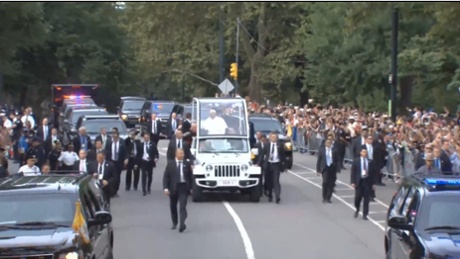
The crowds are going wild for the pope, who is proceeding through central park with an armada of vehicles and secret service agents in tow.
The pope’s message of humility and charity was available for $50 in the heart of New York City on Friday.
Of the ticket, this reporter asked: “Is it real?”
“Is it real? What else would it be!”
Amanda Holpuch tracks down scalpers to buy tickets to the Central Park parade.
Huge crowds have gathered at Central Park to wait for #PopeFrancis. http://t.co/rIbmlTcte2 #PopeInNYC pic.twitter.com/HSwge7wnhO
— CNN (@CNN) September 25, 2015
At Madison Square Garden, where the pope will say mass later tonight, Jennifer Hudson is sending shivers up spines during the “pregame” show:
Y ahora Jennifer Hudson nos pone los pelos de punta con un Aleluya pic.twitter.com/cLu1Tee38l
— Javier M-Brocal (@javierMbrocal) September 25, 2015
In Central Park now:
singing, clapping, waiting #PopeinNYC https://t.co/taZcidiMSj
— Amanda Holpuch (@holpuch) September 25, 2015
Pope Francis now joins over 540,000 New Yorkers as a proud @idnyc holder! You're welcome back anytime. pic.twitter.com/nTaXfKWklM
— Bill de Blasio (@BilldeBlasio) September 25, 2015
Amanda Holpuch is also at Central Park for the procession:
A crowd of 80,000 has descended on Central Park for the pontiff’s parade ahead of his mass at Madison Square Garden.
Inside the park, past intensive security, people had camped out on the lawn as children played football and tag.
Geraldine Quinones said she won a free ticket to the event in a lottery at work, “through the luck of the lord”.
She said she normally avoids crowds but was compelled to go after winning the tickets.
“We’re lucky to have him here,” Quinones said. “I think he’s going to change everything.”
Her new acquaintance, Geraldine Ortiz-Santos, agreed. Both women were pleased with how quickly Francis has discussed major issues. They cited his comments about women and nuns supporting the church as especially valuable.
“They [nuns] are like the army,” Ortiz-Santos said.
As it neared to the time of Francis’s scheduled arrival, people would rush to the roadside every time there was intermittent clapping – which was sometimes caused by police and other times by a crowd of people singing hymns.
Waiting for #PopeFrancis #CentralPark #PopeonParade pic.twitter.com/igG5kZYFNM
— Kate Cucco (@KateCucco) September 25, 2015
Updated
The pope makes his way to Central Park for the procession. Guardian religion correspondent Harriet Sherwood checks in:
At Columbus Circle, on the south west corner of Central Park, hawkers of papal kitsch jostled with television crews and police officers for the attention of New Yorkers with tickets for the pope’s drive-by.
T-shirts and tote bags were retailing for $10; “Yo el Papa Francisco” badges were $5 apiece. Sitting behind a trestle table piled with t-shirts, Earl said he had done a brisk trade since early morning.
“I’m not a Catholic, I’m an internationalist,” he said. “I have seven holy books at home. I’m a little bit Jewish, a little but Muslim, a little bit Christian.”
At 3.30pm, the time the park gates were scheduled to close ahead of the 5pm event, people were still flooding out of the subway, seeking directions to their designated entrance. “I don’t think you’re going to make it,” a police officer sympathetically told ticket-holders.
Lisa, a New York City employee, had rushed from work but missed the 3.30pm deadline. A friend had given her a ticket, knowing she was a Catholic.
“He’s the best pope we’ve ever had,” Lisa said as she dejectedly prepared to go home to watch the motorcade on television.
Not everyone was swept up in pope-mania. Peter and Ann Ferens had arrived in New York from the UK on Thursday ahead of a cruise to Quebec departing on Saturday, unaware that their visit coincided with the pope’s.
“We went down to see the 9/11 site this morning, but couldn’t get near it,” said Peter Ferens. “Then we thought we’d go for a bike ride in Central Park. That’s clearly not going to happen. So we’re going to have a nice cup of tea.”
Meeting the students has totally recharged the pope’s batteries. He zips off in the Fiat to cheers.
"Como desearía yo, una Iglesia pobre y para los Pobres." -@Pontifex #PopeinUS #PapaEnUSA pic.twitter.com/b9Q1ZaZYiy
— Fr. Manuel Dorantes (@TweetingPriest) September 25, 2015
“A church poor, and for the poor.”
Pope Francis blesses the people and asks, in English, that they “Don’t forget the homework”. Then he steps down from the stage.
The pope is in his element, smiling and hugging people, waving and talking with everyone. He’s in the US, but is preaching the same way he did in Cuba: expressly encouraging people to offer what they have, whether that be gifts, songs, or just prayers. It’s Francis’s spirituality straight up and down, that the intimate encounter with the other as they really are is what matters.
And that means preserving something to give: culture, solidarity and so on. At no stage has he said to immigrants that they need to assimilate or change their language or culture. On the contrary: Francis has shown repeatedly that the church can be shown to the world through the gifts of its members. It’s wonderful to watch.
Then there’s this:
Quote of the day: Girl at Our Lady Queen of Angels School in Harlem to Pope looking at a computer screen: "You have to double click it!"
— James Martin, SJ (@JamesMartinSJ) September 25, 2015
Updated
The pope asks someone in the crowd to sing to him. “Who’s the boldest?” Two women burst into song. They’ve got great voices.
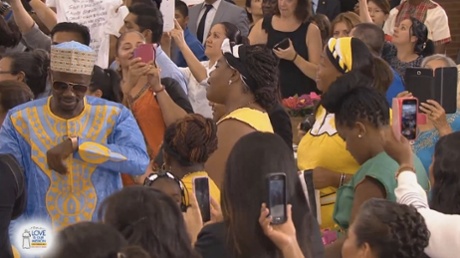
One more song and then Pope Francis asks everyone to pray the Lord’s Prayer with him.
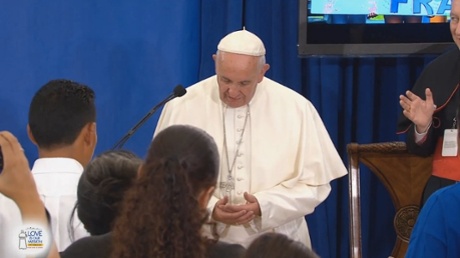
Finally, Francis tells the children: “I want to give you some homework.”
It is just a little request, but a very important one. Please don’t forget to pray for me, so that I can share with many people the joy of Jesus. And let us also pray so that many other people can share the joy like yours.
May God bless you today and Our Lady protect you.
The pope speaks off script for a little bit, with a mischievous glint in his eye:
Who sows sadness? Who sows anger? Who sows envy? What’s the name of that? The devil. The devil!
Updated
“Today we want to keep dreaming,” pope Francis tells the students”. We celebrate all the opportunities which enable you, and us adults, not to lose the hope of a better world with greater possibilities.”
I know that one of the dreams of your parents and teachers is that you can grow up and be happy. It is always good to see children smiling. Here I see you smiling. Keep smiling and help bring joy to everyone you meet.
Dear children, you have a right to dream and I am very happy that here in this school, in your friends and your teachers, you can find the support you need. Wherever there are dreams, there is joy, Jesus is always present. Because Jesus is joy, and he wants to help us to feel that joy every day of our lives.
He shows off his knowledge of northern Manhattan’s geography, invoking Martin Luther King Jr to encourage the children
Very near here is a very important street named after a man who did a lot for other people. I want to talk a little bit about him. He was the Reverend Martin Luther King. One day he said, “I have a dream”. His dream was that many children, many people could have equal opportunities. His dream was that many children like you could get an education. It is beautiful to have dreams and to be able to fight for them.
The Pope of the Poor is very much at home here. #PopeInUS pic.twitter.com/O9urnGquiH
— Fr. Manuel Dorantes (@TweetingPriest) September 25, 2015
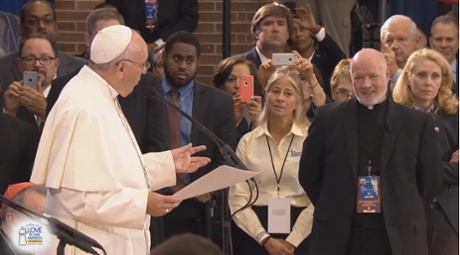
The pope tells the children, all in elementary school classes, that the good thing about being at school with different people is making new friends,
We meet people who open doors for us, who are kind to us. They offer us friendship and understanding, and they try to help us not to feel like strangers. To feel at home. How nice it is to feel that school is a second home.
This is not only important for you, but also for your families. School then ends up being one big family. One where, together with our mothers and fathers, our grandparents, our teachers and friends, we learn to help one another, to share our good qualities, to give the best of ourselves, to work as a team and to pursue our dreams.
East Harlem school welcomes pope
Pope Francis is meeting with students at Our Lady Queen of Angels on East 110th Street – he immediately tells the children how glad he is to be there and thanks their teachers “for stealing a few minutes of their class time”.
They tell me that one of the nice things about this school is that some of its students come from other places, even from other countries. That is nice!
Even though I know that it is not easy to have to move and find a new home, new neighbors and new friends. It is not easy. At the beginning it can be hard, right? Often you have to learn a new language, adjust to a new culture, even a new climate. There is so much to learn! And not just at school.
A priest from Catholic charities presents a cross to the pope, saying “Our service is a blessing from God”. He kisses it.
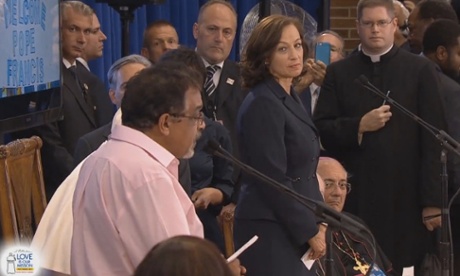
Readers stand to recite the famous passage from Matthew 25 in their own languages:
For I was hungry and you gave me something to eat, I was thirsty and you gave me something to drink, I was a stranger and you invited me in, I needed clothes and you clothed me, I was sick and you looked after me, I was in prison and you came to visit me.
Pope Francis takes the podium, begging forgiveness for stealing the teachers’ class time.
Pope Francis enters the auditorium. There is a press of people. The whole neighbourhood seems to be here.
Pope Francis poses for a photo with some students wearing soccer jerseys. They present him a soccer ball signed by children of immigrants.
Next he meets two men from United Workers, and then receives a book of over 1,000 stories of Harlem residents is presented to the pope by a young man.
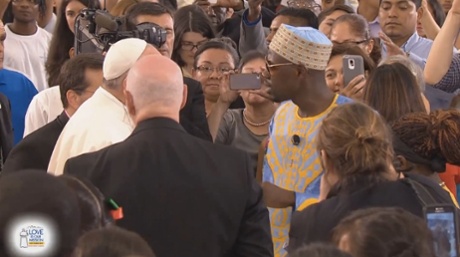
An immigrant mother and daughter from Honduras ask for a kiss. Then a group of mothers have made a tablecloth for pope francis. It’s a replica of those used in the mass today. Afterwards a woman asks Pope Francis to bless a bracelet for a disabled person. This is real, popular devotion.
Mayor de Blasio shakes Cardinal Timothy Dolan’s hand and thanks the children. In the main auditorium, more people await the pope.
It’s worth noting that Our Lady Our Lady Queen of Angels is in East Harlem, which is 80% black and hispanic, younger than average, and ranks lower on socioeconomic and educational indices.
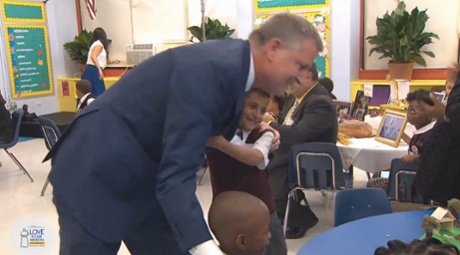
The pope, spotted in the wild.
The children are thrilled to meet the pope. They are really more interested in being blessed by him, or holding his hand, than the media or their projects. The pope meets the family of New York Mayor Bill de Blasio.
Each of the groups of children are from a different school and have prepared a project with a specific theme. The students from St Charles Borromeo school have focused on the natural world.
The children try to help Pope Francis to use a smartboard. Remember, he hasn’t watched a TV for years and has his tweets printed out for his approval before being sent by an aide. He struggles, and the classroom laughs.
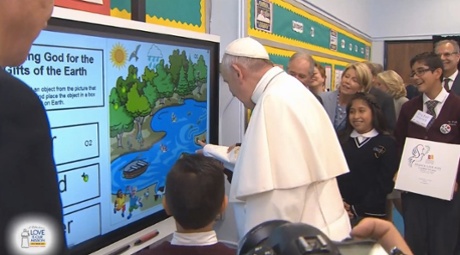
Guardian reporter Lauren Gambino is getting into the spirit of the day.
.@Pontifex just passed us pic.twitter.com/Cbme3ynMP8
— Lauren Gambino (@LGamGam) September 25, 2015
G’day, Adam Brereton back on the liveblog with you. Alan Yuhas, who has put in a marathon session this morning, is off to receive a plenary indulgence for his good works.
The pope is attending Our Lady Queen of Angels School in East Harlem. The student have sung a hymn and said the Hail Mary, and are now explaining their school projects. It’s adorable – one girl points out a model of fruits and vegetables to the pope.
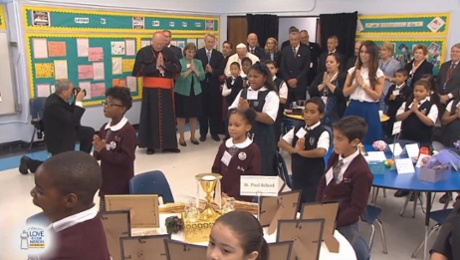
The schoolchildren are singing the hymn of St Francis to the pope. He’s encouraging them to sing louder.
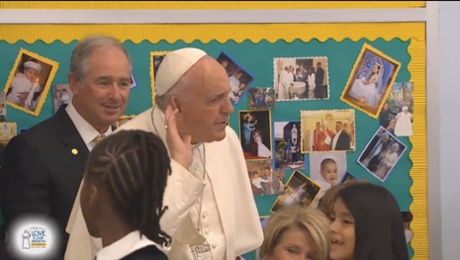
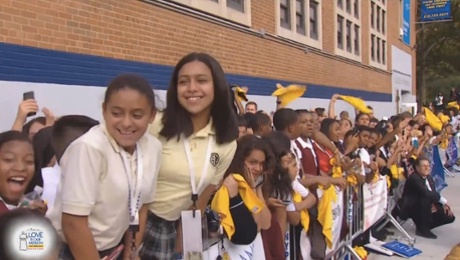
The pope’s Fiat has rolled up to the school, where students are chanting: “Holy Father, we love you!”
Pope Francis waves his hands and grins at all the children lined up to greet him, high-fiveing students, clasping outstretched hands, and blessing the crowd. Students have their phones out and are taking photos furiously as the pope draws closer and chats and jokes with the kids.
The Guardian’s Lauren Gambino is in East Harlem, ready with the crowds for the pope’s arrival at Our Lady Queen of Angels elementary school.
Papal heads #PopeinNYC pic.twitter.com/zYEGHQP74p
— Lauren Gambino (@LGamGam) September 25, 2015
Waiting for @pontifex to arrive at Our Lady Queen of Angels, a Catholic school in east Harlem #PopeinNYC pic.twitter.com/uM2A1VPLcI
— Lauren Gambino (@LGamGam) September 25, 2015
“Mexico was very difficult to survive. It was very hard to find a job,” Francisco Duque Gonzalez, one of the immigrants who will meet Pope Francis this afternoon told my colleagues Lauren Gambino and Laurence Mathieu-Léger.
Duque, his wife and two older daughters emigrated from Mexico in the early 2000s, and have faced poverty, unemployment and, briefly, the threat of arrest and detention. Since then they have rebuilt their lives in the United States, and with their four daughters will meet the pontiff in East Harlem this afternoon.
Ahead of Francis’s visit to New York, Fatima, 15, has prepared a letter that will be presented to him along with letters from other immigrants. In the letter she described her dreams for a better life, and said that she hopes to go to college and become a lawyer, but said she is restricted by the current immigration laws.
“I want to do so much, but I can’t,” she wrote in the letter. “I want to be able to.”
Your guide to the pope’s travels on day four of his tour through the US.
My colleague Amanda Holpuch is out on the west side of Central Park and amid the papal mania.
Walk out of Columbus Circle, enter a Pope memorabilia bazaar: t-shirts, rosaries, flags #popeinnyc pic.twitter.com/k5Uvr1cg3B
— Amanda Holpuch (@holpuch) September 25, 2015
Some highlights of the pope’s travels in Washington DC and New York, courtesy my colleagues on the video team.
Martin Fierro, mentioned by Pope Francis in his address to the UN, is a character beloved in Argentine literature (Jorge Luis Borges was also a fan). Writing for the Guardian, Angela Bruno has more:
Pope Francis quoted Martin Fierro, a classic piece of 19th century Argentinean literature and epic poem by journalist and politician Jose Hernandez:
“Brothers should stand by each other, because this is the first law; keep a true bond between you always, at every time – because if you fight among yourselves, you’ll be devoured by those outside.”
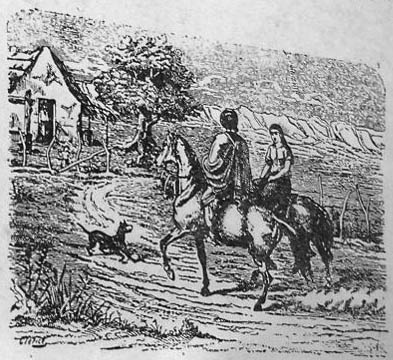
Martin Fierro is known to be a critique of the Argentine president of its time, Domingo Faustino Sarmiento, who encouraged large-scale immigration from Europe, a primary threat to the protagonist of Hernandez’s work, the gaucho or the nomadic cowboy of the Argentinean grasslands. The indigenous and black communities of Argentina are also targets in Hernández’s work.
Within this context, Francis’ choice to quote this text could be seen as a curious one and at odds with his advocacy for immigrant and human rights.
Stranger still is this comparison of the similarities between Fierro and Tea Party supporters.
Updated
The view from above Columbus Circle and Central Park.
And New Yorkers moved to tears at even a glimpse of Pope Francis in passing.
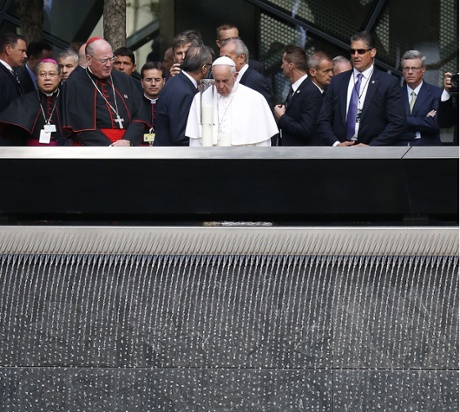
Pope Francis views Spencer Finch’s art installation at #911memorial #PopeinNYC - love this pic pic.twitter.com/fGgEIgzQYj
— Jo-Anne Rowney (@JoAnneRowney) September 25, 2015
Updated
Summary
- Pope Francis delivered a ranging and forceful address to the UN general assembly in New York, asserting the “right of the environment” and blaming the excesses of capitalism for contributing to climate change and the exclusion of the poor.
- In the speech, the pope chided the UN for its bureaucratic stallings, warned nations against “the Pandora’s box” of abusing the organization’s powers, praised “the potential” of the Iran deal and called for a ban on nuclear weapons, and said that climate change threatens the entire human species.
- Visiting the 9/11 Memorial in the financial district, Pope Francis prayed by the recessed pools where the World Trade Center towers once stood and met with the families of victims of the September 11 attacks.
- Inside the memorial’s museum, he and other leaders from various religions prayed and called for unity and a celebration of their differences. “You can feel the grief here is palpable,” the pope said. “This place of death became a place of life too, a place of saved lives, a song that affirms that life will always triumph over the prophets of destruction and death.”
- The pope’s day continues in New York with a 4pm ET visit to an East Harlem school of mostly black and Latino students, a 5pm procession through Central Park, where thousands of people are expected to gather, and a 6pm mass held at Madison Square Garden in midtown Manhattan.
Perhaps convinced he had found a loophole to the rule “don’t drink the holy water”, a US congressman has confessed that he filched and sipped Pope Francis’ glass of water after the pontiff’s speech to Congress on Thursday.
“How many people do you know that drank out of the same glass as the pope?” Pennsylvania representative Bob Brady told the Philadelphia Daily News. “I took a sip out of it.”
My colleague Adam Gabbatt writes:
Like a bachelor party attendee spotting a discarded pint, the Democratic congressman plucked Francis’s glass from the lectern. Rather than immediately down the drink, however, he carried it to the confines of his office, to enjoy the pontiff’s water in peace.
Brady’s wife Debra and two of Brady’s staffers also quaffed some.
The Daily News said a presumably excited Brady invited Senator Bob Casey into his office to behold the glass of water. “The three dipped their fingers into the glass. Pictures were taken, joy was in the air,” the paper reported.
Once the trio had withdrawn their fingers Brady “poured the rest of the water into a bottle”. He now plans to bless his four grandchildren with the fluid.
Among the world leaders at the UN this morning were a few figures less influential than the average diplomat but more famous to the crowd who rarely tunes in for council meetings and debates over resolutions.
Was that James Bond representing England at the UN? #PopeinNYC pic.twitter.com/oM5mU3IU1f
— Paul Sabin (@Ski_Sabin) September 25, 2015
Daniel Craig was named the UN’s global advocate for the elimination of mines and explosive headquarters, and was in attendance for the pope’s address (as was Colombian singer Shakira).
When Craig, the current actor who plays James Bond, was announced as advocate in April, UN secretary general Ban KI-moon said: “As 007, Mr. Craig had a ‘licence to kill.’ Today we are giving him a ‘license to save.”
Slightly more able comics have also weighed in.
Makes me nervous that James Bond is at the UN right now, but at the same time I know that @Pontifex will be safe in his hands. #PopeinNYC
— Heather Dickey-Wells (@soigneeallday) September 25, 2015
Electric guitar with the reverb amped up, pounding drums, a moody rolling synth line, and fake trumpets interspersed throughout – could anything be more papal?
The Vatican seems not to think so, putting its new single of Pope Francis-sampled pop rock online as a free download, and making orders available for an entire album on iTunes.
A collaboration with European record label Believe Digital, the record features pop rock riffs mixed in with excerpts of Pope Francis’ speeches and hymns in several languages, according to Rolling Stone, which first announced the album and interviewed one of the composers behind it.
In the record’s eponymous single, “Wake Up!”, Francis shouts in his quiet way “Wake up! Go! Go! Forward!” at a South Korean audience, and mutters “it is a duty to be vigilant, not to allow the pressures, the temptations and the sins to dull our sensibility of the beauty of holiness.”
Tony Pagliuca, an Italian keyboard player who helped compose the album, told Rolling Stone that after touring with prog-rock band Le Orme in the 1970s, he “also made an important journey of faith”.
“Putting my music in the service of the words and the voice of Pope Francis has been a fantastic experience and a very interesting artistic challenge,” he told the magazine. If you’re eager to know yet more about the pope’s first ever Christian rock-ish album, enjoy the tracklist and streaming single below.
1. “Annuntio Vobis Gadium Mangum”
2. “Salve Regina”
3. “Laudato Sie…”
4. “Poe Que Sufren Los Ninos”
5. “Non Lasciatevi Rubare La Speranza!”
6. “La Iglesia No Puede Ser Una Ong!”
7. “Wake Up! Go! Go! Forward!”
8. “La Fa Es Entera, No Se Licua!”
9. “Pace! Fratelli!”
10. “Per La Famiglia”
11. “Fazei O Que Ele Vos Disser”
Updated
Pope Francis has a bit of a break before he again takes to the streets of New York with a 4pm visit to East Harlem. For those who didn’t win lottery tickets to get close to the pontiff as he visits the US for the first time in his life, the question remans: how can you meet the pope?
My colleagues Kate Lyon and Rachel Obordo have the answers, from going to Rome to becoming a nun to getting married or simply being a child (not just in spirit).
Like the pontiffs of old who maneuvered the feuding states of Europe and the Middle East, Pope Francis displayed a shrewd mind for diplomacy, my colleague Rory Carroll (@rorycarroll72) writes of this morning’s UN speech.
Pope Francis’s white vestments symbolise purity and light but his UN speech is showing an ability to navigate the grey shades of real world diplomacy.
Just as he slalomed between the hopes of progressives and conservatives in Thursday’s address to Congress, here in New York he’s giving some encouragement – and scolding – to everyone.
The IMF and World Bank will have squirmed at his exhortation to not subject developing countries “to oppressive lending systems which, far from promoting progress, subject people to mechanisms which generate greater poverty, exclusion and dependence”. You could almost hear the cheers in Athens and African capitals.
Yet authoritarian regimes who struggle under debt burdens were then promptly upbraided for violating democratic norms: “No human individual or group can consider itself absolute, permitted to bypass the dignity and the rights of other individuals or their social groupings. The effective distribution of power.. among a plurality of subjects, and the creation of a juridical system for regulating claims and interests, are one concrete way of limiting power.”
Take that, Robert Mugabe. Vladimir Putin and Nicolas Maduro may also have been gazing at their shoelaces at this point.
When he assailed poverty China may have swelled with pride, since it has lifted millions out of poverty, only to find itself, along with other polluters, taken down a peg: “Man possesses a body shaped by physical, chemical and biological elements, and can only survive and develop if the ecological environment is favourable. Any harm done to the environment, therefore, is harm done to humanity.”
His central point, about social exclusion, applied to pretty much every country. “The poorest are those who suffer most from such offenses, for three serious reasons: they are cast off by society, forced to live off what is discarded and suffer unjustly from the abuse of the environment. They are part of today’s widespread and quietly growing ‘culture of waste’.”
Even social democratic, recycling, safety-net Scandinavia could reflect on that.
Not naming anyone, but with praise here, chastisement there, he man in white knows how to get his points across.
Watching the pope as he wanders Manhattan.
A look back at Pope Francis’ meeting with families of September 11 victims, and of his visit to the memorial pools.
Really incredible. @Pontifex meeting families of 9/11 victims, greeting each one attentively, listening. #PopeinNYC pic.twitter.com/KjxsKenQRC
— Joshua McElwee (@joshjmac) September 25, 2015
#PopeFrancis places white flower at the 9/11 memorial. pic.twitter.com/9XwngS17I7
— Cindy Wooden (@Cindy_Wooden) September 25, 2015
#PopeFrancis at the south reflecting pool #911memorial @WNYT pic.twitter.com/GWSRrIvXEf
— Benita Zahn (@BenitaZahn) September 25, 2015
He and the other religious leaders are finishing services inside the memorial museum.
He concludes with a call for a moment of silence and an appeal to peace.
This can only happen if we rid from our hearts all feelings of hate, and rancor. We know that that is only possible as a gift from heaven. Here, in this place of memory, I would ask everyone together, each in his or her own way, to spend a moment in silence and prayer. Let us implore from on high the gift of commitment to the cause of peace.
Peace in our homes, our families, our schools and our communities. Peace in all those places where war never seems to end. Peace for those people whose faces have known nothing but pain. Peace throughout this world which God has given us as the home of all and a home for all. Simply, peace.
Let us pray in silence.
In this way, the lives of our the ones we loved which will one day be forgotten. Instead, they will be present whenever we strive to be prophets not of tearing down but of building up, prophets of reconciliation, the prophets of peace.
The pope says that the memorial should remind everyone that no differences are insurmountable and that no dispute cannot be reconciled.
In this place of pain and memory I am full of hope, because I can join with leaders representing the many religious, and because we can enrich the life of this great city. I trust that our presence together will be a powerful sign of our shared desire to be a force for reconciliation, peace and justice in this community and throughout the world.
For all our differences and disagreements, we can live in a world of peace. In the face of every attempt to make us uniform, we can and must build unity on the basis of our diversity of languages, cultures and religions, and raise our voices against anything that would stand in the way of such unity. Together we are called to say ‘no’ to every attempt to make us the same, and ‘yes’ to accepting diversity and reconciliation.
Ground Zero is 'a place of death and life', pope says
Pope Francis goes further, describing the unity and selflessness that grew out of New York’s loss and suffering.
Here in this pain we can also feel the capacity for heroic goodness which people are capable of, those hidden reserves of strength from which we can draw. In the times of greatest pain and suffering, you also witnessed the greatest acts of generosity and service.
Hands reached out, lives were given. In a metropolis which might seem impersonal, faceless, lonely, you demonstrated the powerful solidarity born of mutual support, love and self-sacrifice. At that moment no one thought about race, nationality, neighborhoods, religion or politics. It was all about solidarity, meeting immediate needs, brotherhood.
It was about being brothers and sisters. It was a matter of humanity. New York City firemen came into the towers that were crumbling, with no concern for their own wellbeing. Many fell. For duty and in sacrifice they were able to save a great many others.
This place of death became a place of life too, a place of saved lives, a song that affirms that life will always triumph over the prophets of destruction and death, and good over evil, reconciliation and unity over hatred and division.
Pope Francis links meeting with the bereaved families to a theme from his UN speech: the personal costs of conflicts and violence, and the hope borne by memory.
A few moments ago I met some of the families of the fallen first responders. Meeting them made me see again how acts of destruction are never impersonal, abstract, it’s never about material things. They always have faces, real stories, names. In those family members, we see the face of pain, a pain which still leaves us speechless and cries out to heaven.
At the same time, those family members showed me the other face of this attack, the other face of their grief: the power of love and remembrance. A memory that does not leave us empty and withdrawn. On behalf of so many loved ones the names are written around the bases of these towers. We can see them, we can touch them, and we can never forget them.
“The water cascading also a symbolizes our tears,” he says. “Tears that symbolize the destruction of yesterday and today.
This is a place where we cry, we cry out of a sense of helplessness in the face of injustice, murder, and the inability to settle conflicts through conversation.
In this place we cry for the injustice and the an of innocent lives because of the inability to find solutions that respect the common good. This water reminds us of yesterday’s tears, but also of all the tears being shed today.
Pope Francis at 9/11 Memorial: 'the grief here is palpable'

The pontiff is delivering his speech near the stark black walls of the 9/11 Memorial’s pools. He opens by remarking on the water rushing down the sides of the rectangular pits: “I feel many different emotions standing here at Ground Zero, where thousands of lives were taken in a senseless act of violence and destruction.
You can feel the grief here is palpable. The water we see flowing towards that empty pit reminds us of all those lives which fell prey to those who believe that destruction is the only way to solve conflicts, tearing down, is the only way to settle conflicts. That silent cry of those who were victims of a mindset which knows only violence, hate and revenge. A logic which can only cause pain, suffering, destruction and tears.
Updated
Each of the leaders, Christian, Muslim, Jewish, Buddhist, Hindu, Sikh, Jain and Native American, are now offering prayers, blessings, songs and a cantor, some in English and others in other languages.
Updated
Pope Francis offers a blessing to the victims of September 11, for the men and women who were “here 14 years ago”
He asks God to “heal the pain of the still grieving families and loved ones of this tragedy. Give them strength to continue their lives with courage and hope. We are mindful as well of those who suffered death, injury and loss in Shanksville, Pennsylvania. Our hearts are one with theirs as we embrace their pain and suffering.”
He then asks for God to “bring your peace to our violent world. Peace in the hearts of all men and women and peace among the nations of the world.
“We seek your light and guidance as we confront such terrible actions.
“Comfort, give us solace, strength, love and hope, and give us the wisdom and courage to work tirelessly for the world where true peace and love reign among nations and in the hearts of all.”
Rabbi Elliot Cosgrove and imam Khalid Latif are now at the two podiums, remarking on the memorial and appealing for unity.
“In this place where horrendous violence was committed falsely in the name of God,” Cosgrove says. “We representatives of world religions in the great city of New York, gather to comfort and pray.”
Latif says “intolerance and ignorance fueled those who attacked this place”, and that “we stand totgether as brothers and sisters to condemn their horrific acts.”
He quotes the Quran, “one life lost is like all mankind and one life saved is like all mankind”, and says “where others fail let us be the peaceful reminders of that notion.”
Cosgrove in turn quotes the Torah and then invokes St Francis, saying “let us become instruments of peace.”
“We should love peace and we should pursue peace.”
“Let us move beyond a mere toleration of our differences and toward a celebration of them,” Latif concludes.
Religious leaders of several faiths, including, of course, Pope Francis, have gathered inside the 9/11 Memorial Museum – the pontiff is going down the line shaking the hands of Jewish, Muslim, Sikh, Buddhist and Hindu leaders.
Cardinal Timothy Dolan welcomes the pope on behalf of the dignitaries: “Now I can tell you Papa Francesco, we in New York are sinners. Sinners. We have many flaws and we make many mistakes. But one of the things we do very well is sincere and fruitful inter-religious friendship.
“Our ancestors came here for religious freedom and they found in New York City a … respect for religious diversity.” He thanks the pope for coming.
Updated
More than 1,000 people have arrived at Ground Zero to welcome the pope, like the thousands who’ve met him in Washington and elsewhere in New York. “But this is no ordinary crowd,” my colleague Ed Pilkington writes from the site.
You can tell that when you see so many among them carrying photos of their loved ones lost on 9/11.
Take Anna Florentina who was holding up a card with a picture of her nephew Charles Luciana attached to it. He was an electrician working on the 87th floor of the South Tower when it was hit. He’d only been on the job for two weeks, she said.
It’s striking that she is not the only person here who has said it was her first visit to Ground Zero. In 14 years she never managed it. “I couldn’t face it,”she said.
Which puts the popes visit in context. “It comforts me, it makes me strong,” was how she put it.
In the financial district, the pope is meeting with former mayor Michael Bloomberg and other New York officials.
Pope Francis is on his way to the dual pools of the 9/11 Memorial in downtown Manhattan, where he’ll cohost a multi-faith service and meet with families of September 11 victims.

My colleague Ed Pilkington (@edpilkington) reports from Ground Zero:
The memorial park is starting to fill up with what you could call the “9/11 community” – relatives of victims, survivors, emergency workers who were involved on the day – ahead of Pope Francis’s visit. About 1,000 people have been selected through a lottery to gather around the pool that marks the footprint of the South Tower of the World Trade Center.
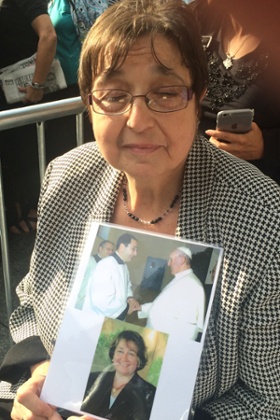
One of the early arrivals, sitting patiently some three hours before the pope’s arrival, is Maria Crifasi. She is carrying a photograph of her sister Lucia Crifasi who was 51 when she was trapped on the 94th floor of the North Tower where she was working for American Express after the skyscraper was struck by American Airlines Flight 11.
The sisters were born in Italy to a Catholic family and came to New York as children. Maria Crifasi said she had come to Ground zero to seek the pontiff’s special blessing both for herself and for her lost sister.
“It’s been 14 years but the pain never goes away. It’s as fresh now as it was that day. For me, this is a holy place – I feel it’s where my sister is. That’s why I need to be here.”
Updated

The Guardian’s religion correspondent Harriet Sherwood weighs in on the pope’s in-your-face confrontation with the ways of the UN:
While paying fulsome tribute to the United Nations on its 70th birthday, Pope Francis also appeared to be rebuking the global body for too much talk and not enough action.
On the UN’s achievements, he ticked off the development of international law and human rights norms, conflict resolution, peace-keeping and reconciliation. ‘All these achievements are lights which help to dispel the darkness of the disorder caused by unrestrained ambitions and collective forms of selfishness,’ he said.
But later in his speech, Francis also said: ‘Solemn commitments, however, are not enough, even though they are a necessary step toward solutions.’
He made a clear call to action by the UN and its member states on very specific fronts, warning against ‘declarationist nominalism’ – something that is very much a feature of the UN and its myriad agencies.
This is what he said: ‘Our world demands of all government leaders a will which is effective, practical and constant, concrete steps and immediate measures for preserving and improving the natural environment and thus putting an end as quickly as possible to the phenomenon of social and economic exclusion, with its baneful consequences: human trafficking, the marketing of human organs and tissues, the sexual exploitation of boys and girls, slave labour, including prostitution, the drug and weapons trade, terrorism and international organized crime. Such is the magnitude of these situations and their toll in innocent lives, that we must avoid every temptation to fall into a declarationist nominalism which would assuage our consciences. We need to ensure that our institutions are truly effective in the struggle against all these scourges.’
And if that was not enough, Francis later delivered an even more pointed reproach. Citing the preamble of the UN’s charter, he said: ‘The ideal of “saving succeeding generations from the scourge of war”, and “promoting social progress and better standards of life in larger freedom” risks becoming an unattainable illusion, or, even worse, idle chatter which serves as a cover for all kinds of abuse and corruption.’
There’s been plenty of abuse and corruption in the UN’s history. No doubt Ban Ki-moon and others in the hall will have squirmed to hear the pope’s words.
Series right here.
Updated
Finishing his remarks, pope Francis asks the assembled leaders to put aside their “partisan interests and sincerely strive to serve the common good”.
The praiseworthy international juridical framework of the United Nations organization and of all its activities, like any other human endeavor, can be improved, yet it remains necessary. At the same time it can be the pledge of a secure and happy future for future generations.
And so it will, if the representatives of the States can set aside partisan interests, and sincerely strive to serve the common good.
I pray to Almighty God that this will be the case, and I assure you of my support and my prayers, and the support and prayers of all the faithful of the Catholic Church, that this Institution, all its member States, and each of its officials, will always render an effective service to mankind, a service respectful of diversity and capable of bringing out, for sake of the common good, the best in each people and in every individual.
Upon all of you, and the peoples you represent, I invoke the blessing of the Most High, and all peace and prosperity. Thank you.
With that the pope leaves the podium and the people in the audience rise to their feet to give him an ovation.
Francis quotes the great Argentine writer Jose Hernandez, in his work Martin Fierro, linking el Gaucho to a “stead social fragmentation” of the age.
Martín Fierro, a classic of literature in my native land, says: “Brothers should stand by each other, because this is the first law; keep a true bond between you always, at every time – because if you fight among yourselves, you’ll be devoured by those outside”.
The contemporary world, so apparently connected, is experiencing a growing and steady social fragmentation, which places at risk the foundations of social life and consequently leads to battles over conflicting interests.
The present invites us to give priority to actions which generate new processes in society, so as to bear fruit in significant and positive historical events. We cannot permit ourselves to postpone “certain agendas” for the future. The future demands of us critical and global decisions in the face of world-wide conflicts which increase the number of the excluded and those in need.
Updated
Francis now calls for respect for every human life, noting not just the poor and “those considered disposable” but also “the unborn”.
The common home of all men and women must continue to rise on the foundations of a right understanding of universal fraternity and respect for the sacredness of every human life, of every man and every woman, the poor, the elderly, children, the infirm, the unborn, the unemployed, the abandoned, those considered disposable because they are only considered as part of a statistic.
This common home of all men and women must also be built on the understanding of a certain sacredness of created nature.
He says that such an understanding calls for “a higher degree of wisdom” and “rejects the creation of an all powerful elite”.
[The understanding and respect] recognizes that the full meaning of individual and collective life is found in selfless service to others and in the sage and respectful use of creation for the common good. To repeat the words of Paul VI, “the edifice of modern civilization has to be built on spiritual principles, for they are the only ones capable not only of supporting it, but of shedding light on it”.
Francis invokes Pope Paul VI, saying his words “remain ever timely:
The hour has come when a pause, a moment of recollection, reflection, even of prayer, is absolutely needed so that we may think back over our common origin, our history, our common destiny. The appeal to the moral conscience of man has never been as necessary as it is today...
For the danger comes neither from progress nor from science; if these are used well, they can help to solve a great number of the serious problems besetting mankind.
“Human genius,” Francis adds in his own words, when “well applied will surely help to meet the challenges of ecological deterioration and of exclusion”.
And I continue in quoting Paul VI: “The real danger comes from man, who has at his disposal ever more powerful instruments that are as well fitted to bring about ruin as they are to achieve lofty conquests”. That is what Pope Paul VI said.
He goes on to suggest that stealthier wars are also undermining the world’s peace and stability: trafficking and exploitation, whether with drugs, people or arms.
Along the same lines I would mention another kind of conflict which is not always so open, yet is silently killing millions of people. Another kind of war experienced by many of our societies as a result of the narcotics trade. A war which is taken for granted and poorly fought.
Drug trafficking is by its very nature accompanied by trafficking in persons, money laundering, the arms trade, child exploitation and other forms of corruption. A corruption which has penetrated to different levels of social, political, military, artistic and religious life, and, in many cases, has given rise to a parallel structure which threatens the credibility of our institutions.

Guardian US opinion contributor Ali Gharib weighs in on that key passage on the Iran nuclear deal:
When speaking to the US Congress on Thursday, Pope Francis made allusion to diplomacy, in general, lauding ‘efforts made in recent months to help overcome historic differences’ – an ambiguous statement that could have been about either the Iran nuclear deal or the thaw with Cuba.
At the UN, the pope referred directly to the accord struck between Iran and world powers. After calling for a ‘world free of nuclear weapons’, Francis got specific:
‘The recent agreement reached on the nuclear question in a sensitive region of Asia and the Middle East is proof of the potential of political good will and of law, exercised with sincerity, patience and constancy,’ he said, according an English translation of his prepared remarks distributed by the Vatican delegation. ‘I express my hope that this agreement will be lasting and efficacious, and bring forth the desired fruits with the cooperation of all the parties involved.’
Francis couched his approval of the nuke deal in a broader anti-war message, urging the international community that, whatever their interests, the first duty is to protect innocent civilians – something war, he made clear, fails to do. The proximity, in the UN speech, to his blessing of the Iran deal suggests an implicit endorsement of the Obama administration’s perspective that diplomacy was an alternative to more war.
The pope assailed those who would use their power within the international system of the United Nations for their own ends, when international norms are “considered simply as an instrument to be used whenever it proves favorable.” Instead, acting on these norms on the basis of justice, he said, is the way toward realizing the UN’s goals of “peace, the pacific solution of disputes and the development of friendly relations between the nations.”
Pope Francis continues his plea to the world’s leaders to remember the humanity of each person on the ground, where geopolitical conflicts are lived in flesh and blood.
Not only in cases of religious or cultural persecution, but in every situation of conflict, as in Ukraine, Syria, Iraq, Libya, South Sudan and the Great Lakes region, real human beings take precedence over partisan interests, however legitimate the latter may be.
In wars and conflicts there are individual persons, our brothers and sisters, men and women, young and old, boys and girls who weep, suffer and die. Human beings who are easily discarded when our only response is to draw up lists of problems, strategies and disagreements
As I wrote in my letter to the Secretary-General of the United Nations on 9 August 2014, “the most basic understanding of human dignity compels the international community, particularly through the norms and mechanisms of international law, to do all that it can to stop and to prevent further systematic violence against ethnic and religious minorities” and to protect innocent peoples.
He then moves on to say he hopes for the best from the Iran deal with western powers, calling it “proof of potential good will and of law”.
The recent agreement reached on the nuclear question in a sensitive region of Asia and the Middle East is proof of the potential of political good will and of law, exercised with sincerity, patience and constancy. I express my hope that this agreement will be lasting and efficacious, and bring forth the desired fruits with the cooperation of all the parties involved.
After getting specific, he then repeats his call for peaceful resolution in the continuing crises of the Middle East, noting that people of many faiths have been caught up in violence totally outside their desires and intentions.
For this reason, while regretting to have to do so, I must renew my repeated appeals regarding to the painful situation of the entire Middle East, North Africa and other African countries, where Christians, together with other cultural or ethnic groups, and even members of the majority religion who have no desire to be caught up in hatred and folly, have been forced to witness the destruction of their places of worship, their cultural and religious heritage, their houses and property, and have faced the alternative either of fleeing or of paying for their adhesion to good and to peace by their own lives, or by enslavement.
Updated
Pope calls for ban on nuclear weapons
Nuclear weapons and arms proliferation are among the dangers of a careless UN, the pope warns. He calls for the complete ban of nuclear weapons.
The Preamble and the first Article of the Charter of the United Nations set forth the foundations of the international juridical framework: peace, the peaceful solution of disputes and the development of friendly relations between the nations.
Strongly opposed to such statements, and in practice denying them, is the constant tendency to the proliferation of arms, especially weapons of mass distraction, such as nuclear weapons.
An ethics and a law based on the threat of mutual destruction – and possibly the destruction of all mankind – are self-contradictory and an affront to the entire framework of the United Nations, which would end up as “nations united by fear and distrust”.
There is urgent need to work for a world free of nuclear weapons, in full application of the non-proliferation. Treaty, in letter and spirit, with the goal of a complete prohibition of these weapons.
When the powers of the UN are used opportunistically and without principle, the pope warns, the world’s nations open “a true Pandora’s box”.
To this end, there is a need to ensure the uncontested rule of law and tireless recourse to negotiation, mediation and arbitration, as proposed by the Charter of the United Nations, which constitutes truly a fundamental juridical norm.
The experience of these 70 years since the founding of the United Nations in general, and in particular the experience of these first 15 years of the third millennium, reveal both the effectiveness of the full application of international norms, and the ineffectiveness of their lack of enforcement.
If we respect and apply the charter of the United Nations with transparency and sincerity, and without ulterior motives, as an obligatory reference point of justice and not as a means of masking spurious intentions, peace will be obtained.
When, on the other hand, the norm is simply used as an instrument to be used whenever it proves favorable, and to be avoided when it is not, a true Pandora’s box is opened, releasing uncontrollable forces that gravely harm defenseless populations, the cultural environment and even the biological environment.
The pope calls for “the recognition of certain incontestable natural ethical limits”.
Without those limits, he says, “the ideal of ‘saving succeeding generations from the scourge of war’, and ‘promoting social progress and better standards of life in larger freedom’ – he’s again invoking the UN charter – “risks becoming an unattainable illusion.”
Or even worse, [it risks becoming] just idle chatter that serves as a cover for all kinds of abuse and corruption, or for carrying out an ideological colonization by the imposition of anomalous models and lifestyles which are alien to people’s identity and, in the end, irresponsible.
War is the negation of all rights and a dramatic assault on the environment. If we want true integral human development for all, we must work tirelessly to avoid war between nations and between peoples.
Francis: climate change threatens the human species
“The ecological crisis” in Pope Francis’s words, “and the large-scale destruction of biodiversity, can threaten the very existence of the human species.”
He then links the destructive tendencies of the consumer economy to the consequences of climate change.mis
The baneful consequences of an irresponsible mismanagement of the global economy, guided only by ambition for wealth and power, must serve as a summons to a forthright reflection on man: “man is not only a freedom which he creates for himself. Man does not create himself. He is spirit and will, but also nature”.
Creation is compromised ‘where we ourselves have the final word … The misuse of creation begins when we no longer recognize any instance above ourselves, when we see nothing else but ourselves.’
Consequently, the defence of the environment and the fight against exclusion demand that we recognize a moral law written into human nature itself, one which includes the natural difference between man and woman, and absolute respect for life in all its stages and dimensions .
Pope Francis expands slightly on those rights: “housing, dignified and properly remunerated employment, adequate food and drinking water; religious freedom and, more generally, spiritual freedom and education.”
At the same time, these pillars of integral human development have a common foundation, this is the right to life and, more generally, what we could call the right to existence of human nature itself.
He then lists the rights that the government should do more to provide access to: shelter, work, religious freedom, education, civil rights.
At the same time, government leaders must do everything possible to ensure that all can have the minimum spiritual and material means needed to live in dignity and to create and support a family, which is the primary cell of any social development.
In practical terms, this absolute minimum has three names: lodging, labour, and land; and one spiritual name: spiritual freedom, which includes religious freedom, the right to education and other civil rights.
The pope draws applause after listing the three material rights of people.
Francis now asserts the right to education – including for girls – as well as the rights of families first and then churches to educate children.
To enable these real men and women to escape from extreme poverty, we must allow them to be dignified agents of their own destiny. Integral human development and the full exercise of human dignity cannot be imposed.
They must be built up and allowed to unfold for each individual, for every family, in communion with others, and in a right relationship with all those areas in which human social life develops – friends, communities, towns and cities, schools, businesses and unions, provinces, nations, etc.
This presupposes and requires the right to education – also for girls (excluded in certain places) – which is ensured first and foremost by respecting and reinforcing the primary right of the family to educate its children, as well as the right of churches and social groups to support and assist families in the education of their children. Education conceived in this way is the basis for the implementation of the 2030 Agenda and for reclaiming the environment.
The pope urges action and not just policy or statements from the leaders, saying it’s urgent that they remember “we are dealing with real men and women who live, struggle and suffer.”
We can rest content with the bureaucratic exercise of drawing up long lists of good proposals – goals, objectives and statistical indicators – or we can think that a single theoretical and aprioristic solution will provide an answer to all the challenges.
It must never be forgotten that political and economic activity is only effective when it is understood as a prudential activity, guided by a perennial concept of justice and that does not lose sight of the fact that, above and beyond our plans and programs, we are dealing with real men and women who live, struggle and suffer, and are often forced to live in great poverty, deprived of all rights.
“Solemn commitments, however, are not enough,” the pope says, a line that could easily be heard as a suggestion that the UN’s many vows and condemnations lack force behind them.
But Francis avers: “they are a necessary step toward solutions.”
The classic definition of justice which I mentioned earlier contains as one of its essential elements a constant and perpetual will: Iustitia est constans et perpetua voluntas ius sum cuique tribuendi.
He goes on to say the world demands of leaders “a will that is effective, practical and constant”. He adds that what’s also necessary are:
Concrete steps and immediate measures for preserving and improving the natural environment and thus putting an end as quickly as possible to the phenomenon of social and economic exclusion, with its baneful consequences: human trafficking, the marketing of human organs and tissues, the sexual exploitation of boys and girls, slave labour, including prostitution, the drug and weapons trade, terrorism and international organized crime
Such is the magnitude of these situations and their toll in innocent lives, that we must avoid every temptation to fall into a declarationist nominalism which would assuage our consciences.
He draws applause for having listed off warning against this self-satisfied talk – “declarationist nominalism” seems to be a euphemism for a lack of will. He concludes: “We need to ensure that our institutions are truly effective in the struggle against all these scourges.”
He says that “the dramatic reality” of exclusion and inequality has caused him, Christians and others “to take stock of my grave responsibility and to speak out”.

The pope says the adoption of the 2030 Agenda for Sustainable Development at the World Summit “is an important sign of hope”, and that he’s similarly confident that the I am similarly confident that the Paris Conference on Climatic Change will secure fundamental and effective agreements.
Pope Francis shifts from the environment to his other great theme, the poor, by tying the two together via the ravages of ambition and capitalism: “The misuse and destruction of the environment are also accompanied by a relentless process of exclusion.”
In effect, a selfish and boundless thirst for power and material prosperity leads both to the misuse of available natural resources and to the exclusion of the weak and disadvantaged, either because they are handicapped, or because they lack adequate information and technical expertise, or are incapable of decisive political action.
He then forcefully denounces the extremes of “economic and social exclusion” as “a complete denial of human fraternity and the gravest offense against human rights and the environment.”
The poorest are those who suffer most from such offenses, for three grave reasons: they are cast off by society, at the same time forced to live off what is discarded and suffer unjustly from the abuse of the environment. These phenomena are part of today’s widespread and quietly growing “culture of waste”.
Pope asserts 'right of the environment'
Pope Francis now forcefully declares that “a true ‘right of the environment’ does exist for two reasons” – in part because humans themselves are a part of the nature and thus must respect it.
First, because we human beings are part of the environment. We live in communion with it, since the environment itself entails ethical limits which human actions must acknowledge and respect.
Man, for all his remarkable gifts, which ‘are signs of a uniqueness which transcends the spheres of physics and biology’, is at the same time a portion of these spheres. He possesses a body shaped by physical, chemical and biological elements, and can only survive and develop if the ecological environment is favorable. Any harm done to the environment, therefore, is harm done to humanity.
He then argues that all life has value and connections with other life, and that people of faith have a particular duty to respect the environment.
Second, because every creature, particularly a living creature, has an inherent value, in its existence, its life, its beauty and its interdependence with other creatures.
We Christians, together with the other monotheistic religions, believe that the universe is the fruit of a loving decision by the Creator, who permits man respectfully to use creation for the good of his fellow men and for the glory of the Creator; he is not authorized to abuse it, much less to destroy it. In all religions, the environment is a fundamental good.
The audience applauds.
You can read our full report from the speech by my colleague Suzanne Goldenberg, the Guardian’s US environment reporter inside Turtle Bay, right here:
Updated
Citing the founding charter, Pope Francis says the UN’s work “can be seen as the development and promotion of the rule of law”, based on the idea that “justice is an essential condition for achieving the ideal universal fraternity.
In this context, it is helpful to recall that the limitation of power is an idea implicit in the concept of law itself.
Francis now calls for nations to limit their own power, with the UN acting as a the check and balance – a radical enough idea for a crowd of world leaders, in a nation where a belief in “American exceptionalism” is a common creed.
The classic definition of justice means that no human individual or group can consider itself absolute, permitted to bypass the dignity and the rights of other individuals or social groups.
An effective distribution of power – political, economic, defense, etc – and a judicial system, the pope continues, “are one concrete way of limiting power”.
At last the pope segues into his two largest themes: “victims of power badly exercised: for example, the natural environment and the vast ranks of the excluded.”
These sectors are closely interconnected and made increasingly fragile by the actual dominant political and economic relationships. That is why their rights must be forcefully affirmed, by working to protect the environment and by putting an end to exclusion.
Updated
He now raises inequality among nations, saying the UN should do more to ensure equity among its members.
Reform and adaptation to the times is always necessary in the pursuit of the ultimate goal of granting all countries, without exception, a share in, and a genuine and equitable influence on, decision-making processes.
The problem is “especially true” in the case of the security council and international financial agencies, he says, suggesting that a few countries have outsize influence.
This will help limit every kind of abuse or usury, especially where developing countries are concerned. The international financial agencies should care for the sustainable development of countries, and should ensure that they are not subjected to oppressive lending systems which, far from promoting progress, subject people to mechanisms which generate greater poverty, exclusion and dependence.
He draws applause at the line about not subjecting some nations to “oppressive lending systems”, takes a sip of water, and carries on.
#PopeFrancis at United Nations: 'I thank you, each and all, for your efforts in the service of mankind' #PopeinNYC pic.twitter.com/w9iLStWv3L
— NBC News (@NBCNews) September 25, 2015
Francis says for these reasons “I pay homage to all those men and women whose loyalty and self-sacrifice have benefitted humanity as a whole in these past 70 years.”
In particular he says he remembers people who lost their lives while working as peacekeepers or on humanitarian missions for the UN.
The pope lists some of the UN’s accomplishments in its 70-year existence, “a period of unusually fast-paced changes”:
The codification and development of international law, the establishment of international norms regarding human rights, advances in humanitarian law, the resolution of numerous conflicts, operations of peace-keeping and reconciliation, and any number of other accomplishments in every area of international activity and endeavor.
All these achievements are lights which help dispel the darkness of the disorder caused by unrestrained ambitions and collective selfishness.
He adds that though “many grave problems” remain unresolved, without interventions “mankind would not have been able to survive the unchecked use of its own possibilities.”
Every one of these political, juridical and technical advances is a path towards attaining the ideal of human fraternity and a means for its greater realization.
WATCH LIVE: Pope Francis giving speech to U.N. General Assembly http://t.co/cysHnaCCEh pic.twitter.com/ZHElvfI5ol
— WPXI (@WPXI) September 25, 2015
Francis notes that this is the fifth time a pope has visited the UN, after Paul VI (1965), John Paul II (1979 and 1995) and Benedict XVI (2008).
All of them expressed their great esteem for the organization, which they considered the appropriate juridical and political response to this moment of history, marked by our technical ability to overcome distances and frontiers and, apparently, to overcome all natural limits to the exercise of power.
He adds his praise for the UN to his predecessors’, saying the organization exists in part to guard against power in the wrong hands:
An essential response, inasmuch as technological power, in the hands of nationalistic or falsely universalist ideologies, is capable of perpetrating tremendous atrocities. I can only reiterate the appreciation expressed by my predecessors in reaffirming the importance which the Catholic Church attaches to this institution and the hope which she places in its activities.
His Holiness Pope Francis addressing historic 70th session UNGA. pic.twitter.com/TdFSgGgiyA
— DG UNON (@UnonDg) September 25, 2015
Pope Francis addresses #UNGA pic.twitter.com/NEO2FEZ0B5
— martin shearman (@martin_shearman) September 25, 2015
Pope Francis addresses the UN
The pope begins his remarks with greetings and gratitude, saying he feels honored to be welcomed at the UN.
Once again, following a tradition by which I feel honored, the Secretary General of the United Nations has invited the pope to address this distinguished assembly of nations. In my own name, and that of the entire Catholic community, I wish to express to you, Mr Ban Ki-moon, my heartfelt gratitude. And I’d like to thank you for your kind words.
I greet the heads of state and heads of government present, as well as the ambassadors, diplomats and political and technical officials accompanying them, the personnel of the United Nations engaged in this 70th Session of the General Assembly, the personnel of the various programs and agencies of the United Nations family, and all those who, in one way or another, take part in this meeting.
Through you, I also greet the citizens of all the nations represented in this hall. I thank you, each and all, for your efforts in the service of mankind.”
Secretary general Ban Ki-moon is now speaking, saying that the general assembly is to its members a “sacred” place.
Never in its 70 year history has the United Nations been honored to welcome a pope for the opening of its general assembly.”
Your holiness, thank you for making history. Thank you for demonstrating yet again your global stature as a man of faith for all faiths.
Ban invokes Francis’s motto – “lowly but chosen” – saying the pope strives “every day to include the excluded.”
Updated
Pope Francis is in the general assembly chamber, and is being introduced to the audience – “as head of the Roman Catholic Church and as a defender of humanity and the life support systems of our planet”.
“You spoke directly to the three pillars of the United nations and to the interdependency and the interconnectedness between those three pillars,” the speaker says.
He notes some of the pope’s most common themes: “the injustices of poverty” and “the need to reduce inequalities” and the problems of climate change and capitalism: “to protect out home by changing unsustainable patterns of consumption”.
The Fiat swapped for a golf cart inside the UN.
And yes... @Pontifex did use our @UN #PopeMobile today... #Blessed pic.twitter.com/iTzXoaZp8Z
— UN Spokesperson (@UN_Spokesperson) September 25, 2015
Pope Francis draws a full house at the UN … and celebrities.
Shakira llega a la ONU para llevar su mensaje de paz. En Barranquilla se baila así. #PopeInOnu pic.twitter.com/tTvazewCfY
— Javier M-Brocal (@javierMbrocal) September 25, 2015
Casi lleno el salón de plenos de la Asamblea General de la ONU pic.twitter.com/x79foJ87yu
— Andrés Beltramo A. (@sacroprofano) September 25, 2015
With that the pope’s miniature speech to the UN staffers ends, and they applaud him with a shout of “viva Papa!”
“Many of you have come to this city from countries the world over,” the pope continues, “as such you are a microcosm of the people which this organization represents.
Like so many people worldwide, you are concerned about your children, and education. You worry about the future of the planet and what kind of a world we will leave for future generations. But today and every day I would ask each of you whatever your capacity to care [for] one another. Be close to one another. Respect one another.
He asks that the people embody “this organization’s ideal of a united human family, living in harmony, working not only for peace but in peace, working not only for justice but in the spirit of justice.”
He blesses the audience, and asks “if any of you are not believers, to wish me well”.
Updated
Pope Francis is now greeting UN workers, saying “dear friends, good morning.”
He says the workers are “the backbone” of the world aid group, and says he’s sorry for the friends and family who could not be “here with us – because of the lottery.”
“I am grateful for all that you have done to prepare for my visit,” he says.
Behind the scenes your daily efforts make possible many of the diplomatic culture, economic, and political initiatives of the United Nations which are so important for meeting the hopes and expectations of the people.
Updated
Pope Francis signs what must be the guest book of the UN.
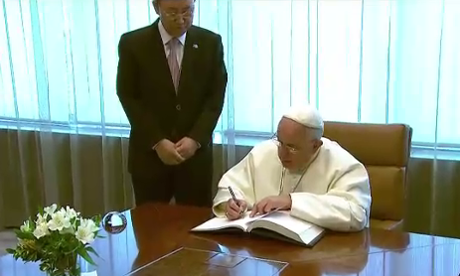
The pope arrives at the UN
Pope Francis has just rolled up to the UN headquarters in his Fiat, as crowds cheer from a distance. The pontiff steps out and greets UN secretary general Ban Ki-moon.
The pair head into the building to the chitter of camera shutters – they pose for some photos, but it’s not till two small children meet the pope that he seems to come alive. He smiles at the boy and girl, holds their hands and pats their heads.
Secretary-General of the UN Ban Ki-moon greets Pope Francis upon his arrival: http://t.co/JG90G9Uw0K pic.twitter.com/1NeVio9mMH
— ABC News (@ABC) September 25, 2015
Updated
On his arrival to New York yesterday a large crowd (including my colleague Jessica Glenza) was on hand to greet Pope Francis at the airport.
After being blessed by the pontiff, some of the people presented Francis with a miniature doll of himself as a gift.
Hello and welcome to the Guardian’s live coverage of the fourth day of Pope Francis’s visit to the United States, which will see him speak before the UN and in Central Park as he winds up his Friday in New York before heading to Philadelphia.
After meeting Barack Obama and delivering an emotionally and politically charged address to Congress in Washington DC, the pope flew to New York on Thursday to continue his tour of meetings with and remarks to what has been called the largest ever gathering of world leaders.
8.30am ET (12.30pm GMT): Pope Francis’s day will begin with an address to the United Nations General Assembly, in which he is expected to confront world leaders with calls to action on migration and climate change. The pope is expected to begin speaking at 10am ET (2pm GMT).
11.30am ET (3.30pm GMT): From midtown Manhattan the pontiff will travel down into the heart of the financial district to visit the 9/11 Memorial and participate in a multi-faith service. The pope will meet relatives of some of the victims of the September 11 terrorist attacks in New York.
4pm ET (8pm GMT): The pope visits Our Lady Queen of Angels School in East Harlem, where he will meet with elementary students of the mostly black and Latino parish school. He is also scheduled to meet with immigrants, mostly from from central and South America.
5pm ET (9pm GMT): Pope Francis will lead a procession through Central Park, where the secret service has erected a fence along the drive to help contain the thousands of people who won a ticket to enter the park and see the pontiff.
6pm (10pm GMT): The pope will hold mass at Madison Square Garden, where Jennifer Hudson, Gloria Estefan and a band of other celebrities will perform during the service.
Stay tuned for the speeches, services and all other live updates throughout the day.
Updated