Summary
It is Pope Francis’s penultimate day in Cuba before heading to the US for his first ever visit to the country. Francis is credited with playing a key role in the easing of relations between the two countries, though the US economic embargo against Cuba remains.
The pontiff will deliver a homily at a Santiago church tomorrow before heading to Washington DC.
Here are some of the highlights of his trip from today:
- Pope Francis arrived in Santiago, Cuba’s second-largest city, in the late-afternoon. He then traveled to El Cobre to pray with bishops. Tomorrow morning, he is due to give a homily at the village’s Our Lady of Charity church.
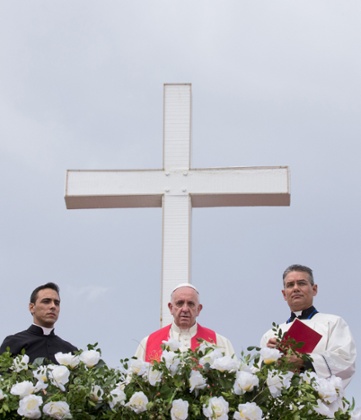
- He blessed the city of Holguín from Loma de la Cruz, a hill that is topped by a wooden cross. After the blessing, he and his entourage took the papal plane to Santiago, a short flight south.
- After giving a homily in Holguín‘s Revolutionary Square, Francis held an open mass for a crowd of hundreds of thousands of people who braved temperatures of 104 degrees fahrenheit.
-
Francis’s homily focused on a favorite theme of his, mercy. “May we learn to see them as Jesus sees us. Let us share his tenderness and mercy with the sick, prisoners, the elderly and families in difficulty. Again and again we are called to learn from Jesus, who always sees what is most authentic in every person, which is the image of his Father.”
Pope Francis is in the village of El Cobre, praying to Our Lady of Charity in the Minor Basilica of the Shrine of Our Lady of Charity. He will give a homily there tomorrow at morning mass.
Pope Francis, praying to Our Lady of Charity, also known as Our Lady of Copper. #PapaEnCuba. pic.twitter.com/4UPZPWj1FO
— Ines San Martin (@inesanma) September 22, 2015
#PapaEnCuba leaves a silver vase with his coat of arms and ceramic flowers at Shrine of Our Lady. pic.twitter.com/Fm2BWaCwP0
— Cindy Wooden (@Cindy_Wooden) September 22, 2015
Pope Francis travels to village of El Cobre in Santiago for a visit to Our Lady of the Charity.
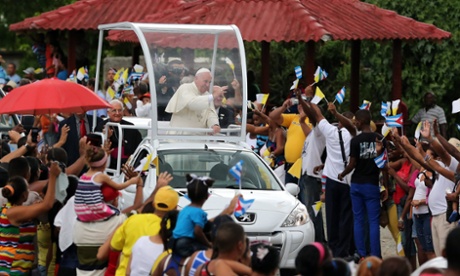
Updated
While the Pope refrained from making overtly political statements during his first few days in Cuba, his audience may not have seen it that way, says John L Allen, associate editor of the news site Crux.
This is especially true, Allen says, because as a leader of a global religion, the Pope’s actions are “unavoidably political.” More in his analysis on Crux:
When the pontiff invoked “change,” he seemed to have in mind primarily personal moral conversion. When he referred to a traitor, he was talking about the New Testament figure of Matthew, who was a tax collector for the Romans and thus considered a traitor to his own Jewish people.
In other words, this was not party rhetoric but basic homiletics.
Yet in the Cuban context, in which “change” is the watchword of everyone hoping for the island’s isolation and stagnation to end, and where generations have been raised to watch out for counter-revolutionary traitors, those terms still can’t help but have a political ring.
Video from Pope Francis’s open mass in Holguín earlier today. More than 100,000 people gathered for the mass at Revolutionary Square.
Updated
Francis is meeting with bishops in Santiago before a prayer at the Minor Basilica of the Shrine of Our Lady of Charity of El Cobre. Similar to today, he has a packed schedule for tomorrow, when he makes his first trip to the US.
He’ll begin Tuesday back at the Minor Basilica for mass, where he will deliver a homily. Then, he’ll deliver a speech and meet with families at the Cathedral of our Lady of Assumption.
The Pope and his entourage are due to leave Cuba around noon, heading to Andrews Air Force Base just outside of Washington DC. President Barack Obama is set to officially welcome him at the base, a rare gesture that has been extended to nearly no other world leader.
Scenes from the Pope’s blessing of Holguín from the Loma de la Cruz.
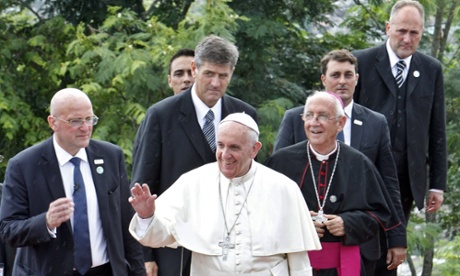
More from Angela Bruno, who spotted this piece by BBC Mundo Miami Editor Lilet Heredero, who was born and raised in Cuba. She shed light on what it was like to grow up in the atheist Cuba of the 80s – and what it was like to enter a new world full of religion once she left.
The whole story is in Spanish, here. Below, we’ve translated Heredero’s most revelatory memories.
A Very First Easter
“When I left Cuba and experienced by first Holy Week, it was then only that I realized how removed my life had been from religion. … My reality was very different than that of other Latin American countries.
I remember sitting with my friend under the spring London sun. She explained to me that during Easter, the resurrection of Christ was celebrated. … I didn’t have a clue.”
Praying to Che
“In school, we pledged allegiance to communism and our daily ‘prayer’ was dedicated to becoming just like Che. I don’t remember hearing about religion in any class. During that time, one of the most common catchphrases was Marx’s, ‘Religion is the opium of the people.’”
No Xmas, Just Revolution
“If you’re asking what happened during Christmas, I’ll tell you: We had a family dinner on the 24th and a party to await the 1st of January, known to us as the anniversary of the Revolution. No mention of Christ and no Christmas tree.”
Hidden Prayers
“The religious had to hide their beliefs if they didn’t want to lose their jobs or be expelled from the university. Some people had a very rough time – but that was never spoken of.”
Grandmothers and Saints
“My two grandmothers never went back to church. Before the revolution, they went to mass every Sunday. But the two of them always hid their saint medallions in their chests. My maternal grandmother wore a medallion for the Lady of Charity, Cuba’s patron saint. My paternal grandmother wore one for Saint Jude, because according to her, it made miracles happen.”
Goodbye to Godlessness
“When the Berlin wall fell, some of the winds of change could be felt in Cuba. … In the early ‘90s, the Communist Party admitted its first Catholic member.
During Cuba’s hard economic crisis, known as the Special Period, my grandmother returned to the church. She would come back home with canned meat, tuna and medicine.
Every Sunday, the lines for the church in my neighborhood grew longer … they were several blocks long.
In 1992, Cuba amended its constitution, leaving atheism behind and declared itself a secular state.”
Updated
Some insights in to what the Catholic clergy are up to while waiting for the Pope.
selfies have arrived in Cuba, btw pic.twitter.com/ldjVzVRSUv
— Rhina Guidos (@CNS_Rhina) September 21, 2015
Warming up the chair? pic.twitter.com/uxSfF7mXXE
— Rhina Guidos (@CNS_Rhina) September 21, 2015
Updated
Tomorrow, Francis heads to Washington DC, where he will become the first Pope to address Congress. The Capitol has put some measures in place in an attempt to deter politicians from overwhelming the pontiff with photo ops and handshakes.
David Hawkings wrote in Roll Call about how Congressional leadership is looking for lawmakers to line the aisles and promise not to go for a papal handshake:
All of them are on the same page about bending over backward to accommodate the Vatican’s expectations, which can summarized as “Look, but don’t touch,” lest Congress drive its record-low public approval even lower by coming across as collectively preening and boorish before a global television audience.
The first manifestation of that was last week’s “courtesy notice” delivered to all senators and House members, over the signatures of the top four leaders, offering this behavioral guidance: “Out of respect for the pope’s schedule and the expectation of a timely address, we respectfully request that you assist us by refraining from handshakes and conversations along and down the center aisle.”
But the bosses are assuming their ask is going to be ignored — by the most fervently faithful Catholic lawmakers, who won’t be able to risk trying to kiss the papal ring or touch the hem of his cassock, as well as by many of the most publicity-driven members, desperate to make it into the same TV frame as Francis and get photographed glad-handing or even hugging him.
The Pope’s visit has offered a platform to celebrate Cuban music, says my colleague Angela Bruno.
Yami Montoya, a Cuban journalist, said on Twitter: “Cuban rhythms, faith and culture are present in today’s in today’s holy celebration conducted by Pope Francis in Holguín”
Paloma Ovejero, correspondent for Spain’s COPE, captured musicians playing at this morning’s mass in Holguín.
The video prompted Twitter user José Sierra to remark on the Pontiff’s restraint: “How difficult it is not to dance or move, even just a little bit, while listening to this music!”
@pgovejero Qué dificilísimo es de no bailar o no moverse ni siquiera un poquito, al escuchar esta música. #PapaEnCuba #Holguín
— José Sierra ن (@Jose5ierra) September 21, 2015
Pero qué música!!! Pero qué Cuba esta!!! Toma Aleluya @cope_es #ElPapaenCuba pic.twitter.com/7Qi7RYY040
— Paloma Gª Ovejero (@pgovejero) September 21, 2015
Ovejero wrote: “What music! This country that is Cuba!”
Updated
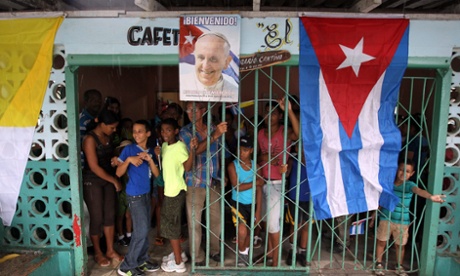
Catechism students and musicians are waiting for the Pope in Santiago, where he has just landed.
Un grupo de niños de la catequesis de la Caridad del Cobre se prepara para dar la bienvenida al @Pontifex_es mañana pic.twitter.com/SQhNt2Bi24
— Teresa de Miguel (@tdemiguel_AP) September 20, 2015
Los santiagueros esperan a ritmo de son al @Pontifex_es #PapaEnCuba pic.twitter.com/q5eFulxERU
— Teresa de Miguel (@tdemiguel_AP) September 21, 2015
In the above video from AP reporter Teresa de Miguel, the lead singer belts out, “How good it is to wait for the Pope, this town of Santiago is waiting for the Pope …”
Updated
Pope Francis arrives in Santiago
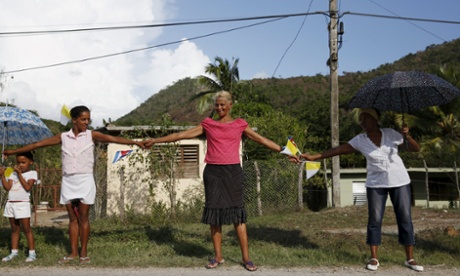
The papal plane has landed in Santiago, where it was met by cheering, flag-waving crowds.
Pope Francis will spend the evening meeting and praying with bishops.
Tomorrow morning, he is scheduled to deliver a homily and speech in Santiago, before flying to Washington DC in the afternoon for his first visit to the US.
Democratic presidential hopeful Martin O’Malley, the only Catholic running from that party (so far), wrote an editorial for National Catholic Reporter about the Pope’s visit to the US.
O’Malley agrees with Francis’s stance on climate change and economic inequality, issues that have been more difficult for the six Catholic Republicans running for president to discuss.
This, I believe, is why so many people — not only Catholics, but people of so many creeds and faiths, and those who profess to not have religious faith — are energized by Pope Francis’ message. He is a reformer, but one who creates change by “letting the light in” so all of us can see the truth and act upon that truth. As he works to heal wounds and divisions within his own church, he inspires millions of others: to embrace those who have been marginalized by poverty or discrimination; to act now to head off the devastation of climate change for the sake of our “common home,” this one earth; and to reach out and help those most in need.
What does the call of his message hold for us as citizens of the United States?
Pope Francis will undoubtedly challenge America with a question: At a time of growing inequality, entrenched poverty, and widespread uncertainty and unrest in the world, will we be a force for healing and reconciliation? Or, out of fear for ourselves and distrust of the unknown, will we turn our backs on the work of waging peace, as a moral leader among nations?
The live feed in Cuba shows that the Pope’s Alitalia jet has left from Holguín for Santiago, reports the Guardian’s Latin America correspondent Jonathan Watts, who is in Havana.
Soon, Pope Francis will pray at the Shrine of Our Lady of Charity of El Cobre, the patron saint of Cuba. To the country’s many Santería followers, this will look like him honoring their deity, Ochún.
A survey conducted earlier this year showed that about 13% of Cuba’s population practices Santería, the syncretic religion with ties to Catholic saints.
The Guardian’s Jonathan Watts reports from Havana:
Eduardo Marrero, a pensioner, wearing a green Santería bracelet said that he occasionally went to church, but that he sought help from Santería priests for specific problems, such as health issues, or wishes, including more wealth or a longer life. Once a year or so, he sacrifices a chicken to the saints. “I have faith in both. They complement one another,” he said.
Throughout history, the Catholic church has had a somewhat awkward relationship with such syncretic religions. At times, priests have described them as the work of the devil. Today, however, they are more tolerant, partly because congregations would probably fall dramatically if Santería followers were excluded.
“There have been worried about this, but I don’t think syncretism damages the church. It’s not prohibited,” said Cirilo Castro, a priest. “When people come on Sundays, some are devout, some are pragmatic and some are Santería believers. But they all take their place and they are all respectful.”
The scene from Santiago hours before the Pope arrives:
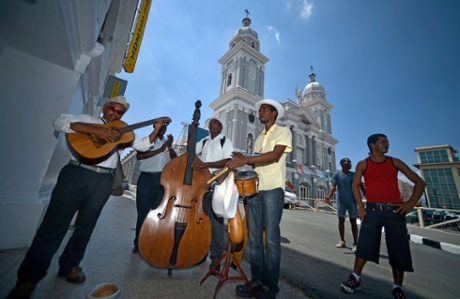
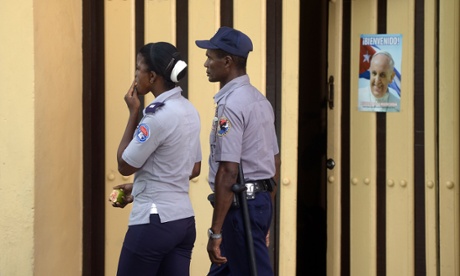
After a few minutes on Loma de la Cruz, the Pope headed back down the hill to the Holguín airport, where he will take a short trip south to Santiago, Cuba’s second largest city.
There, he will meet with bishops before holding a prayer with them and his entourage at the Minor Basilica of the Shrine of Our Lady of Charity of El Cobre.
Boarding for Santiago. #PapaEnCuba pic.twitter.com/W53YMzQNUW
— Cindy Wooden (@Cindy_Wooden) September 21, 2015
Pope Francis is near the summit of Loma de la Cruz (Cross Hill), where he is preparing to bless the city of Holguín. A children’s choir sang Ode to Joy just before the ceremony began.
.@Pontifex about to offer solemn blessing over entire city of Holguin, Cuba. #PapaEnCuba pic.twitter.com/aNb4HHqOFR
— Joshua McElwee (@joshjmac) September 21, 2015
Pope Francis to the chorus of children: You sing very well. And please, don't forget, pray for me! #PapaEnCuba pic.twitter.com/b2KHxD9cDx
— Ines San Martin (@inesanma) September 21, 2015
In less than an hour, Pope Francis will bless the city of Holguín from Loma de la Cruz, a hill that is topped by a wooden cross. The city is on the eastern part of the island and it is the first time it has hosted a Pope.
He delivered a homily at a mass at the city’s Plaza de la Revolución earlier today:
I know the efforts and the sacrifices being made by the Church in Cuba to bring Christ’s word and presence to all, even in the most remote areas. Here I would mention especially the “mission houses” which, given the shortage of churches and priests, provide for many people a place for prayer, for listening to the word of God, for catechesis and community life. They are small signs of God’s presence in our neighborhoods and a daily aid in our effort to respond to the plea of the apostle Paul: “I beg you to lead a life worthy of the calling to which you have been called, with all lowliness and meekness, forbearing one another in love, eager to maintain the unity of the Spirit in the bond of peace” (cf. Eph 4:1-3).
I now turn my eyes to the Virgin Mary, Our Lady of Charity of El Cobre, whom Cuba embraced and to whom it opened its doors forever. I ask Our Lady to look with maternal love on all her children in this noble country. May her “eyes of mercy” ever keep watch over each of you, your homes, your families, and all those who feel that they have no place. In her love, may she protect us all as she once cared for Jesus.
More from my colleague Angela Bruno.
Anti-Castro activists have been sharing this image on Twitter, showing what appears to be the arrest of members of the Ladies in White – an opposition group campaigning for the release of detained relatives.
The quote bubble above the Pope’s head reads, “Everything’s good, General Castro.”
RT @KarelBecerra: Visita del #PapaEnCuba #Cuba #PopeinUS #PopeFrancis pic.twitter.com/9BEJB2pvBk
— #Cuba MartaLopez (@aircag) September 21, 2015
Numerous pro-democracy activists have been detained by Cuban security forces and prevented from attending the Pope’s events over the last two days, including 22 of the 24 members of the Ladies in White.
It is not clear when this picture was taken, but it is in sharp contrast to the whimsical Pope emojis and Pope paraphernalia that have emerged stateside.
This kind of criticism runs through an opinion piece by Guardian contributor Alfredo José Estrada, who says that Cubans – and especially Cuban Americans – want the pope to hold the Castros accountable:
Conservative Cuban Americans gave stink-eye to the pope’s active involvement in negotiations between Obama and Castro. He not only sent each of them a personal letter of encouragement, but also hosted secret meetings within the walls of the Vatican. Having put his credibility on the line, he also has much riding on the success of the trip.
This includes efforts to increase the influence of the Church in Cuba. Much has changed since John Paul’s visit – Christmas and Good Friday are once again national holidays. Cuba remains the most restrictive place in Latin America for Catholics: for instance, the Church is not allowed to operate elementary and secondary schools. Francis would also like to obtain the return of confiscated church properties, such as Belen, the Jesuit high school where Fidel Castro was educated.
His religious efforts, too, get mixed reviews from Cuban Americans, who accuse the Church of accommodating a corrupt regime in service of its aims. Cuban Archbishop Jaime Ortega (who also welcomed John Paul and Benedict to Cuba) has been criticized for cozying up to the Castros and ignoring the plight of dissidents. Equally troubling to my parents is Raul’s unusually close relationship with the pope, which has encompassed multiple meetings between the two. In the early years of the Revolution, by contrast, Raul was his brother’s enforcer, an unflinching Marxist ideologue; recently he has become more pragmatic, and after meeting with the Pope said he might even rejoin the faith. Many Cuban exiles regard him as a war criminal and mass murderer.
In Philadelphia, where the Pope is due for a visit on Saturday and Sunday, residents are being warned about how Francis’s trip will affect their ability to buy liquor and send mail.
Guardian US deputy sports editor Bryan Graham, a native Philadelphian, captured some of the preparation this past weekend.
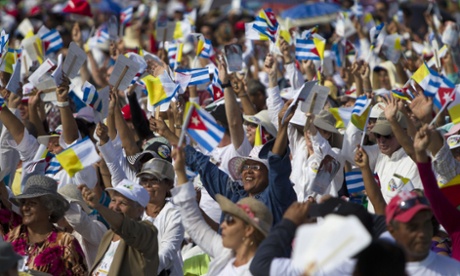
As Pope Francis prepares to travel from the Cuba to the US, the AP is reporting that his work to ease relations between the two countries could show in a vote at the United Nations General Assembly next month.
When the annual UN vote to demand an end to the US economic embargo against Cuba comes up, the US may divert from tradition and abstain from the vote, according to the AP.
The US typically votes against the resolution, but the AP said that the Obama administration may abstain instead. Diplomatic ties between the two countries were formally restored in July and Francis is credited with playing a key role in the rapprochement. The AP reports:
The United States has lost the votes by increasingly overwhelming and embarrassing margins. Last year’s tally was 188-2 with only Israel siding with the U.S. Israel would be expected to vote whichever way the U.S. decides.
The American officials said that the U.S. is still more likely to vote against the resolution than abstain. However, they said the U.S. will consider abstaining if the wording of the resolution significantly differs from previous years. The administration is open to discussing revisions with the Cubans and others, they added, something American diplomats have never done before.
Updated
The Holy See has released a short message from the Pope to the city of Philadelphia, where he will lead a mass for the World Meeting of Families.
“I will be there because you will be there,” Francis says in English. “See you in Philadelphia.”
Updated
The Vatican flag will be raised at the United Nations for the first time on Friday.
Member states adopted a resolution to allow flags from the Vatican and Palestine to be flown at the New York building. Their flags have not been raised at the UN because the regions have non-member observer status and are not considered member states.
Francis is scheduled to address the UN on Friday, but the Holy See insisted that it did not push for the flag to be raised. The move was celebrated by many Palestinians, however. More from AFP:
“The Holy See and the United Nations secretariat have agreed that the flag will be raised with no ceremony” on Friday, said Achbishop Bernadito Auza, the Vatican’s UN ambassador.
“UN personnel will raise it at the same time they will raise the other flags that day,” he told reporters.
For their part, the Palestinians have invited hundreds of leaders to attend a formal flag-raising ceremony on September 30 in the presence of Palestinian president Mahmud Abbas.
Palestinian envoy Riyad Mansour said the flag-raising will be a “glorious day” for the Palestinians who won backing from 119 countries in favor of the resolution.
The Guardian’s Alan Yuhas spoke with the archbishop of Philadelphia ahead of the Pope’s visit to the city on Saturday.
Archbishop Charles Chaput said that while Francis’s style and tone are different from Popes of the past, the content of his message is in line with earlier papal messages. More from the interview:
“His vocabulary and emphases are different, like his personal style of leadership,” Chaput said. “But that doesn’t mean a change in content. People risk being very disappointed if they imagine it does.”
Chaput is no stranger to the culture wars – he is an outspoken proponent of immigration reform and a critic of abortion – he also repeated a criticism of Barack Obama’s administration that he made earlier this year: “the current White House is the least friendly to religious freedom in our history.”
In fact, Chaput appears in public to be diametrically opposed to Pope Francis in many ways. In 2013 Francis said that church’s leadership should spend less time harping on controversial issues, saying they should devote greater attentions to the poor and “cannot be obsessed with the transmission of a disjointed multitude of doctrines to be imposed insistently”.
Chaput told the Guardian the church had never lost sight of the poor and insisted on the importance of such issues: “If there’s an ‘obsession’ in the way we do our work, it’s not an obsession with sex. That problem belongs to the media and the general culture.”
People in Philadelphia, the third and final city Pope Francis will visit during his US tour this week, are capturing some astounding images of what $1.2 million-worth of portable toilets looks like, writes my colleague Angela Bruno.
Papal porta-potties spanning Walnut and Chestnut Street bridges @iPhillyChitChat . Good to know where to go! pic.twitter.com/8id51QL5dh
— uTobia (@MikeUtobia) September 20, 2015
According to Philadelphia Archbishop Charles Chaput, that will be the expected cost of the 3,000 potties being set up in anticipation of the millions who will descend upon the city. More than 1.5 million people are expected to attend Sunday’s Papal Mass on Benjamin Franklin Parkway.
A plethora of Papal porta-potties proliferate on the promenades of Philadelphia. #popeocalypse pic.twitter.com/cyfZYHK0Gu
— Margaret C. Sullivan (@mcsullivan) September 21, 2015
Meanwhile in Cuba, the amenities are somewhat more basic:
Updated
Hello, this is Amanda Holpuch in New York taking over the live blog before the Pope travels to Cuba’s second-largest city, Santiago de Cuba.
He will bless the city of Holguín later this afternoon, then board the papal plane.
In Santiago de Cuba, he plans to meet with bishops from the Seminary of St Basil the Great and lead a prayer – the final scheduled event for the night.
I’m going to hand you over now to my colleague Amanda Holpuch, who will continue our live coverage as Pope Francis heads to Santiago de Cuba this evening.
Stay tuned.
In an editorial published today, the National Catholic Reporter called on Pope Francis to speak out against nuclear weapons and nuclear war on his 10-day trip to Cuba and the US:
These are grave threats to humanity and ones our nation plays a huge role in perpetuating. Sadly, the humanitarian threats posed by nuclear weapons -- and we are going forward fast to build more -- get almost no U.S. media coverage. Out of sight, out of mind. This is how our policymakers like it.
Francis can change this.
He spoke eloquently on the subject of nuclear weapons in a letter read on his behalf at the Vienna Conference on the Humanitarian Impact of Nuclear Weapons last December. He called for ridding the planet of these weapons, speaking about their enormous financial and humanitarian costs.
You can read the whole editorial here.
This is a great view of the dais from which Pope Francis officiated mass earlier today.
#PopeinCuba: Mass in Holguin, Cuba pic.twitter.com/hhOnoqeDtg (foto via @oss_romano) #PapaEnCuba #PapaFranciscoEnCuba
— VudatNation (@VudatNation) September 21, 2015
“While Presidents Obama and Castro are treating Pope Francis’s first visit to Cuba like a diplomatic reaffirmation of US-Cuba ties, Cuban Americans see it quite differently than a chess move on the world stage. For us, it’s personal,” Cuban-American writer Alfredo José Estrada says, in a comment piece arguing that Pope Francis’ failure to chide the Cuban regime makes his visit “an empty symbol.”
While nearly 3,500 prisoners were released in honor of the pope’s visit, these were not political prisoners. Indeed, Cuba’s official position is that it has no political prisoners. But just last week, Cuban police detained 50 members of the predominantly Catholic dissident group Ladies in White.
You can read the whole piece here.
Pope Francis may be speaking to adulatory crowds in Cuba, but in New York, groups representing children abused by Catholic priests are preparing for his visit.
Today, representatives from three organizations held a press conference at the United Nations, urging the Vatican to take concrete steps to address sexual assault and its cover-up in the Catholic Church.
The Survivors Network of those Abused by Priests (SNAP) said:
Francis often talks of mercy. He’s right to do so. But hundreds of thousands of innocent boys and girls have been raped by priests, nuns, bishops, and seminarians because of excessive mercy shown to criminal clerics by their complicit colleagues. Mercy won’t protect children from child-molesting clergy.”
BishopAccountability.org, an archival and research group that gathers documents and data about the global crisis of sexual abuse of children within the Roman Catholic Church, said in a statement:
The catastrophe of child sex abuse abuse in the Catholic church has not been resolved, and an especially alarming aspect of it has been revealed recently: Priests who have been kicked out of U.S. dioceses because of child sex abuse allegations are thriving today in church assignments in South America and the Philippines, according to our global research as well as a new investigation by GlobalPost.
We urge Pope Francis to mark his first visit to the United States by announcing an end to this terrible situation.”
The Center for Constitutional Rights is a legal and advocacy human rights organization that has represented SNAP at the International Criminal Court in The Hague and the United Nations in Geneva. They issued the following statement:
Pope Francis’s public statements about the Vatican’s concern for children and other survivors of sexual assault by priests are at odds with the Vatican’s actions under his leadership. This week, amidst discussions of climate change at the United Nations General Assembly and elsewhere, he should explain the Vatican’s formal submissions to the UN committees that called them to account last spring.
To the Committee on the Rights of the Child and the Committee Against Torture, they made the preposterous claim they were only responsible for what happens inside the .44 square kilometer of Vatican City and have no responsibility for what happens outside its walls.
Worse, his representatives told the Committee Against Torture that rape and sexual assault by priests do not amount to torture or cruel, inhuman, or degrading treatment and refused to provide both committees with the information they had requested—once again minimizing the damage the church has caused and denying the severity of the physical and mental harm survivors live with every day.
If Francis wants to truly bring change to the church, he must ensure the Vatican complies with the United Nations requests and recommendations, increase transparency when dealing with these crimes, and order all cases and reports turned over to local civil authorities for independent investigation.
A Guardian report from last week highlighted how the shadow of sexual abuse may loom over the Pope’s visit to the us.
Updated
My colleague Angela Bruno has this report on the scorching, “insufferable” 104-degree heat in Revolutionary Plaza in Holguín, where Pope Francis just officiated mass.
As priests passed around the communion wafers, many in the crowd sheltered from the intense sun under brightly-coloured sun-umbrellas.
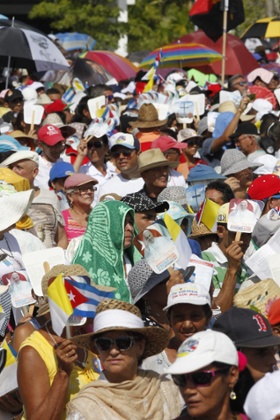
Associated Press correspondent Christine Armario captures another sweltering moment. Armario notes that some spectators chose to leave after the Pope made his way to the stage in Holguín, opting to watch the service from their homes instead.
La Nacion (Italy) correspondent Elisabetta Piqué notes that only a parasol makes it possible to withstand the “stifling” heat while “on the front lines” with another reporter.
Solo con paraguas se aguanta el calor bochornoso... Misa #Papa #Holguin aquí al pie del cañon junto a @pgovejero pic.twitter.com/YdHWUac4Du
— Elisabetta Piqué (@bettapique) September 21, 2015
Another correspondent captures the crowds in Holguín, saying some have even “fainted” as a result of the humid and “insufferable” heat.
Calor húmedo e insoportable en misa de @Pontifex en Holguin, varios desmayados pic.twitter.com/cqx2AIzPVP
— Andrés Beltramo A. (@sacroprofano) September 21, 2015
Some facts about Roman Catholicism in Cuba from Ines San Martin, the Vatican Correspondent for cruxnow.com.
Church numbers in Cuba: 60% of 11 mil. pop is catholic, only 5 attends Mass. There are 650 parishes, 357 priests, and 2300 mission homes
— Ines San Martin (@inesanma) September 21, 2015
The Washington Post has a lovely illustrated history of the popemobile, including Pope Pius XI’s 1930 Mercedes-Benz Nürburg, Pope Paul VI’s 1964 Lincoln Continental, and Pope John Paul II’s 1988 Ferrari Mondial.
An illustrated history of popemobiles, from horse-drawn carriages to bulletproof 'pope boxes' http://t.co/H1QyZ1KLvn pic.twitter.com/o0vz7rgpG6
— Post Graphics (@PostGraphics) September 21, 2015
Updated
More from my colleague Angela Bruno on Cuba’s detention of dissidents and activists during the papal visit:
Madrid-based El Diario de Cuba spoke with Martha Beatriz Roque, one of the dissident activists detained Sunday on her way to Havana’s Cathedral to greet the pope. Roque said she was stopped even though she had been invited by the Vatican’s diplomatic mission.
In her interview (published in Spanish), Roque says she was detained twice while trying to see the Pope, first on Saturday night, when she was arrested by agents of the Department of State Security and prevented from reaching the Vatican’s diplomatic mission in Havana.
The Vatican said that no official meeting had been planned with the dissidents.
The Papal nunciate in Havana did make calls to some leaders “as a sign of attention to these people,” according to Vatican spokesman Rev. Federico Lombardi.
Lombardi added that some dissidents were invited to events to receive a greeting from the pope, but that he didn’t know why the greeting didn’t take place.
According to Roque, while on her way to the Cathedral on Sunday, her taxi was pulled over by agents of the Department of State Security.
She tweeted about the incident yesterday, saying: “I was violently arrested to stop me reaching the Cathedral invited by Pope Francisco”
#Cuba fui arrestada con violencia impedir llegara Catedral invitada x Papa Francisco
— Martha Beatriz Roque (@marthabroque) September 20, 2015
“I had not even paid the taxi driver when one of the agents violently took me by the arm and dragged me out,” Roque told El Diario. “I asked him to identify himself and told him he had no right to touch me.”
She was then taken to a police station and detained for the afternoon. While detained, security agents told her that “not even with the proper credentials would she have been allowed to enter the cathedral” and that if she had any messages for the Pope, she would “first have to communicate it to State Security and they would be in charge of passing it along.”
Roque does indeed have a message for the Pope – and a strong one:
If the Vatican is truly interested in us seeing the Pope, they will have to come and find us and put us in front of the Holy Father—because if he tries to come to my house, I’m sure they’ll arrest him, too.”
Up next this afternoon:
- At 3:45PM eastern time (8:45PM GMT) the Pope will bless the city of Holguín from Cross Hill (Loma de la Cruz).
- After that, at 4:40PM eastern time (9:40PM GMT) the papal plane will take off for Santiago de Cuba, Cuba’s second-largest city, a flight that will take just more than an hour.
- After his arrival he will meet with bishops from the Seminary of St. Basil the Great, then at 7:45PM eastern time (12:45AM GMT) he will lead a prayer to Our Lady of Charity with bishops and the papal entourage.
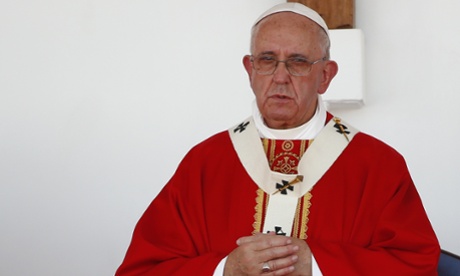
One day before Pope Francis makes his first trip to the US, America magazine - a Catholic publication - has released an interview with Joe Biden, who is the first Roman Catholic to serve as vice president, and is reported to be mulling a 2016 presidential run that would pit him against Hillary Clinton and Bernie Sanders for the Democratic nomination. Stephanie Kirchgaessner in Rome has this report:
In the interview, Biden expressed his excitement about Pope Francis’s papacy, calling the pope ‘the embodiment of the Catholic social doctrine that I was raised with, the idea that everyone is entitled to dignity, that the poor should be given special preference, that you have an obligation to reach out and be inclusive.’
He was also asked about whether it was difficult to be at odds with the leadership of the church on issues like abortion. The church sees the procedure as a grave sin, while Biden supports abortion rights.
‘It has been, it has been hard in one sense, because I’m prepared to accept de fide doctrine on a whole range of issues as a Catholic… I’m prepared to accept as a matter of faith, my wife and I, my family, [the Church’s teaching on] the issue of abortion,’ but, Mr. Biden added, he is not prepared to ‘impose’ what he considers ‘a precise view, that is born out of my faith, on other people.’
He was asked whether there was a home for pro-life Americans in the Democratic party, which is generally seen as a party that supports women’s reproductive rights and choices.
‘Absolutely. Absolutely, positively. And that’s been my position as long as I’ve been engaged.’
The comment was well received by Christopher Hale, the executive director of Catholics in Alliance for the Common Good, a Catholic social justice organization that supports charity for the poor and is opposed to abortion. According to its website, the group seeks to ban all abortions after 20 weeks of pregnancy.
Hale said in response to the Biden interview:
‘The Vice President is absolutely right: people who are pro-life should be welcomed in the Democratic Party. At the heart of the progressive movement is radical inclusion. A party that fails to welcome pro-life individuals doesn’t live up to this important ideal. A Democratic Party that is more open to members of the pro-life movement is a party with a brighter future.’”
The full version of the America interview is available at http://papalvisit.americamedia.org and at http://youtube.com/c/AmericaMedia
Pope Francis has finished mass in Holguín’s Revolutionary Square
He ended by presenting a ceremonial chalice to Bishop Aranguren of Holguín, per reports.
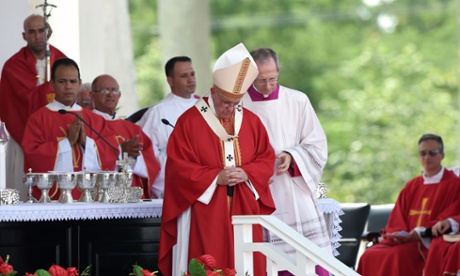
Security agents didn’t appear to be letting members of the crowd get close to the Pope in Holguín’s Revolutionary Square this morning, reports the Associated Press. On Sunday, an apparent dissident hung on to the popemobile and appeared to be appealing to the pope before the man was dragged away.
The head of the opposition group Ladies in White said 22 of 24 members who wanted to attend Francis’ Mass on Sunday were prevented from going by Cuban security agents. And two well-known Cuban dissidents said agents detained them after the Vatican invited them to the pope’s vespers service at Havana’s cathedral.
The Vatican spokesman, the Rev. Federico Lombardi, confirmed that some dissidents were invited to events to receive a greeting from the pope but that he didn’t know why the greeting didn’t occur.
Asked if the Holy See would lodge an official protest, Lombardi demurred. He stressed that it was a “passing greeting,” not an official meeting, and that it was set up out of a “desire to show an attention for everyone, including dissidents.”
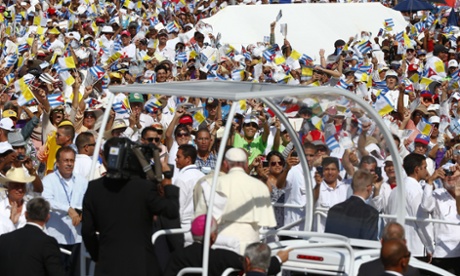
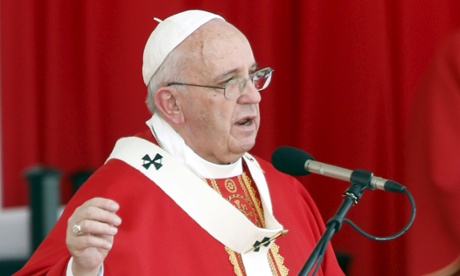
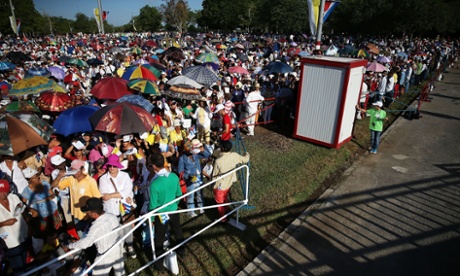
As priests pass around the communion wafers, many in the crowd shelter from the intense sun under brightly-coloured sun-umbrellas.
With humidity, it is a scorching 104 degrees Farenheit in Holguín today.
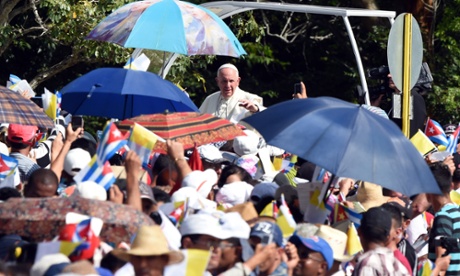
My colleague Angela Bruno writes:
Associated Press reporter Christine Armario is on the ground with the Cuban pueblo. In these Instagram posts, she meets Berta Luísa Fernández in Holguín.
Berta tells the a familiar story for many Cubans: that of separation from family members in the US – who she’s only seen twice in the last 40 years.
The good news: Today she will be reunited with her cousin from Miami, who, after a 14-hour drive from Havana to Holguín, has arrived in time for Pope Francis’ mass.
Berta says, “ I waited for them with a lot of love … and everything has turned out well.”
The assembled crowd is now partaking in communion.
Today marks a special day for Pope Francis, according to the Associated Press: the anniversary of the day he decided, as a teenager, to become a priest.
On Sept. 21, 1953, when Jorge Mario Bergoglio was 17, he went to confession at his parish church in the Flores neighborhood of Buenos Aires. During his confession, he later wrote, he “realized God was waiting for me” and decided to enter the priesthood.
Bergoglio wouldn’t enter the seminary for several more years, but Sept. 21 the feast of St. Matthew has remained a crucial reference point for the pope. His motto Miserando atque eligendo (Having had mercy, he called him) is inspired by the feast day.
Pope Francis holds mass in Revolutionary Square
After giving a homily on one of his favoured topics, mercy, on the Feast of St. Matthew, Pope Francis performs mass in front of a crowd of hundreds of thousands.
Biggest crowd yet in Cuba, at Holguin, for Pope's mass Sept 21 pic.twitter.com/1KXcogldPT
— Gerard O'Connell (@gerryorome) September 21, 2015
Some more interesting analysis and context from Ivereigh, as Pope Francis finishes his homily in Holguín.
I went to a Mission House in a Havana parish the other night: there are 120 of them in that parish alone, each of 15-20 people.
— Austen Ivereigh (@austeni) September 21, 2015
Pope in Holguin notes how Casas Misión provide place of prayer and catechesis in absence of churches and priests.
— Austen Ivereigh (@austeni) September 21, 2015
(There are fewer than 400 priests for the whole island of 11m people. Only one new church built since Revolution.)
— Austen Ivereigh (@austeni) September 21, 2015
Updated
“Let us gaze upon the Lord in prayer, in the Eucharist, in Confession, in our brothers and sisters, especially those who feel excluded or abandoned,” Pope Francis continues.
“May we learn to see them as Jesus sees us. Let us share his tenderness and mercy with the sick, prisoners, the elderly and families in difficulty. Again and again we are called to learn from Jesus, who always sees what is most authentic in every person, which is the image of his Father. “
I know the efforts and the sacrifices being made by the Church in Cuba to bring Christ’s word and presence to all, even in the most remote areas. Here I would mention especially the “mission houses” which, given the shortage of churches and priests, provide for many people a place for prayer, for listening to the word of God, for catechesis and community life.
They are small signs of God’s presence in our neighborhoods and a daily aid in our effort to respond to the plea of the apostle Paul: “I beg you to lead a life worthy of the calling to which you have been called, with all lowliness and meekness, forbearing one another in love, eager to maintain the unity of the Spirit in the bond of peace”
Now, the Pope begins to construct the political message of the address from the story of Matthew.
After the look, a word.
After love, the mission.
Matthew is no longer the same; he is changed inside. The encounter with Jesus and his loving mercy has transformed him.
He leaves behind his table, his money, his exclusion. Before, he had sat waiting to collect his taxes, to take from others; now, with Jesus he must get up and give, give himself to others. Jesus looks at him and Matthew encounters the joy of service.
For Matthew and for all who have felt the gaze of Jesus, other people are no longer to be “lived off”, used and abused. The gaze of Jesus gives rise to missionary activity, service, self-giving.
Pope Francis continues his homily:
After the Lord looked upon him with mercy, he said to Matthew: “Follow me.” Matthew got up and followed him. After the look, a word. After love, the mission. Matthew is no longer the same; he is changed inside. The encounter with Jesus and his loving mercy has transformed him. He leaves behind his table, his money, his exclusion.
Before, he had sat waiting to collect his taxes, to take from others; now, with Jesus he must get up and give, give himself to others. Jesus looks at him and Matthew encounters the joy of service. For Matthew and for all who have felt the gaze of Jesus, other people are no longer to be “lived off”, used and abused.
The gaze of Jesus gives rise to missionary activity, service, self-giving. Jesus’ love heals our short-sightedness and pushes us to look beyond, not to be satisfied with appearances or with what is politically correct.
“We are celebrating the feast of the apostle and evangelist Saint Matthew,” Pope Francis begins. “We are celebrating the story of a conversion. Matthew himself, in his Gospel, tell us what it was like, this encounter which changed his life. He shows us an ‘exchange of glances’ capable of changing history.”
The Feast of St. Matthew gives Pope Francis the opportunity to expound on one of his favourite themes in this homily: mercy.
In this case, Jesus’ mercy for Matthew, the tax-collector.
“We know that Matthew was a publican: he collected taxes from the Jews to give to the Romans. Publicans were looked down upon and considered sinners; as such, they lived apart and were despised by others,” Francis continues.
Jesus, on the other hand, stopped; he did not quickly take his distance. He looked at Matthew calmly, peacefully. He looked at him with eyes of mercy; he looked at him as no one had ever looked at him before. And this look unlocked Matthew’s heart; it set him free, it healed him, it gave him hope, a new life, as it did to Zacchaeus, to Bartimaeus, to Mary Magdalen, to Peter, and to each of us.
Papal Mass in Holguin, Cuba #ThePope pic.twitter.com/OYuCARZsph
— Trisha Thomas (@TrishaThomasAP) September 21, 2015
A fascinating historical tidbit from Pope Francis’ biographer Austen Ivereigh, who says that today, the day of the Feast of St. Matthew, has special meaning for the pontiff.
Mass in Holguín begins. Feast of St Matthew whose conversion always inspired @Pontifex. His papal motto is from today's Office of Readings.
— Austen Ivereigh (@austeni) September 21, 2015
The pope was welcomed at the airport by Holguin’s Bishop Emilio Aranguren and the Cuban government’s number two official, Miguel Diaz-Canel, reports the Associated Press, as a large crowd shouted, “Francis our friend, the people are with you!”
Holguín is known for a cross that has overlooked the city from a hilltop since a Franciscan monk hauled it up there in 1790 - though the original wooden version succumbed to old age and the 1950 replacement was destroyed by lightning.
Now made of concrete, the five-meter (16-foot) landmark has endured through centuries of hurricanes and years of tensions between the Church and the communist regime, which was officially atheist for more than three decades until 1992.
Some 150,000 people are expected.
“We came to see him because we love him so much for all he has done for peace and for Cuba,” said Norales Mendoze, a 45-year-old security guard from the city of Guantanamo who made the nine-hour bus trip to Holguín with hundreds of other faithful.
“Francisco is the missionary who will now go to the United States and wants to unite our two peoples,” said Carlos Berejano from the neighboring province of Granma.
After mass the pope will visit the hilltop cross to bless the city of 291,000 inhabitants, Cuba’s fourth-largest.
According to legend, locals first saw a statue of Cuba’s patron saint, Our Lady of Charity of El Cobre, floating in the Holguin bay in 1612 after a storm.
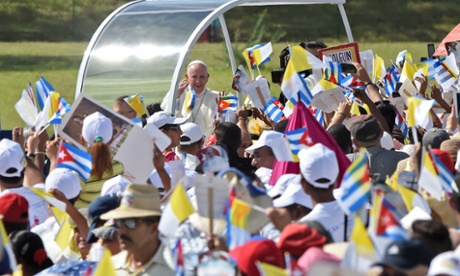
Pope Francis is currently being introduced.
Presenter at Mass in Communist Cuba explaining Francis' apostolic exhortation "The Joy of the Gospel." Interesting times... #PapaEnCuba
— Joshua McElwee (@joshjmac) September 21, 2015
Playing a starring role in #PapaEnCuba is Our Lady of Charity of El Cobre. A copy present for Mass in Holguin. pic.twitter.com/6k5Yhnhqyw
— Cindy Wooden (@Cindy_Wooden) September 21, 2015
This is the dais in Revolutionary Plaza from which Pope Francis will give his homily in just a few moments.
El #PapaFrancisco recordará hoy en Holguín la figura del Apóstol y Evangelista, San Mateo. #ElPapaEnCuba pic.twitter.com/Z3rbqtUZPP
— Radio Rebelde (@radiorebeldeweb) September 21, 2015
Pope Francis is arriving now.
.@Pontifex weaving into Holguin's Revolution Square for Mass... #PapaEnCuba pic.twitter.com/dKW2omBuEb
— Joshua McElwee (@joshjmac) September 21, 2015
#ThePope kisses a child as he arrives at Mass in Holguin Cuba pic.twitter.com/COV6vg1Lih
— Trisha Thomas (@TrishaThomasAP) September 21, 2015
#PopeFrancis in his element among the poor on the periphery in Holguin Cuba pic.twitter.com/7wcprnBwlH
— Trisha Thomas (@TrishaThomasAP) September 21, 2015
Among the world leaders visiting Cuba for the papal visit is Argentina’s President Cristina Fernández de Kirchner, who attended yesterday’s mass in Havana’s Plaza de la Revolución writes Angela Bruno.
#LaFoto | Presidenta Cristina Fernández durante Santa Misa oficiada por el papa Francisco en La Habana #ElPapaEnCuba pic.twitter.com/bOuLKajRNN
— teleSUR TV (@teleSURtv) September 20, 2015
Some Twitter users have raised their eyebrows at la presidenta’s expensive tastes – she arrived at Havana’s José Martí Airport on Saturday sporting a Hermès bag which can cost up to $22,000. Guardian correspondent Jonathan Watts also spotted her driving away in a Jaguar.
Such displays of wealth seem somewhat at odds with the Pope’s message: he has repeatedly criticised excessive consumption, warning in his homily last night that “wealth impoverishes us.”
Para @KarelBecerra @CFKArgentina se bajó del avión en Cuba con una cartera Hermes de 22000 dólares. Super Nac&Pop pic.twitter.com/94m17mwl2m
— Soy Diseniador (@soydiseniador) September 19, 2015
The Pope and Kirchner have had their share of differences. Guardian correspondent Stephanie Kirchgaessner spoke to their once-rocky relationship in her coverage of the Pope’s trip to Latin America during the summer:
There was bad blood between them when Francis was still known as Father Jorge Bergoglio, archbishop of Buenos Aires and a fierce critic of corruption in Argentinian politics.
The icy relationship worsened after Fernández passed a law legalising same-sex marriage in Argentina in 2010 when Bergoglio headed a march against the gay marriage bill.
‘Pity there is no ‘popess’; if not, I could compete for the post,’ Fernández said when she heard that Bergoglio had become pope.
Since then, however, the two have managed to improve their relationship: Relations have seemingly warmed and Fernández has become a frequent visitor at the Vatican.
“Francisco! Francisco! Francisco!” chant the assembled crowd, as they are serenaded with music from a live band in Revolutionary Square.
Pope Francis is slowly making his way through Holguin, stopping to greet children and members of the assembled crowd. Mass is scheduled to start in 20 minutes.
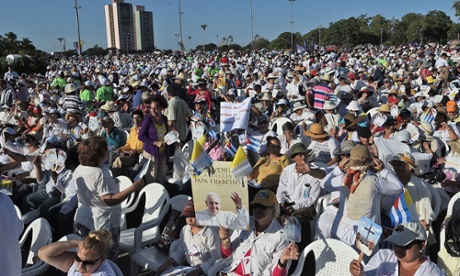
A great shot from the Associated Press’ Trisha Thomas of the crowd awaiting the Pope in Holguín.
Crowd in Holguin #Cuba waiting for #ThePope pic.twitter.com/YOMZ4Bm2IM
— Trisha Thomas (@TrishaThomasAP) September 21, 2015
Updated
The Pope is now touring the city of Holguin in the popemobile.
.@Pontifex now in @the_popemobile, touring east Cuban city of Holguin. People lining with flags. Incredible.
— Joshua McElwee (@joshjmac) September 21, 2015
An interesting preview of the pope’s visit to the US - the Vatican flag will be raised at the UN for the first time, according to the National Catholic Reporter’s Vatican correspondent.
#Vatican: Holy See flag to be raised at @un for 1st time Sept. 25 "with no ceremony." #PopeinUS
— Joshua McElwee (@joshjmac) September 21, 2015
Journalists travelling with the Pope are boarding the transport that will take them to Holguín’s Revolutionary Plaza.
Our transport to Holguin Mass is literally under the plane. #PapaEnCuba pic.twitter.com/AAyftk3lWz
— Cindy Wooden (@Cindy_Wooden) September 21, 2015
Updated
Some video of the pope’s arrival in Holguin.
| @inter_pl | El #PapaFrancisco desciende del avión que lo llevó a Holguín. En vivo ► http://t.co/5SaPdW5VfX pic.twitter.com/4v9PbgFOCb
— Prensa Libre (@prensa_libre) September 21, 2015
Translation: “Pope Francis descends from the aircraft that brought him to Holguin.”
Correspondents prepare to exit the plane with Pope Francis.
Landed in Holguin with #PapaEnCuba pic.twitter.com/Iz1EI7x73j
— Cindy Wooden (@Cindy_Wooden) September 21, 2015
In the last few minutes the papal plane has touched down at Holguín's Frank Pais international airport.
Pope Francis is the first pontiff to visit Holguín - the province where Fidel and Raul Castro grew up, Reuters reports.
Updated
This is Holguín’s Plaza de la Revolution, where Pope Francis is due to hold a mass at 10:30AM eastern time (3:30PM GMT) near the mausoleum of the famous Cuban revolutionary Major General Calixto Garcia..
Thousands have already gathered since the early hours of the morning to hear the pontiff speak.
Updated
Hello and welcome to our coverage of the third day of Pope Francis’ ten-day visit to Cuba and the United States.
A plane carrying Pope Francis has left Havana for the eastern city of Holguín, the third-largest on the island, where thousands of people have already gathered in the city’s plaza for today’s papal mass.
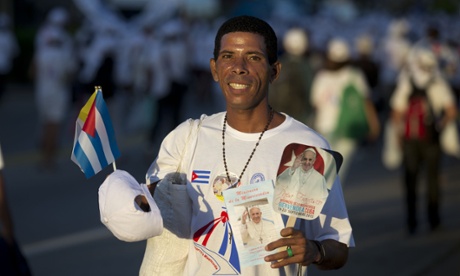
Fifty-eight-year-old Idael Confesor Martinez Leyva wore a straw hat topped with Cuban and Vatican flags as she entered the plaza. She said the pope “is going to transform the world and bring us what we need most, especially the young people”.
This evening, Francis heads to Cuba’s second city, Santiago.
Yesterday he led a mass in Havana, as well as meeting with a group of young people; on Saturday, he was met at Havana airport by Cuban president Raul Castro, who gave a politically-charged welcome speech in which he called the ongoing US trade embargo “immoral” and demanded the return of Guantanamo Bay.
I ask you to join me in praying for my trip to Cuba and the United States. I need your prayers.
— Pope Francis (@Pontifex) September 18, 2015
The papal plane is scheduled to touch down at Holguín airport at 9.20am ET (1.04pm GMT).
Stay tuned for live updates throughout the day.
Updated