The Pope has arrived in Lesbos to meet refugees trapped in the controversial detention centres mandated by the EU-Turkey deal as they face being deported.
He landed at the island’s airport at around 10am local time (8am BST), being greeted on a red carpet by the Greek Prime Minister, Alexis Tsipras, and a delegation of Catholic and Orthodox Church leaders.
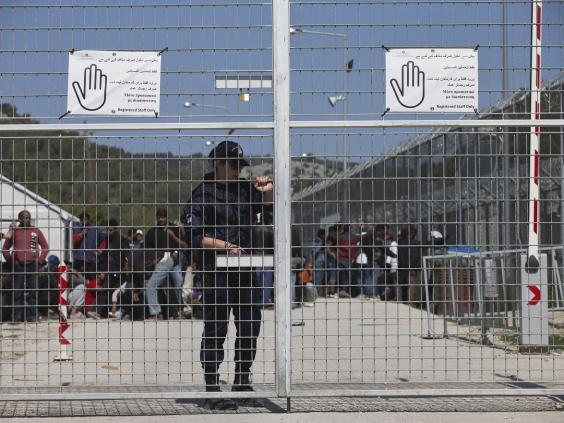
The visit comes as thousands of asylum seekers continue to be detained in walled camps, which were urgently spruced up yesterday ahead of Pope Francis’ arrival.
Council workers were also seen scrubbing graffiti reading “Papa don’t preach” that had been sprayed on walls and buildings in Mytilene, the capital, overnight.
The pontiff is due to visit Moria, a refugee camp-turned detention centre currently housing almost 3,000 migrants.
After visiting Moria, the delegation will have lunch with refugee representatives and make a joint declaration, before heading to the island’s capital for a prayer service in memory of the many asylum seekers who have drowned attempting to reach Europe.
The Vatican said the five-hour visit to Lesbos was purely humanitarian and religious in nature, not political, and wasn't meant as a criticism of the deportation programme seeing some asylum seekers sent back to Turkey.
Pope Francis said he intended “to express closeness and solidarity both to the refugees and to the Lesbos citizens and all the Greek people who are so generous in welcoming (refugees).”
“Refugees are not numbers, they are people who have faces, names, stories, and need to be treated as such,” a tweet from his official account said as the visit began.
The pontiff has been outspoken in calls for greater compassion and international co-operation in the refugee crisis, denouncing the “globalisation of indifference” during a trip to Lampedusa – another migrant hotspot.
Controversy continues over the situation in Lesbos, which is now subject to the 18 March EU-Turkey deal.
It stipulates that anyone arriving clandestinely on Greek islands will be returned to Turkey unless they successfully apply for asylum in the country.
For every Syrian sent back, the EU will take another Syrian directly from Turkey for resettlement in Europe but other nationalities make up more than half of those arriving.
In return, Turkey was granted concessions including billions of euros to deal with the more than 2.7 million Syrian refugees living there, and a speeding up of its stalled accession talks with the EU.
Despite the measures, condemned by human rights groups as “shameful” and “inhumane”, desperate asylum seekers fleeing war and persecution in the Middle East and Africa continue to arrive.
Frontex, the European border agency, intercepted a dinghy carrying 41 Syrians and Iraqis off the coast of Lesbos, three hours before the Pope was due to land.
They were detained and brought to shore in the port of Mytilene.
Charities are warning of appalling conditions in the two main camps on the island, which has seen the largest number of arrivals in Europe.
Sacha Myers, who is working inside Moria with Save the Children, told The Independent that walls and fences were painted as part of preparations on Friday.
“We hope the improvements continue but they don’t change the fact that we have still got thousands of people locked inside this detention centre with no idea how long they were be here,” she said.
“The camp was built to hold 2,000 people and now there are 2,900. Families are living on top of each other, there is absolutely no privacy.

“We’re seeing a real deterioration in conditions.”
Ms Myers, a communications and media manager for the charity, said she had met Iraqi and Syrian mothers whose babies were ill with diarrhoea and fever amid declining hygiene.
More than 200 unaccompanied children are being held in Moria, where they report illness, fights and theft.
Charity workers described dirty rooms without enough beds, where children are denied legal services and basic support despite concerns for their mental and physical wellbeing.
Amnesty International has accused the Greek authorities of holding refugees "arbitrarily in appalling conditions amid growing uncertainty, fear and despair".
“Some people are aware of the Pope’s visit,” Ms Myers said. “They really want him to help them and understand their issues.”
Pope Francis is being joined by Eastern Orthodox leader Ecumenical Patriarch Bartholomew, and the head of the Orthodox Church of Greece, Athens Archbishop Ieronymos II for the tour.