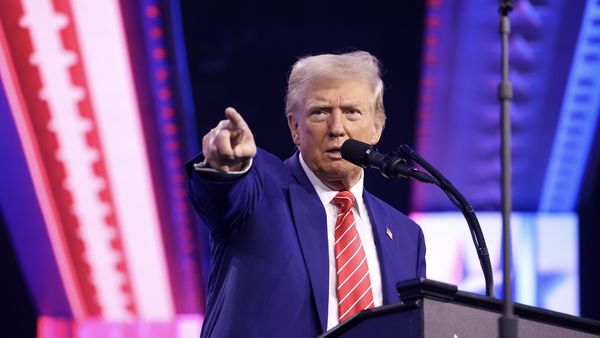
PHILADELPHIA _ The Republican convention generated a modest increase in Donald Trump's poll standing, moving the New York businessman back into a lead over Hillary Clinton.
Through Sunday, the USC Dornsife/Los Angeles Times "Daybreak" tracking poll of the race shows Trump gaining about 3 percentage points in the aftermath of the convention. That would be roughly in line with the convention bounces enjoyed by Democratic and Republican nominees in the last three election cycles.
As of Sunday, the poll, which is updated daily, showed Trump leading Clinton 45 percent to 41 percent. The lead is within the poll's margin of error of 3 percentage points in either direction, meaning that the apparent lead could be the result of chance.
Trump led Clinton by a similar margin a week before the GOP convention started, after the sharp criticism she received from FBI Director James B. Comey over her handling of classified information in her emails when she was secretary of state. But Clinton's support rose in the days immediately before the GOP convention, and the two were tied in the poll for much of the last week.
Though the Republican convention appears to have shifted some voters to Trump, it also seems to have deepened the intent to vote among Clinton's backers.
In addition to asking respondents to rate from 0-100 the likelihood of their voting for Clinton, Trump or for someone else, the Daybreak poll also asks them to rate their likelihood of voting. Among Clinton backers, that likelihood has gone up over the last two weeks by an average of about 5 points _ again, within the poll's margin of error, but suggesting that recent events may be motivating her supporters.
The poll suggests that Trump has also started to seem like a plausible winner to more people. Two weeks ago, poll respondents, by 53 percent to 41 percent, said they expected Clinton to win the presidency. Now, that gap has narrowed significantly, to 50 percent to 44 percent _ still a Clinton advantage, but a much tighter one.
The question of which candidate people think will win is sometimes _ although not always _ a better predictor of the election than asking people whom they plan to vote for. That's particularly true when the election remains many weeks away.
Since the start of the GOP convention, Trump appears to have gained ground among young voters, with fewer saying they expect to vote for a third-party candidate. And what was a clear lead for Clinton among voters with a college degree has tightened so that her advantage with that group is now within the survey's margin of error.
A similar increase for Trump has showed up in some other surveys. A poll by Morning Consult, a polling and media firm, showed him taking a 44 percent to 40 percent lead, the first time he has had the advantage in that poll.
Trump got a slightly larger increase in the latest CNN/ORC survey _ a 6-point bump, which moved him from trailing Clinton in that poll to leading, 48 percent to 45 percent. When tested in a four-way matchup that included Gary Johnson, the Libertarian candidate, and Jill Stein of the Green Party, Trump led 44 percent to 39 percent, with Johnson getting 9 percent and Stein 3 percent, the CNN/ORC poll found.
The question for this week will be whether Clinton can generate an increase of her own out of the Democratic convention. At a briefing for reporters Monday morning, her pollster, Joel Benenson, said he believed Republicans had left a significant opening for her to do so.
Republicans "solidified their base" at their convention, he said. "What they didn't do was reach out to voters who weren't already in their base."
"Hillary has a commanding advantage" on the question of which candidate "is going to fight for me," he said. "What we really want to do is to drive that on the positive side."
Democratic pollster Geoff Garin, who also spoke at the briefing sponsored by The Atlantic magazine, acknowledged that some voters are attracted to Trump because he promises change, even if they are not sure what his change would mean.
Clinton "needs to convince them that she is on their side, and that she will make their lives better as president," he said.
Republicans set out "very clearly and forcefully" that they want the election to primarily be about which candidate voters believe will keep the country safe, he added. "What we need out of this convention," he said, "is a clear definition of what the election is about ... what kind of country they want to lead us toward."
Both men asserted that Clinton has a strong shot at winning a couple of swing states that President Barack Obama lost in 2012, most notably North Carolina, which Obama carried in 2008. Benenson also listed Arizona, a state with a large share of Latino voters, as a target for the Democrats.
On the flip side, Garin said that of the industrial states that Obama carried in 2012, where Trump hopes his opposition to current trade deals and his tough image will attract blue-collar voters, "Ohio is the toughest to hold. Ohio is qualitatively different from the others."
Clinton is "farthest ahead in Michigan," he said _ an assessment shared by Republican pollsters in Cleveland for their party's convention last week.
Both parties usually experience an increase in support after their conventions, which typically are among the few events in a presidential race that actually move large numbers of voters.
The increase usually stems from two things: Conventions tend to strengthen partisan feelings, so a party's voters typically coalesce around the nominee during or just after the gathering. The convention is also the one time during a campaign in which one party gets disproportionate attention to its message. That typically sways some voters who don't have strong partisan feelings.
In some cases, candidates can get a large and lasting increase from the convention. This happened most notably in 1992, when then-Arkansas Gov. Bill Clinton gained as much as 14 points in some surveys taken just after the Democratic convention.
More recently, however, the trend has been toward smaller post-convention bounces, probably because the country has fewer swing voters.
The Daybreak tracking poll is part of the Understanding America Study conducted by USC's Dornsife Center for Economic and Social Research. The election survey is being done in partnership with The Times and USC's Jesse M. Unruh Institute of Politics.