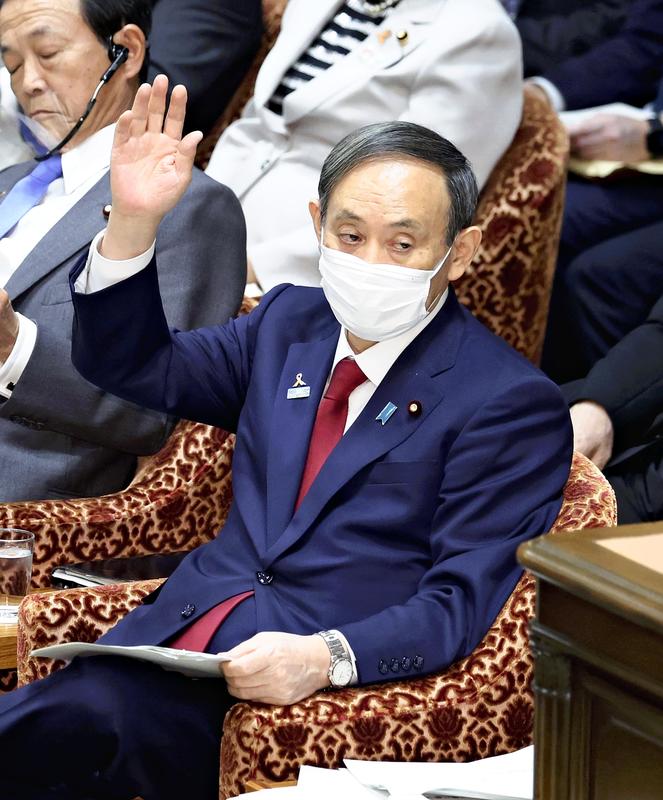
Almost three-quarters of people said integrity was one of Prime Minister Yoshihide Suga's positive points in a public opinion survey jointly conducted by The Yomiuri Shimbun and Waseda University's Institute for Advanced Social Sciences.
The nationwide mail-in survey was conducted to gauge the public's political awareness after the inauguration of the Suga Cabinet, which has received high approval ratings.
The survey included appraisals based on eight categories. Many respondents praised Suga's personality or political stance, with 74% positively evaluating his integrity, 73% his push for reforms, and 71% his approachability.
However, less than half of the respondents positively evaluated his power of explanation, at 43%, and his global awareness, at 46%.
Meanwhile, former Prime Minister Shinzo Abe was positively evaluated for his global awareness by 77% of respondents, the highest figure he received in appraisals based on the same eight categories.
As with Suga, Abe's lowest appraisal was for power of explanation, at 42%
Abe's integrity was positively evaluated by 44% of respondents, 30 percentage points lower than Suga's appraisal.
Only 29% of respondents said they had positive expectations for the merged Constitutional Democratic Party of Japan and the Democratic Party for the People.
However, 82% said that an opposition party that can rival the Liberal Democratic Party is necessary, and 67% said that it would be better if power sometimes changed hands between the ruling and opposition parties.
Among the 3,000 voters surveyed nationwide from Oct. 15 to Nov. 17, 1,953 responded, a response rate of 65%.
-- Successful image strategy
Suga was praised for his sincerity and friendliness. Behind the high rating is an image strategy that emphasizes his popularity among ordinary people. When Suga was chief cabinet secretary, he was feared by bureaucrats in Kasumigaseki for his toughness, but the impression that he is frightening has now disappeared.
In the Liberal Democratic Party presidential election, his image as a hard-working and popular man, a self-made politician from a farming family in Akita Prefecture rather than a hereditary politician, was widely publicized. After Suga was nicknamed "Uncle Reiwa," his image as a prime minister for the masses became established.
Former Prime Minister Shinzo Abe, whose grandfather was former Prime Minister Nobusuke Kishi, is from a political family. Suga's contrast with Abe also affected his image as a man of the people. In a free-response section of the survey, a man in his 60s in Tokyo said, "I think he will become a prime minister with the common people's mind." This strategy is working so far.
Shortly after taking office, Suga launched a series of reforms, including lowering mobile phone fees, reviewing Japan's dependence on hanko seals for documents, and digitization of government administration. These moves led to a positive public perception of his appetite for reform. Toyo University Prof. Heizo Takenaka, who has been described as the prime minister's brain, has advocated a strategy that emphasizes "early small success."
However, when asked about which issues the Cabinet should give high priority (with multiple answers permitted), social security, such as medical care, pensions and nursing care, topped the list with 69%; business conditions and employment received 65%; and measures against the novel coronavirus were named by 59%.
Only 16% of the respondents said the promotion of digitization, one of Suga's key policies, should be prioritized, indicating a gap between the reforms sought by public opinion and the one that Suga attaches importance to.
Public opinion regarding a person's character is often volatile. Whether Suga will be able to maintain his high evaluation will depend on the results of future coronavirus measures and other efforts.
Read more from The Japan News at https://japannews.yomiuri.co.jp/