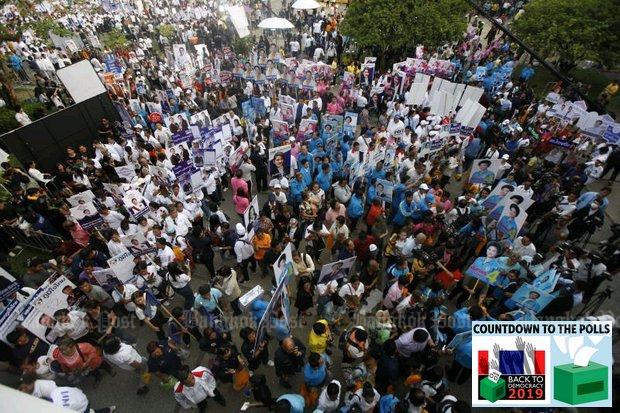
A record 5,831 constituency candidates turned out for the first day of registration, surpassing the 3,899 overall total from 2007, ahead of the March 24 poll.
The sharp increase is believed to be a result of the new election rules set out by the Constitution Drafting Committee.
Unlike the previous system where voters received two ballot papers -- one for the constituency candidate and the other for the party-list system, the new system uses only one ballot paper.
While constituency candidates with the most votes get House seats, the party-list candidates win seats based on nationwide tallies under the "every vote counts" principle.
With these regulations, small- and medium-sized parties have to field as many constituency candidates as possible to boost their party-list chances.
Jade Donavanik, chairman of the Faculty of Law at the College of Asian Scholars, agreed that the more constituency candidates, the bigger chances of being allocated party-list seats.
He said most major players are fielding candidates in more than 300 constituencies because they are aware that their fate is in the voters' hands.
On the first day of candidate registration, a total of 58 parties fielded candidates to contest the polls in the constituency system across the country, said the Election Commission (EC).
According to the EC, the Democrat Party fielded the largest number, with 341 candidates.
The Palang Pracharath Party fielded 335, followed by 333 from the Seri Ruam Thai Party, 330 from the Future Forward Party, 325 from the Bhumjaithai Party, and 301 from the Action Coalition for Thailand.
Only two parties -- the Thai Tham Party and Sangkhom Prachathippatai Thai Party -- submitted their party-list candidates, 15 each.
Mr Jade said the former ruling Pheu Thai Party appears to have adopted a different strategy in only fielding 250 candidates.
In Bangkok, where 30 House seats are available, the Pheu Thai Party sent 22 candidates while its allied parties, Thai Raksa Chart and Puea Chat, are fielding candidates in the eight constituencies that Pheu Thai opted out of.
These parties are believed to be vessels to sweep in party-list seats ahead of a likely coalition with Pheu Thai later on.
"The Pheu Thai Party seems to think that it's better to opt out of the constituencies it is not going to win," he said.
According to Mr Jade, it remains to be seen whether the Pheu Thai Party's strategy will work because in this mixed member apportionment system it is the people, not political parties, who have control.
The academic also pointed out that the change of name by several Puea Chat Party candidates ahead of the polls was likely to circumvent the election rules which bar outsiders' influence on party affairs.
He was referring to the name change by six Puea Chat candidates to "Thaksin". A female candidate also changed her name to "Yingluck".
Mr Jade said it was a tactic to allow these candidates and their party to use the names during their campaign without breaking the law.
Currently, any party that is found to be controlled by an outsider may face dissolution, and its executives may be banned from participating in politics.
However, he noted that the tactic could backfire if voters or election authorities suspect that they have a hidden agenda.
Meanwhile, the poll agency on Monday strongly urged election candidates and political parties to strictly observe the rules or face stiff penalties.
EC secretary-general Jarungvith Phumma said that the disqualification of candidates in this election would have a significant impact because political parties whose candidates are disqualified from the race will lose those party-list votes.
- First, some fun: Dress-up action heroes lighten up the serious politics
- Earlier report: Thousands are eager to register