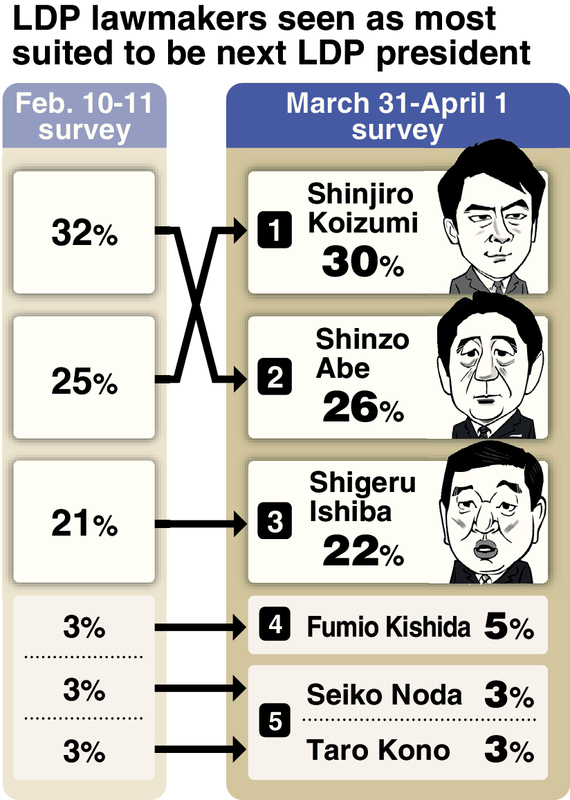
Shinjiro Koizumi, chief deputy secretary general of the Liberal Democratic Party, topped the list of LDP lawmakers seen as most suited to be the next party president, according to a nationwide survey by The Yomiuri Shimbun. Ranked second in the poll was Prime Minister Shinzo Abe, a result that would appear to indicate an unclear outcome for the LDP's presidential election later this year.
Thirty percent of the survey's respondents were in favor of Koizumi as the next LDP leader. This compared to 26 percent who supported Abe, who also serves as the LDP president, down six points from the previous survey conducted in February.
Koizumi switched places with Abe in the latest survey, moving up from second place in the February poll.
Abe had been deemed highly likely to secure his third consecutive term in office. However, the scandal over the falsification of documents related to Moritomo Gakuen appears to have made unclear the fate of the LDP presidential race scheduled for the autumn.
Koizumi has made a series of stern comments about the government, saying recently in reference to the scandal, "All power corrupts, so those who exercise it must have a humble attitude." His comment was seen as an attempt to counter Abe.
The latest survey appears to indicate that Koizumi's stance has gained a certain amount of support.
The support rate for former LDP Secretary General Shigeru Ishiba was 22 percent, almost unchanged from the previous survey.
Among LDP supporters, however, Abe overwhelmed his rivals with a support rate of 53 percent. Koizumi was backed by 19 percent, and Ishiba by 15 percent.
The Hosoda faction, the largest LDP faction and the one that Abe used to belong to, maintains its support for him, as do the Aso faction and Nikai faction. "The prime minister's footing is perfectly stable [toward his third consecutive term]," an LDP cadre said. Many LDP members also made similar comments.
But it is unclear when and how the party's local branches may express their dissatisfaction with Abe ahead of unified local elections and the House of Councillors election set for 2019. In the LDP leadership election in 2012, Abe lost to Ishiba, who garnered more votes from rank-and-file LDP members.
Given that Koizumi supported Ishiba in the 2012 race, "votes cast by the party's rank-and-file members may go to Ishiba [depending on the moves by Koizumi]," a mid-ranking LDP member said.
Facing the document falsification scandal, Abe will likely be forced to carefully steer his administration, observers said.
Meanwhile, 44 percent of the respondents supported Abe's proposal to keep the second paragraph of Article 9 of the Constitution intact and add a provision to stipulate legal grounds for the existence of the Self-Defense Forces. Forty-one percent said they were against it.
With Ishiba advocating that the second paragraph be deleted, constitutional revision may become a point of contention in the LDP presidential race.
62% urge caution over N. Korea talks
In the survey, 62 percent of respondents said Japan should carefully consider whether to hold a summit meeting with North Korea, while 33 percent said talks should be held as early as possible.
Meanwhile, 46 percent expected recent talks between North Korean leader Kim Jong Un and Chinese President Xi Jinping to help resolve issues related to Pyongyang's nuclear and missile development programs, while 48 percent said they did not have such expectations. In the previous survey conducted on March 9-11, 56 percent said they had high hopes for leadership talks between the United States and North Korea, while 41 percent said they did not.
Asked whether the international community should prioritize dialogue or pressure as a means of stopping Pyongyang's nuclear and missile tests, 46 percent selected dialogue, up from 42 percent in the previous survey. Forty-three percent said pressure should be emphasized, unchanged from the previous survey.
By age group, more than half of respondents in their 40s or younger expressed a preference for dialogue, while respondents in their 60s were almost evenly divided between dialogue and pressure. Those in their 50s, and in their 70s and older favor pressure.
Read more from The Japan News at https://japannews.yomiuri.co.jp/