Many voters expressed distrust in politicians and bureaucrats in a public opinion poll conducted jointly by The Yomiuri Shimbun and the Waseda Institute of Political Economy from January to February, with 73 percent not trusting politicians and 70 percent not trusting bureaucrats.
According to the mail-in survey on political awareness, 60 percent of respondents said they do not trust political parties and 56 percent said they do not trust the political system.
The latest opinion poll was conducted before the revelation of the Finance Ministry's alterations of approved documents related to a controversial sale of a state-owned land plot to private school operator Moritomo Gakuen. The results highlight the harsh gaze that many Japanese people direct at politicians and bureaucrats.
Looking at respondents by the political party they support, 90 percent of respondents with no party affiliation distrusted politicians. Political parties were not trusted by 87 percent of unaffiliated respondents, and bureaucrats were not trusted by 83 percent of such respondents.
Among opposition party supporters, 78 percent did not trust bureaucrats, 76 percent did not trust politicians and 62 percent did not trust political parties. Even among respondents who support the ruling parties, more than half of them, or 57 percent, expressed distrust in bureaucrats, while 56 percent expressed distrust in politicians, surpassing the 43 percent who trust them.
Asked about Prime Minister Shinzo Abe's abilities in eight fields, 51 percent, the largest proportion, appreciated his diplomatic ability. He ranked lowest, at 23 percent, for the percentage of people who appreciate his ability to explain things and convince others.
Meanwhile, 80 percent said a strong opposition party that can compete with the Liberal Democratic Party is needed. Asked about mergers and cooperation among opposition parties, 65 percent said political parties with the same policies should cooperate with each other, exceeding the 32 percent who said opposition parties should cooperate to expand their power even though there are some differences in their policies.
42% see moderate awareness
Respondents were asked to choose the levels of their own political awareness and that of other Japanese voters' from five levels of "high," "moderately high," "moderate," "moderately low" and "low."
As for their own political awareness, the percentage of respondents who chose "moderate" was the largest at 42 percent. However, when it comes to the level of political awareness of other Japanese voters, 43 percent, the largest proportion, chose "moderately low."
By age group, the younger the respondents were, the higher the percentage who deemed their own political awareness to be "low" or "moderately low," with 59 percent of respondents aged from 18 to 29 and 51 percent of those in their 30s choosing these levels.
The percentages of respondents in their 40s and 50s who said their own political awareness is "moderately low" or "low" were in the 30 percent range, while around 20 percent of those in their 60s and aged 70 or older chose these levels.
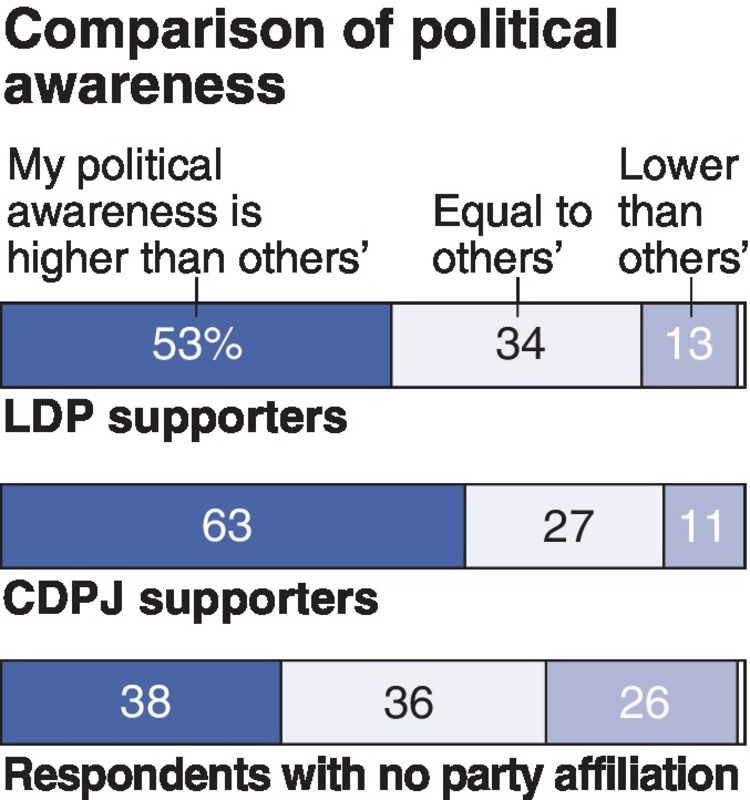
When it comes to differences between evaluating their political awareness and that of other Japanese voters, 49 percent of respondents thought their own political awareness is higher than other voters', while 33 percent think their level of political awareness is the same as others'. Seventeen percent said their political awareness is lower than others'.
Looking at respondents by the political party they support, 63 percent of those supporting the Constitutional Democratic Party of Japan said their political awareness is higher than other voters, followed by 53 percent of those supporting the LDP. Meanwhile, 38 percent of respondents with no political party affiliation think their own political awareness is higher than others.
By age group, many middle-aged respondents said their political awareness is higher, including 59 percent of respondents in their 60s, the largest among the age groups. They were followed by 52 percent in their 50s. Among other age groups, 49 percent of those aged 70 or older felt they had higher political awareness, followed by 48 percent in their 40s, 42 percent in their 30s and 36 percent aged 18 to 29.
The survey was conducted from Jan. 23 to Feb. 28 on 3,000 eligible voters across the nation, with 1,822, or 61 percent, giving valid answers.
Read more from The Japan News at https://japannews.yomiuri.co.jp/