The idea
You Talk, They Listen is a series of events we’re hosting at universities around the UK – each focusing on the topics you care about most in the run-up to the election; from higher education, to freedom of speech, climate change and immigration – young people talk and politicians listen. This time we focused on how politics could change to re-engage young voters.
The panel
Helen Pidd, Northern editor, the Guardian
Professor Ian Rotherham, Sheffield Hallam University expert on environmental management and change
Professor Matthew Flinders, University of Sheffield, writer and broadcaster and author of Defending Politics (2012)
Dr Knut Roder, senior lecturer and BA politics course leader at Sheffield Hallam University
The chair
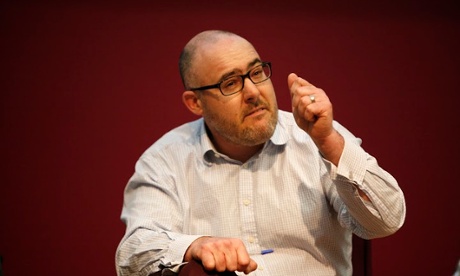
Rick Edwards, TV presenter and writer of None of the Above, a new book on why young people aren’t voting and why they should be.
The atmosphere
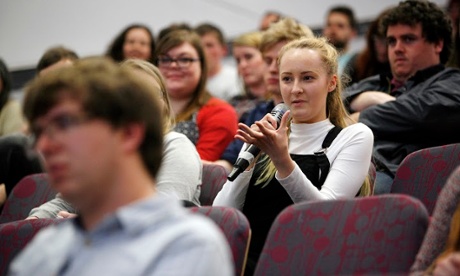
Students led the discussion from the off, challenging our panellists on a wide range of things that they felt UK politics was getting wrong. Wide-ranging criticisms were levelled – and there were some creative new solutions suggested by both panellists and students.
Five top demands on political reform
1) Devolve more powers
“There needs to be a greater focus on local politics that encourages grassroots movements and greater regional autonomy,” said Sheffield Hallam politics student Cat Cutmore, in an opening address to the room. “Scotland in 2014 showed how politically invigorating the possibility of devolved power can be.”
Professor Ian Rotherham said that in his lifetime, there was significant devolved power. “But central government didn’t like it and they removed those powers to the point that I am unable to do anything about the things I care about,” he said.
“Devolution can help with budgets,” added the Guardian’s northern editor, Helen Pidd. “In Manchester, they have been able to better combine mental and social care, for example.”
Professor Matthew Flinders said that the £3bn repair bill facing the Palace of Westminster provided a golden opportunity to move parliament to the north. “We are trapped in the system we have developed, and breaking out of that is difficult,” he said. “But you could knock it down and start again.”
2) Reform the electoral system
“Proportional representation systems encourage a higher turnout,” said panellist Dr Knut Roder, in response to a student’s criticism of the current first-past-the-post system. “The referendum we had was a bad idea. The voters who want a majority Labour or Conservative government would obviously be against it,” he said.
Flinders added that the new model offered was not what the Lib Dems wanted, but thought the debate would return to the forefront of politics soon. “Insurgent parties will get few seats at the election, so electoral reform will come back as a big issue. But all our structures are modelled on a two-party system that doesn’t exist anymore,” he said.
3) More women in parliament
“Our parliament comprises a large majority of privately educated white men. Women are massively under-represented,” said Cutmore.
A student in the audience brought up the 50/50 campaign, which wants to see a male and female MP for each constituency. The panellists were widely supportive of the idea of more women in parliament, and Roder suggested there should be a minimum amount of women MPs. Flinders added that the system would need to change fundamentally first, to encourage women. “Parliament is built for testosterone and willy-jousting,” he said.
4) Teach more politics in schools
“There’s a lack of education about politics in state schools,” said an audience member. Could more knowledge about the political system help to engage people politically at a younger age? Flinders agreed that more politics should be taught in school, but pointed out that New Labour tried and failed to do this.
“We had citizenship introduced as a compulsory subject, but it is seen as a soft topic and young people are quick to pick up on the topics that matter. It has been hollowed out, and is now more about sexual health and looking after your money. We should start teaching politics properly at primary school,” he said.
5) Encourage diversity
“Because of how wide the class divide is, how can politicians who went to top schools be expected to represent a class that they were not a part of - even with the best intentions?” a student in the audience asked.
Pidd said she doesn’t believe being an MP robs people of empathy, but added: “It would be fantastic if all parliamentarians had to have a normal job before entering parliament. They would have a better idea of what the real world is like.”
Flinders said that it was about creating opportunities. “Why can’t you serve a maximum of two terms in government, to create more fluidity?” he asked.