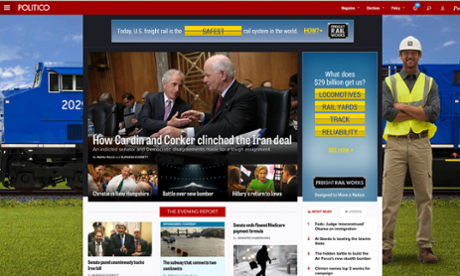
Politico has brought in a raft of new hires including former Times media editor Alex Spence as it builds towards the launch of its European arm on 21 April.
Spence will cover the European media industry from London, joined by author and analyst Ben Judah who will start as a contributing writer by covering the UK election.
Politico is making a “substantial” seven-figure investment in its European launch, which is a joint venture with German publishing giant Axel Springer. On launch it plans to have more than 40 editorial staff and more than 70 overall.
Other hires announced in a memo published by Capital New York include two Wall Street Journal staffers, Matthew Karnitschnig and Noelle Knox.
Karnitschnig will by Politico Europe’s chief correspondent covering Germany, while Knox will head up a five-person tech team from Brussels which will also include former ZDnet and Gigaom writer David Meyer and Zoya Sheftalovich, who was writing for Australian consumers’ association Choice.
Stephen Brown becomes deputy managing editor following three decades with Reuters.
Spence left the Times earlier this year after reporting in January that the Sun was scrapping the topless models that have traditionally run on Page 3. The report from the Sun’s sister title was widely seen as confirmation of the move, but the tabloid briefly reintroduced the controversial images two days later.
He reportedly complained to Times editor John Witherow, deciding to leave after being threatened with a performance review and departing shortly after his last article was published on 30 January.
Politico will also publish a print magazine from 23 April, distributing between 25,000 and 30,000 copies in Brussels, and at political and transport hubs in other major European centres such as London, Paris and Berlin.
In March, Politico co-founder and editor-in-chief John Harris said: “The expansion that we are making in Europe, it’s really by far the biggest project on our plate. I don’t imagine a year from now we could be dominant, [but] we’re certainly going to be a major player in that European conversation.”