KANSAS CITY, Mo. _ A Republican wave has washed over Missouri politics.
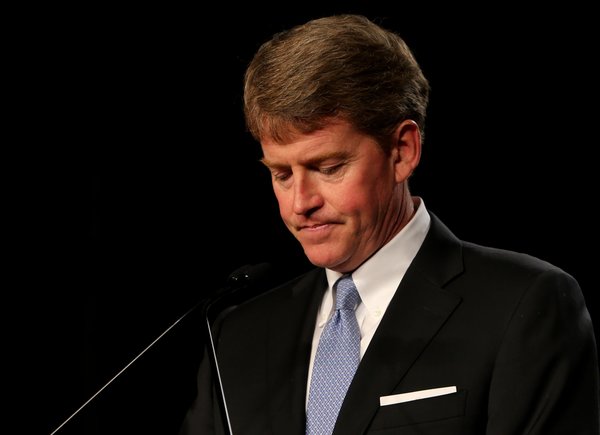
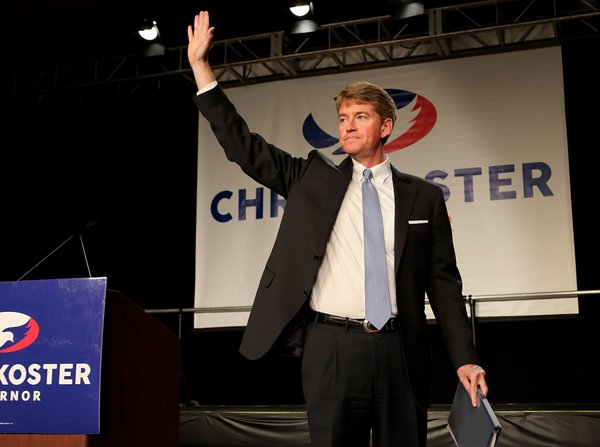
Republican Eric Greitens, a former Navy SEAL who has never before sought elected office, was chosen by Missourians to be the state's next governor. He defeated Democratic Attorney General Chris Koster on Tuesday night. With 70 percent of precincts reporting, Greitens was leading 55 percent to 41 percent.
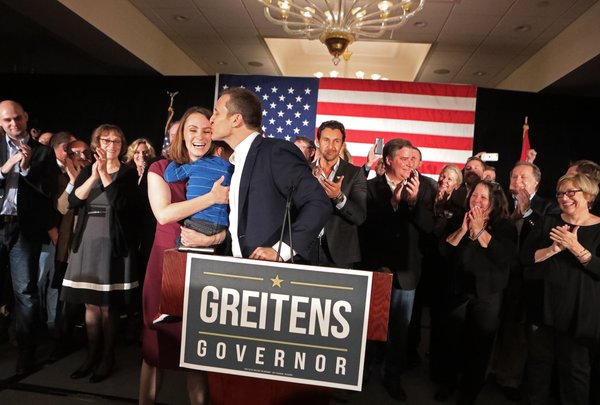
"We're going to take on the special interests and clean up Jefferson City," Greitens said in his victory speech in Chesterfield, a St. Louis suburb. "Our mission in this campaign was to build a stronger and better Missouri we can take in a new direction."
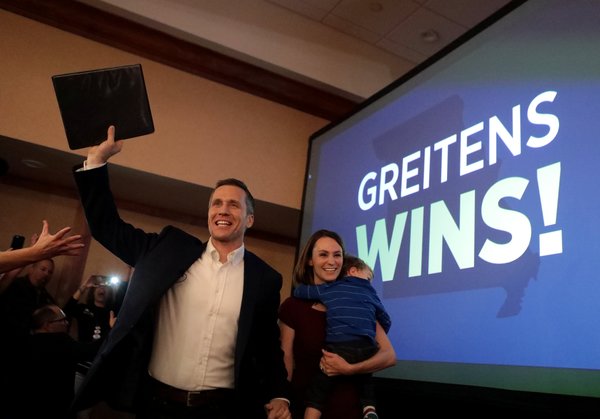
The win gives Republicans control of the governor's mansion and both the state House and Senate for the first time in eight years. Republicans have won the race for governor only once since 1992.
The most immediate ramification of Tuesday's vote could be Missouri becoming a so-called right-to-work state.
Greitens has promised to sign a right-to-work law, which would make it illegal for workers to be required to join a union or to pay dues to a labor organization as a condition of employment.
Supporters argue right to work would strengthen Missouri's economy and encourage businesses to grow. Opponents say it would simply weaken labor unions and lower wages.
Republicans have been trying to enact right to work in Missouri for years, but enough pro-labor Republican lawmakers have joined with Democrats to block the GOP from overriding Democratic Gov. Jay Nixon's veto. They have more than enough votes to send the bill to Greitens' desk.
He's also vowed to cut regulations on businesses and taxes, as well as oppose expanding expansion of Medicaid and an extension of discrimination protection to LGBT Missourians.
Greitens made cleaning up Jefferson City politics the centerpiece of his campaign, railing against "corrupt career politicians," "well-paid lobbyists" and "special interest insiders" who he says are pulling the strings in the Missouri Capitol. He's vowed to push for a ban on lobbyist gifts to lawmakers and to implement a longer waiting period before lawmakers can become lobbyists after leaving office.
After eight years in office, Nixon was barred from running for re-election because of term limits. The two candidates vying to replace him had stark differences in biography and on policy.
Besides being a former Navy SEAL, Greitens, 42, was a Rhodes scholar. He emerged from a bruising four-way Republican primary in August with an upset victory.
Koster, 52, was a former county prosecutor who faced only token opposition in the August primary despite bucking his party's base on several high-profile issues.
Koster promised to veto any attempts to impose tougher regulations on unions, and believes expanding Medicaid eligibility would cover 300,000 uninsured Missourians, create jobs and prolong the lives of struggling rural hospitals. He said he would push for an increase in the minimum wage and for an expansion of discrimination protections to include sexual orientation and gender identity.
Both men supported tax cuts and oppose new regulations on firearms.