WARSAW _ With Poland on the road to become an illiberal state, the ruling Law & Justice party is turning to a western-educated banker to sell the vision to its allies.
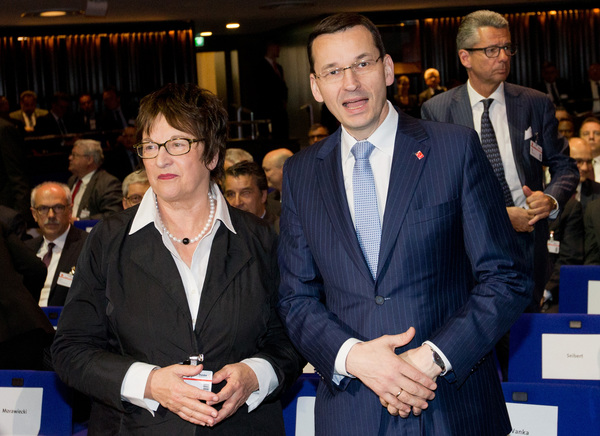
Deputy Prime Minister Mateusz Morawiecki, who's been in charge of economic policy, was nominated to become premier and charged with keeping the engines of growth humming while reassuring foreign investors that the rejection of European Union demands to meet democratic norms doesn't endanger their interests.
The former head of Poland's third-biggest bank takes over from Beata Szydlo, who was dismissed halfway through the government's four-year term. The switch coincides with the culmination of Law & Justice's months-long legislative battle to give politicians more control over the judiciary, including the Supreme Court, which has triggered nationwide protests and an unprecedented threat of sanctions from the leaders of EU states who have warned the government may be eroding the nation's democracy.
"The new situation at home and abroad requires a change in management," Beata Mazurek, a spokeswoman for the ruling party, told reporters in Warsaw, presenting Morawiecki's candidacy for premier. She didn't give any details about other Cabinet changes, saying that Szydlo would have a senior role in government.
Morawiecki, 49, is the architect of an economic program that raised welfare spending for families with children, boosting Law & Justice's support among voters in the country of 38 million people. He has also helped carve out a bigger role for the government in business, central to his party's drive to centralize power and steer Poland away from a model based on foreign investment and EU integration that dominated its post-Communist transformation.
The government didn't immediately make clear who would become finance minister under Morawiecki, or whether he would continue to hold that portfolio. The former chief executive officer of Bank Zachodni WBK SA _ he headed the lender controlled by Banco Santander SA from 2007 to 2015 _ Morawiecki also narrowed the budget deficit, an important benchmark for foreign institutional investors who hold 202 billion zloty ($57 billion) of the government's local-currency bonds.
While fluent in English and a polished veteran of foreign-investor meetings in London, New York and Brussels, at home Morawiecki is a vocal cheerleader for the main source of party's clash with the EU. He has defended the court overhaul as addressing a "widespread pathology in the judiciary" and said it's no business of other countries to decide how a nation imposes the rule of law.
The EU's executive, the European Commission, disagrees. It's conducting the first-ever probe into whether a member is upholding the bloc's democratic values. Leaders including French President Emmanuel Macron and German Chancellor Angela Merkel have suggested that Poland may face penalties for the erosion of democracy, including possible curbs to the tens of billions of euros of development aid that have driven the country's economic growth for more than a decade.
"A personnel change at the helm of the government is a chance for a new opening in relations between Poland and the EU," said Olgierd Annusewicz, a political scientist at Warsaw University. However, Law & Justice isn't likely to change course on its judicial overhaul, keeping relations tense, he said.
Law & Justice has followed in the footsteps of Hungarian Prime Minister Viktor Orban, who has pledged to transform his country, which is also an EU member, into an "illiberal state" modeled on Russia and Turkey.
So far, the Polish government's clash with the EU hasn't hurt its support among voters, with a survey by the pollster IBRiS showing its popularity at 47 percent at the end of November, compared with 37.6 percent in the 2015 election. Morawiecki, who studied in Switzerland, Germany and the U.S, now has the challenge of maintaining that support as the commission and EU states draw closer to a decision on how to handle, and potentially punish, wayward members.
"Most of Law & Justice's agenda has been implemented _ the party needs a new momentum, or risks start loosing support," said Piotr Buras, a political scientist from the European Council on Foreign Relations, a pro-EU think-tank. "Morawiecki's modernization agenda may help protect support, but it won't alter Poland's institutional course, which is at the center of the conflict with the EU."
The leadership change still requires the formal resignation by Szydlo and her Cabinet, Morawiecki's appointment by President Andrzej Duda and a vote of confidence for the new administration in parliament. That vote may not happen before the new year.