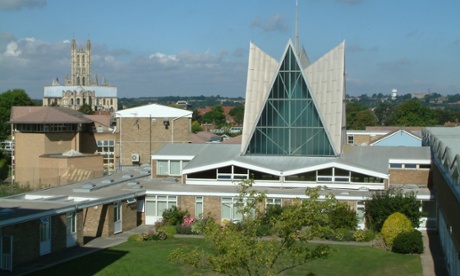
Fresh evidence has shed light on how a police force asked a university to hand over the names of members of the public who were due to attend a public debate on its campus.
Before Christmas, the Guardian revealed how Canterbury Christ Church University had said it had refused to pass on the names. Its academics had invited experts to debate the merits of fracking in an open forum.
To some, it was a telling example of how far the police were going in their efforts to snoop on law-abiding citizens. Critics demanded to know why this had happened and made a complaint.
Kent Police, which denies that its officers asked for the names, has launched an internal investigation into the complaint.
A fuller picture of what happened can be pieced together from documents released under the freedom of information act to the Guardian.
The debate had been organised by sociology academics at the university to discuss fracking as they believed it has become a significant local and national issue.
More than 200 came to listen and question a panel that included a retired geologist, engineers, a local councillor, an analyst from a think-tank and a campaigner. It was not a meeting held to organise any demonstrations or protests.
In the run-up to the debate on November 19, the university and police were in touch with each other about security on the night.
More than a week beforehand, a university employee emailed another to say : “We have already had concern raised from our police special branch colleague about this. I think we need to prepare for potential demonstrators as well.” The university thought disruptive protests were unlikely, but made preparations just in case, as fracking has become controversial.
On November 13, Kent Police had an internal meeting about the debate and decided that there were a number of things that needed to be done.
One of them was that two police officers - names deleted in the documents - “require to know when the tickets are issued will the name of who is in the receipt of the tickets be recorded? (Blacked out) if they are there will need to be some R&D”.
Entrance to the debate was free, but anyone who wanted to attend needed to book a place through the university.
Later that day, Kent Police emailed the university to say :”Kent Police Special Branch are charged with assisting in the maintenance of public order, and to that end, senior management have tasked me to liaise with Christ Church in relation to specific security questions.”
The following day, university security staff replied to police with their plans for managing the debate, adding :” In terms of the request for names of the attendees, I have been advised that the university is checking on whether there’s a data protection issue with us releasing names before I can be authorised to share this information.”
It was a request that troubled the university. That day, a senior academic responsible for organising the debate emailed colleagues to say that the university had “been asked by Special Branch for a list of everyone who will be attending”.
The academic said there were “some concerns about doing so with respect to the data protection act.” She wanted legal advice as “this is very much beyond mine and (blanked out name)’s expertise so we need institutional steer here”.
The university’s lawyers believed that the university could not hand over the list unless the police sent them a written request setting out the legal reasons why they were entitled to have the names.
The following day, the university told the police. A detective constable - whose name is censored - replied : “No problem. The main issue is numbers rather than names. I have asked for any info our end which we can pass onto you”.
That same morning, a police officer had emailed a colleague :”We don’t really need the names. It would be nice but not essential. I fully understand the concerns about releasing that information without the relevant data protection application in place.”
Yesterday, Kent Police said :”As part of our enquiries to ascertain the organisation of the public debate, we asked the university for details of its administration and security arrangements. As part of those enquiries we asked for the capacity of the venue and if the organisers were recording details of those who had registered to attend. At no point did Kent Police ask for those attendees’ details to be handed over.
“Kent Police, however, has received a complaint and is currently conducting a review and will share its findings with the complainant and the Kent Police and Crime Commissioner.”
Ian Driver, a Green Party councillor in Kent who was on the panel, has lodged a complaint with police. He said:”The meeting was a perfectly lawful debate about the pros and cons of fracking. There was no conspiracy, no discussion about planning demonstrations or disruptions. It was a bit like Question Time really.”