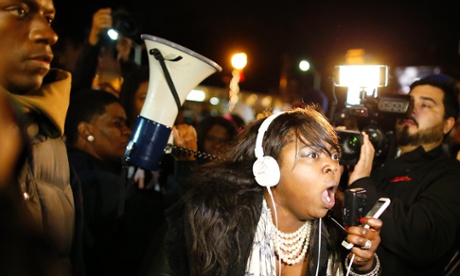
A police commander attempted to lead a gentler response to protests in Ferguson, Missouri, into the early hours of Sunday, even as officers took a reporter into custody while making arrests for a fourth successive night.
Lieutenant Gerald Lohr of St Louis county emerged from Ferguson police headquarters and struck up conversations with demonstrators calling for a grand jury to indict Darren Wilson, a white officer who shot dead Michael Brown, an unarmed black 18-year-old, in August.
After questions about why officers had so quickly reached for helmets, riot shields and batons when confronted by small crowds at the police department last week, Lohr wore a regular patrol uniform and nothing on his head. “I’m just trying to balance,” he told the Guardian.
And he engaged with demonstrators who complain of typically meeting RoboCop-style policing. “Do you think this would be different if Darren Wilson weren’t white and Mike Brown weren’t black?” asked Justin Giuliano, 21. “Maybe,” said Lohr. “I don’t know. Could be.”
The chats proceeded amid loud chanting and drumming from a crowd fearful that the grand jury, whose decision is expected in the coming days, will decline to charge Wilson, 28, with crimes such as murder or manslaughter. The jurors, who have been meeting weekly for three months, are due to reconvene on Monday.
Despite the decision of Lohr and several other officers to remain in regular dress, as the protest grew a group of officers from the county and the Missouri state highway patrol emerged in riot gear. Dozens of demonstrators had spent hours marching through Ferguson in the rain. Some shouted abuse at the line of armoured officers.
Agreeing that African Americans experienced systematic disadvantages in the US justice system, Lohr warned: “I’m not a sociologist, I’m not a psychologist, that wasn’t what I went to college for.” In fact, Lohr, 41, earned a degree in economics from Vanderbilt University.
Still, protesters left him struggling for words. “Can I ask a question?” said Hoda Isak, a diminutive 25-year-old who did not appear likely to follow up with: “Why are we not allowed to stand in the street, but it’s OK for police to murder someone in the street?”
Gesturing to protesters as some spilled on to South Florissant Road, occasionally blocking traffic, Lohr said: “I’m willing to allow a little of this even though it’s technically illegal and helps keep more people safe.”
This tolerance was punctured at about 11.45pm.
Trey Yingst, a 21-year-old reporter for News2Share, was arrested as he filmed from the pavement while officers moved some demonstrators off the street. A tweet from the county police department’s account claimed Yingst “was asked to leave [the] street by the commander and refused.” Yet sergeant Brian Schellman, a spokesman for the force, said in a statement on Sunday morning that Yingst “continued to stand in the area” despite requests from officers to move. He was charged with unlawful assembly.
This led to confusion about who was actually in control of policing the protest. While Lohr styled himself as the commander, the tweet indicated that a Lieutenant Vollmer, who was more aggressive and would not engage with demonstrators or media, was in charge.
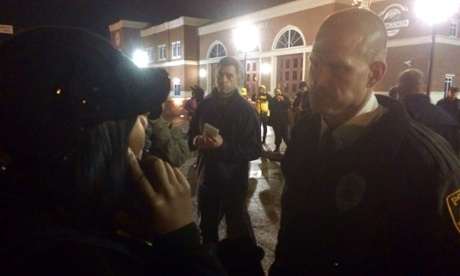
Asked by a reporter for Reason.com which of them was in charge, Lohr replied: “Well, it’s kind of a unified command. Told by the reporter “He’s being a jackass, and you’re being extremely polite,” Lohr reportedly answered: “I know.”
Police retreated inside the station. But about 15 minutes later, David Rodriguez, a 26-year-old demonstrator from neighbouring Illinois who was arrested on Wednesday and Friday nights, returned to the centre of South Florissant Road to block traffic. Rodriguez, wearing the Guy Fawkes-style mask of the Anonymous online activist movement, was arrested without struggle by police in standard uniform. Rodriguez also received a charge of unlawful assembly, according to Schellman.
Further barricading was put in place on Sunday around buildings in Clayton, the St Louis county seat, and in the city of St Louis. Police chiefs also further built up their command centre for dealing with anticipated unrest; it will again be situated in the parking lot of a shopping mall in Jennings, just over the Ferguson city boundary.
The Missouri national guard has been mobilised by Governor Jay Nixon, who last week declared a state of emergency. Military vehicles have been spotted rolling into the area around Ferguson for several days. About 1,000 police officers from regional forces are on standby.
The police cracked down on demonstrations and unrest following Brown’s death in August, using teargas and rubber bullets, leading to widespread criticism of the military-style response. After three months of training, officers last week reacted to gatherings outside the police department by quickly charging at crowds and snatching people for arrest.
Daniel Isom, the Missouri director of public safety, declined to endorse the tactics when asked at a press conference last week why they had been used. “I don’t know why. I can’t say why,” he said. Asked if they had been incorrect, he said: “I don’t know that they were incorrect.”
Asked on Saturday night whether his softer style was in direct response to this criticism, Lohr said: “I understand. I understand what happened.” Referring to the protesters, he said: “They have every right to protest, they have every right to have their voice heard, but they have to be respectful of the community.”
There was still some distance to travel. During a heated conversation with a demonstrator who would only give her name as Black Queen, Lohr suggested: “I don’t think you’re mad at me. I think you’re mad at the system. I don’t think you’re mad at me personally.”
The demonstrator, angry at the aggression shown by other officers, disagreed.
“I am mad at you personally,” she said. “Because you have the authority to give them commands to calm their asses down, and deal with us appropriately.”