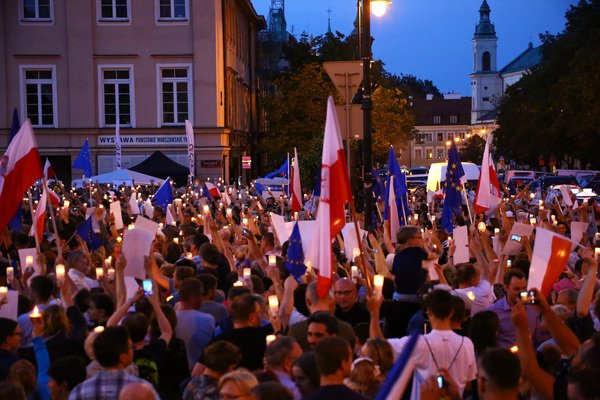
WARSAW, Poland _ Tens of thousands of Poles poured into the streets of the eastern European nation's biggest cities after the passage of a controversial revamp of the judiciary that's been criticized by the European Union for backsliding on democracy.
Over 50,000 people gathered in front of the Presidential Palace in Warsaw, a city spokesman said, while parallel protests were held in about 100 cities including Gdansk and Krakow, according to organizers. They urged President Andrzej Duda to veto legislation passed Thursday in the lower house that would bolster government sway over the courts. Grzegorz Schetyna, head of the opposition Civic Platform, said the bill risks triggering unrest akin to the protests that ousted Ukraine's leader in 2014.
The battle over the court reform is becoming one of the biggest political standoffs in Poland since communism fell in 1989. The EU has already raised the threat of sanctions over the plans. Jaroslaw Kaczynski, head of the Law & Justice party, says he won't back down, though the government backtracked on a 2016 bill to ban abortion when 100,000 protesters, mainly women, flooded the streets. Frustrated that their voice isn't being heard in the legislative process, opposition forces are turning to public protest.
"Constitutional matters are being pushed through under the cover of night without debate _ the crisis is set to escalate," Civic Platform lawmaker and former Defense Minister Tomasz Siemoniak said by phone. "We won't be giving an inch without a fight. Kaczynski backs off when he sees mass protests."
Law & Justice has been rushing to push through the legislation, which would force into immediate retirement all Supreme Court judges, with little or no debate and without consulting the judiciary. Ruling party lawmakers and cabinet members gave a standing ovation after the passage of the bill on Thursday. The upper house, in which Law & Justice has the majority, may review the legislation as early as Friday.
Since regaining power in October 2015, Law & Justice has challenged democratic principles enshrined in the EU treaty and sparked warnings about a drift toward authoritarian rule that communism's collapse was deemed to have ended. The court revamp triggered demonstrations across Poland last weekend, bringing tens of thousands onto the streets.
The government found support from Hungary, which has also been criticized by the EU for democratic infractions. Hungarian Foreign Minister Peter Szijjarto said the European Commission should stay out of Poland's domestic affairs, accusing it of a "witch hunt" against eastern European nations.
A presidential representative said Wednesday that Duda had refused to meet with EU President Donald Tusk to discuss the crisis. Tusk said they should talk to prevent a "black scenario in which Poland is marginalized in the EU."

.png?w=600)