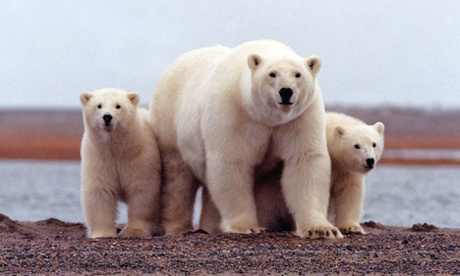
The number of polar bears inhabiting a frozen sea north of Alaska declined by about 40% from 2001 to 2010, according to a study published on Monday.
US Geological Survey researchers and scientists from Canada and the United States found that bear survival rates in the south Beaufort Sea were particularly low from 2004 to 2006, when only two of 80 cubs monitored were known to have survived.
Bears overall fared better than juvenile bears in the study. Overall survival rates began to climb in 2007, but survival of juvenile bears declined throughout the 10-year study period. The bear population was approximately 900 in 2010, the study’s final year.
Scientists said that the low survival rates could be caused by a low seal abundance and limited access to seals in the summer and winter months. Winter ice has become more thin and increasingly mobile over the past few decades, leading it to break more frequently, creating “rough and jumbled” ice conditions that are thought to make it more difficult for bears to capture seals.
“The low survival may have been caused by a combination of factors that could be difficult to unravel, and why survival improved at the end of the study is unknown,” said Jeff Bromaghin, a USGS research statistician and lead author of the study, in a statement.
The Polar Bear Specialists’ Group of the International Union for the Conservation of Nature has been tracking polar bear populations globally. The group will measure the new figures against global historic and current trends.
Dr Steven Amstrup, chief scientist at Polar Bears International, said he spent most of his adult life working with this population of bears and was “pained” to see the decline in the population.
“In 2007, my colleagues and I predicted we could lose polar bears from the southern Beaufort Sea by the middle of this century if we didn’t get on to a different greenhouse gas emissions path,” said Amstrup. “This report confirms we still are on the wrong path.”