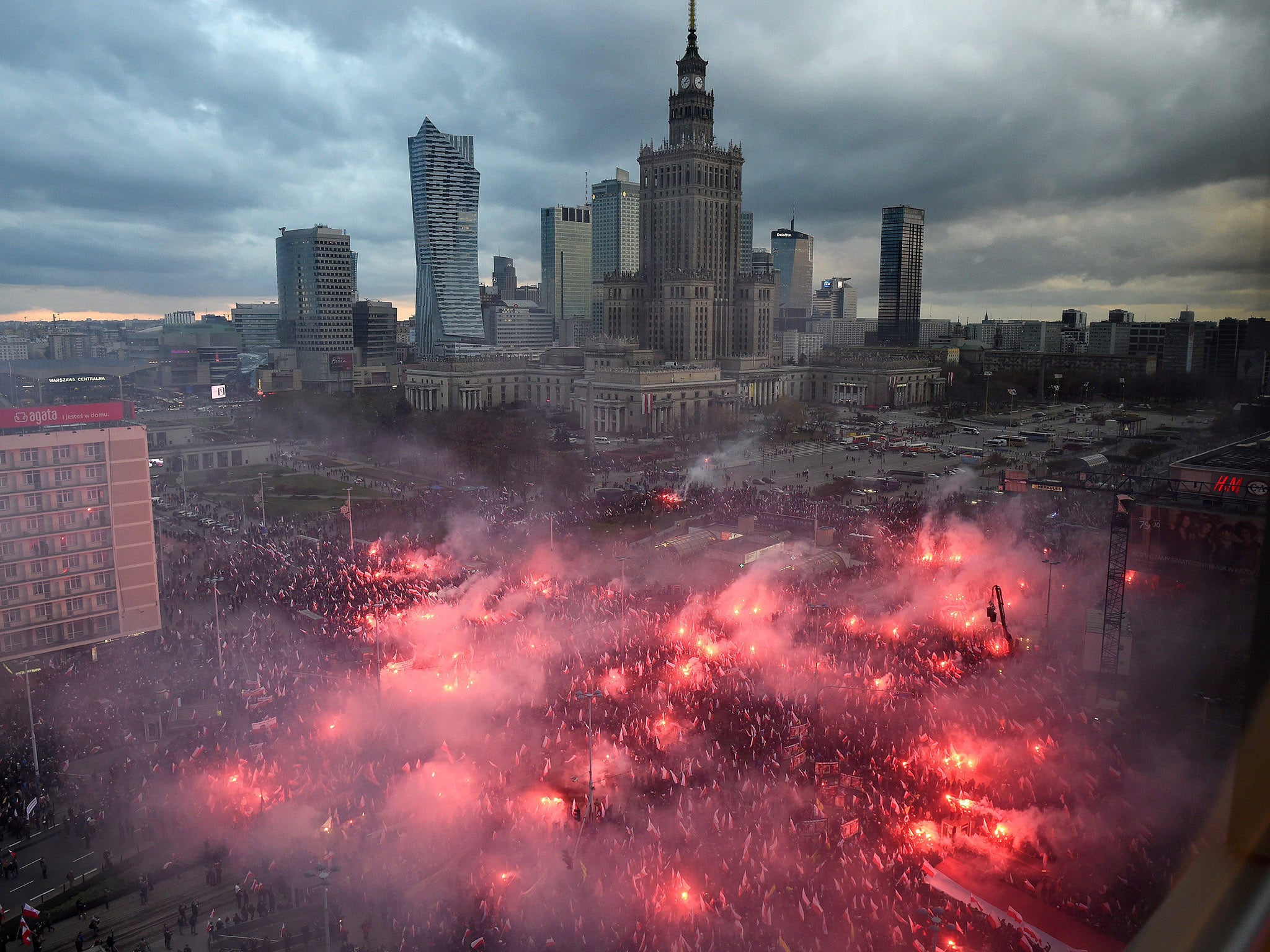
Plans for celebrations to mark 100 years of Polish independence on Sunday have been thrown into turmoil amid concerns the event could be marred by violence between far-right nationalists and counter protesters.
The annual March of Independence, organised by far-right groups and held on 11 November in the capital, Warsaw, has grown in scale in recent years, with last year’s event making international headlines due to the huge turnout – estimated at 60,000 – and numerous xenophobic and racist banners.
This year the Polish government has said it estimates as many as 200,000 people will attend.
The concerns led Warsaw’s mayor on Wednesday to announce a ban on the march this year, citing concerns over security and expressions of hatred.
This was quickly followed by an announcement by Poland’s president and prime minister that an alternative “inclusive” commemorative march would instead be held on the same route, led by military veterans.
But yesterday a Polish court overturned the Warsaw mayor’s ban on the original far-right march, justifying the decision on the constitutional grounds of freedom of assembly.
After the court ruling, it wasn’t immediately clear if both marches will go ahead separately, or as one.
Fears over security have also been heightened by a mass walk-out of police officers in recent days over pay.
The strike prompted the government to ask the defence ministry to help with security on Sunday. But late on Thursday a police union announced it was ending the protest after agreeing upon a deal with the interior ministry.
Warsaw city spokesman Bartosz Milczarczyk said: “We respect the court’s verdict.” He added town hall officials were studying it before deciding whether to appeal.
Earlier in the day, before the ruling, Polish prime minister Mateusz Morawiecki said authorities would do everything in their power to crack down on any expressions of extremism at the march.
“We want the march to be peaceful and not provoke tensions,” Mr Morawiecki told reporters.
His comments come amid other signs Poland’s conservative ruling Law and Justice party is now seeking to take a firmer stance against ultra-nationalists after a period in which they seemed to be trying to appease them.
Extremists from Hungary and elsewhere have in past years joined Poland’s 11 November march, which is meant to mark Poland’s regaining of its independence at the end of the First World War, after being partitioned and ruled since the late 18th century by Russia, Prussia and the Austro-hungarian Empire.
Saying he thought up to 200,000 participants could attend the Warsaw march, Mr Morawiecki acknowledged it could be hard to control them all, but said “we will try to eliminate all banners which are extremist”.
He also said there will be no tolerance for foreign neo-fascists or other agitators.