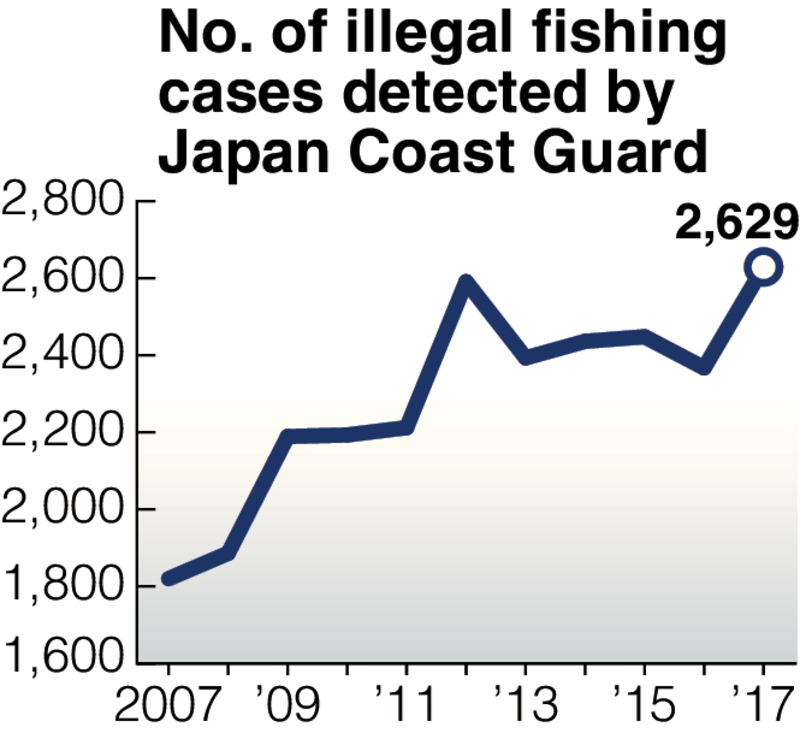
The number of illegal fishing cases detected nationwide last year reached 2,629, marking an increase of more than 40 percent from 10 years ago, according to the Japan Coast Guard.
In most of the cases, individuals were gathering abalones, sazae turban shells and others, without clear awareness that their activity was illegal. It is assumed that the increase is partly because information about places where illegal fishing is possible and other details have been spreading via the internet.
At the same time, organized forms of illegal fishing of sea cucumbers have continued to occur without any signs of stopping, and thus the JCG and fisheries cooperatives across the nation are worried about how to cope with the problem.
Boasting on Facebook
A married couple in their 30s in Aichi Prefecture had posted photos, including one of more than 100 turban shells, on Facebook with comments like "A good catch" The Tsuruga Coast Guard Office in Fukui Prefecture sent papers on the case to prosecutors in November last year on suspicion of violation of the Fishery Law. The couple were alleged to have infringed the fishery rights of others.
According to the coast guard office, the couple visited a beach for sea bathing in Minami-Echizen, Fukui Prefecture, at the time. They caught abalones and turban shells while skin diving, and then posted photos of them on Facebook. A third person saw the photos and informed the office.
The number of illegal fishing cases detected by the JCG has been on the rise. The number last year was 2,629, which was 44 percent higher than the 1,820 cases in 2007.
Targets of such illegal fishing are widely varied, including abalones, sea cucumbers, Japanese spiny lobsters and turban shells.
The law prohibits actions that infringe the fishery rights of local fisheries cooperatives and others. However, many messages are posted on social media websites and elsewhere regarding places and methods for illegal fishing.
A senior JCG official said: "It seems that most of them do it just for fun. But such postings have encouraged illegal fishing."
Diving in darkness
The JCG has also reinforced surveillance on organized illegal fishing of sea cucumbers.
In February last year, the Mizushima Coast Guard Office in Okayama Prefecture and other authorities arrested three people, including a man related to the fisheries industry in Okayama, on suspicion of fishing with unauthorized diving equipment in violation of the law.
The three sailed on a boat to a sea area off Himeji, Hyogo Prefecture, late at night and caught a total of 840 kilograms of sea cucumbers. It is said that they had continued to catch sea cucumbers on the seabed for three hours using diving equipment that can supply air from a boat to a person wearing a wet suit.
The boat was a remodeled one with three engines. It was possible for the boat to sail at speeds faster than those of JCG patrol boats.
Dried sea cucumbers are popular mainly in China. The JCG said that there is information that dried sea cucumbers are traded at 100,000 yen to 200,000 yen per kilogram.
Similar illegal fishing groups have been active behind the scenes not only in the Seto Inland Sea but also other places such as the sea off Hokkaido, the JCG said.
The illegal fishing is done in the dark of night, using boats with their lights turned off. There are even illegal fishing groups who post lookouts to notify confederates of the movements of patrol vessels.
A senior JCG official said, "Their methods are getting increasingly sophisticated."
Surveillance cameras used
Some local fisheries cooperatives have begun their own measures to deal with illegal fishing.
In Mutsu Bay of Aomori Prefecture, damage from organized illegal fishing of sea cucumbers is serious. Starting in April last year, the prefectural federation of fisheries cooperatives associations and other entities set up 15 high-performance security cameras. The security cameras can take clear images even during the night, and were placed in positions surrounding the bay.
The prefectural fisheries federation said that annual damages are worth hundreds of millions of yen.
An official of the federation in charge of the issue said, "By watching the whole of Mutsu Bay, we intend to drive away illegal fishers."
Among punishments for violation of the Fishery Law, the heaviest legal penalty is up to three years in prison or a fine of up to 2 million yen.
But an official of the federation said: "As there are many cases in which violators are given only the fine, there are people who have simply paid the fines and repeated the crimes. We wish authorities would consider toughening the punishments."
Read more from The Japan News at https://japannews.yomiuri.co.jp/