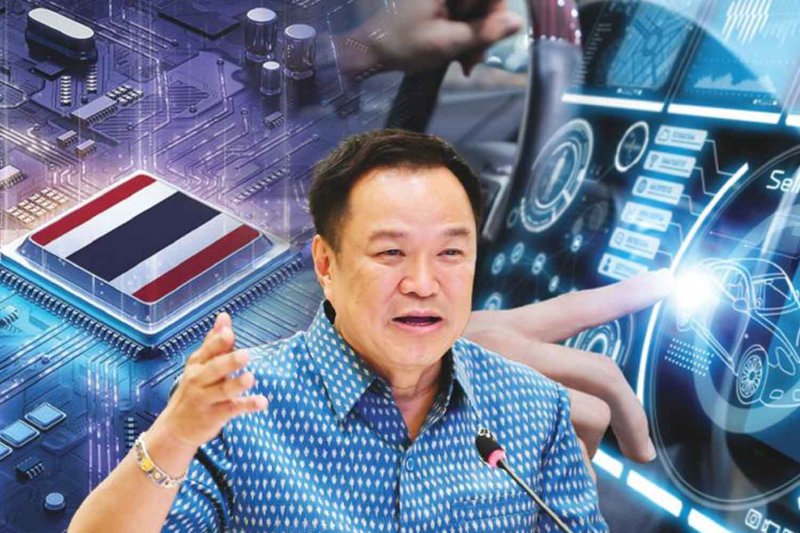
Prime Minister Anutin Charnvirakul is set to embark on a crucial visit to China later this week, aiming to strengthen economic ties and attract investment in Thailand's future industries, notably semiconductors, artificial intelligence (AI), and electric vehicles.
The trip, scheduled from July 16-20, will take Mr Anutin to Beijing and Shanghai, where he will meet with senior Chinese officials and business leaders.
The mission is part of a broader government strategy to position Thailand as a hub for advanced technologies.
Industry Minister Varawut Silpa-archa said the visit will serve as an investment roadshow in major Chinese cities, designed to boost GDP growth and raise gross national income.
"The government expects these roadshow opportunities to help roll out fast-track approval for investment projects," he said.
To support this initiative, authorities are implementing the Thailand Fast Pass investment facilitation programme, which aims to cut red tape and accelerate procedures for prospective investors.
China has long been one of Thailand's most significant sources of foreign direct investment (FDI), particularly in clean energy, smart electronics and digital industries.
According to the Board of Investment, FDI expanded in the first quarter of this year, with 427 projects worth 965 billion baht. Singapore led the pack with 837 billion baht, followed by the UK at 47 billion baht, Japan at 22 billion baht, and China at 17 billion baht.
Mr Anutin earlier signed an order establishing the National Semiconductor and Advanced Electronics Policy Committee, underscoring the government's determination to expand the semiconductor industry.
This move aligns with Thailand's long-term vision to strengthen competitiveness and develop future industries such as robotics, AI and clean energy.
The government considers semiconductors vital to sustainable economic growth and has set ambitious targets: attracting 2.5 trillion baht in investment, training over 230,000 highly skilled workers, and bringing "Made in Thailand" semiconductor products to market by 2050.
Finance Minister Ekniti Nitithanprapas emphasised the importance of data centres in supporting AI development. If Thailand has data centres, it can expand its cloud services industry, he said.
In the automotive sector, under the "30@30" policy, Thailand wants EVs to account for 30% of total auto production by 2030, including 725,000 zero-emission cars, 675,000 electric motorcycles, and 34,000 electric buses and trucks.