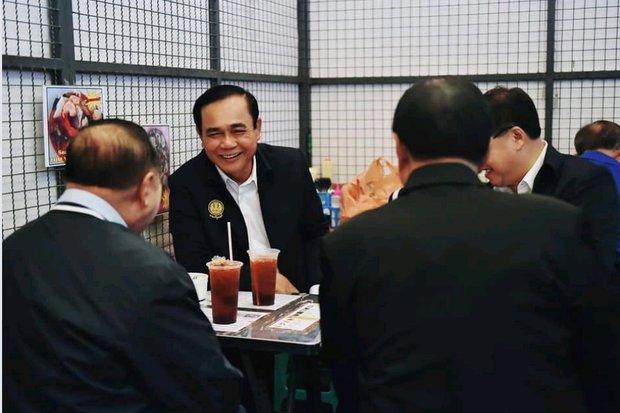
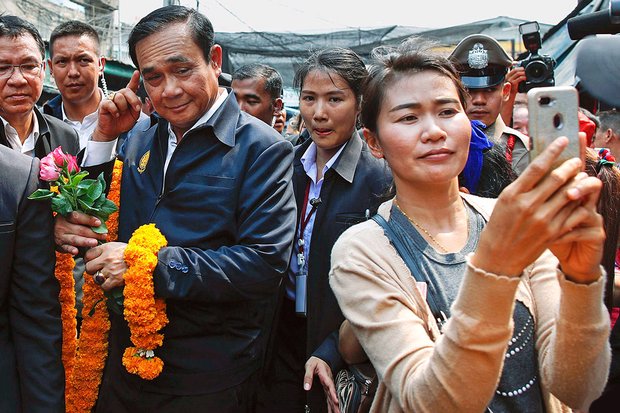
Prime Minister Prayut Chan-o-cha's controversial visit to Chatuchak weekend market on Saturday has sparked more criticism that he was helping the Palang Pracharath Party (PPRP) run its election campaign.
The PPRP, which had been scheduled to canvas for votes in the Chatuchak area the same day, was aware of being a target, so it decided to postpone its trip to Sunday to avoid claims it was taking advantage of its rivals, PPRP executive Buddhipongse Punnakanta said in a response to the criticism.
Among critics who feel government officials do not maintain enough impartiality during the lead-up to the poll on March 24 is Khunying Sudarat Keyuraphan, chief of the Pheu Thai Party's strategic committee.
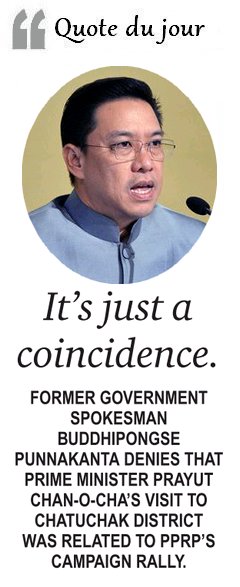
She lashed out at Gen Prayut, who is a prime ministerial candidate for the PPRP, amid reports of allegedly unfair election competition.
"I have one question to ask the prime minister," Khunying Sudarat said as she helped her party introduce its election candidates at Siam Square on Sunday.
"Is the [alleged] use of power by the premier in a way that 'tends to benefit certain parties' legal and appropriate?"
She also asked the Election Commission (EC) to respond to the accusation and asked if the EC "will let the situation go like this until election day?"
Gen Prayut is not allowed to help the PPRP seek votes, Deputy Prime Minister Wissanu Krea-ngam said earlier last week.
However, Mr Buddhipongse said Gen Prayut did nothing wrong during his visit as it was part of the prime minister's job.
The premier led his ministers to inspect the work of the Bangkok Metropolitan Administration which has entered contracts with vendors allowed to run shops in the City Hall-owned market. Mr Buddhipongse insisted Gen Prayut can not help the PPRP seek votes.
Meanwhile, the March 24 election in general, followed by the possible dissolution of the Thai Raksa Chart party, were the most interesting political news stories reported by various forms of media last week, according to a survey by Suan Dusit Rajabhat University, or Suan Dusit Poll.
The poll was conducted on Feb 12-16 among 1,186 people across the country.
Asked which news items they found most interesting, a majority -- 62.5% -- cited the March 24 election, saying it is an important event which could lead to changes in the country; 30.2% cited ongoing legal dramas such as the proposed dissolution of the Thai Raksa Chart Party, the case against six former leaders of the People's Alliance for Democracy (PAD) and the 15-day closure of Voice TV ordered by the National Broadcasting and Telecommunications Commission; 21% the nomination of candidates for prime minister by various parties; 19.8% new candidates and new political parties; and 15.2% the election campaigns by the political parties.
Asked what concerned them most in these news stories, 39.4% mentioned possible election fraud; 31.9% a possible coup; 27.4% the country's economy and their livelihood after the election; 20.5% how the new prime minister would be elected; and 14.2% the methodology of casting ballots in the election.
Asked whether the news would influence their vote, 35.4% said they would have to gather more information, especially about the policies of each party and the qualifications of candidates; 24.6% said "no", saying they already had a candidate and party in mind; and 15.8% said they were determined to exercise their right to vote.