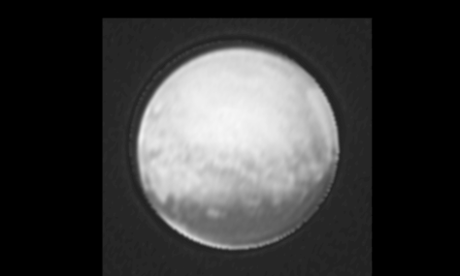
Nasa has released the most detailed picture yet taken of dwarf planet Pluto, captured by the New Horizons spacecraft.
Taken from a distance of 8m kilometres, the relative close-up of the icy world on the fringes of the solar system was sent back to earth on 8 July.
A distinct heart shape can be seen in the corner of the image, which was transmitted following a brief communications dropout over the weekend.
It has been a nine-year wait for the spacecraft to edge close enough to Pluto send back pictures.
“It’s just juicier and juicier,” New Horizons scientist Hal Weaver said.

“The science team is just drooling over these pictures. If you look at the new pictures now, it’s already five to six times better resolution than what we’ve been able to get before”
Recent days have also seen the publication of fresh images of Pluto and its moon Charon.
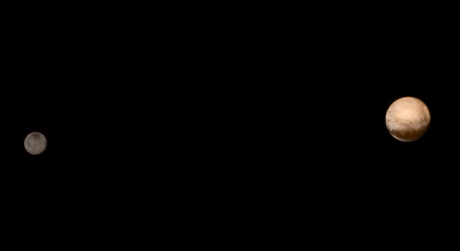
The satellite has a similarly cold climate but the differences end there; while Pluto has an atmosphere, Charon does not. Frozen water exists on the surface of Charon, while Pluto is thought to be covered in frozen nitrogen, methane, and carbon monoxide.
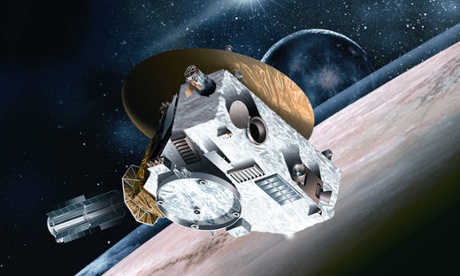
New Horizons will speed past Pluto on July 14 with its scientific instruments gathering data.
As well as taking pictures, New Horizons is taking samples of the solar winds and magnetic fields in Pluto’s vicinity, as well as measuring atmospheric dusts.
Pluto has five known moons. Four of them – Nix, Hydra, Kerberos and Styx were discovered in the past decade by the Hubble space telescope. Charon was discovered in 1978 and is almost half the size of Pluto itself.
Pluto was discovered in 1930 and thought to be the solar system’s ninth planet, but was reclassified as a dwarf planet in 2006.