
Closing summary
I’m wrapping up this live coverage now, but we will have a fresh live blog when the New Horizons team unveils its first findings from the Pluto flypast – that briefing is on Wednesday at 3pm ET (8pm BST/Thursday 5am AEST), and you’ll be able to find that live blog via our Pluto page here.
Before I sign off, a quick round-up of what we learned as Nasa and co celebrate this latest space success:
- The New Horizons probe has made contact with Earth, proof that the spacecraft survived its historic flyby of Pluto.
- The signal was received at precisely 8.52.37pm Eastern time.
- Scientists working on the mission said New Horizons had experienced no problems or error messages, and everything had gone to plan.
- Alice Bowman, mission operations manager, said:
We have a healthy spacecraft. We’ve recorded data of Pluto’s system and we’re outbound from Pluto.
Just like we practised, just like we planned it. We did it.

- The success of the mission means that humans (more specifically, the US) have now reached every single planet in our solar system. (If the scientists involved are happy to call Pluto a planet, I’m just following their lead.)
- So far, only engineering data has been downloaded.
- From Wednesday 5.50am ET (10.50am BST/7.50pm AEST), scientific data will begin to be transferred to mission control.
- This will bring fresh images of Pluto – at 10 times the resolution of even the best pictures so far seen – as well as a wealth of information on the (dwarf) planet, as well as the moon Charon and its other satellites.
-
These will be unveiled at a press conference on Wednesday at 3pm ET (8pm BST/Thursday 5am AEST).
- About 99% of the data New Horizons has collected on its journey is still on the spacecraft, and it will take around 16 months to download it all.
- And the Pluto heart that has garnered so much attention is, we learned, “two-toned”.

That’s it for now – thank you for reading and for all your comments.
We’ve heard a lot about New Horizons “phoning home”, but as this Nasa update explains, the preprogrammed call was “a 15-minute series of status messages beamed back to mission operations at the Johns Hopkins University applied physics laboratory in Maryland through Nasa’s Deep Space Network”.
Travelling at the speed of light, the signal took four hours and 25 minutes to reach Earth, crosssing 4.7bn km of space.
Here’s the probe behind it all – well, a replica model. The real New Horizons is, as Associated Press, helpfully puts it, “the size of a baby grand piano”.
It also moves faster than any spacecraft ever built – at a speed of about 30,800 miles an hour (49,570 kph).

Updated
The New Horizons team is promising bigger and better images in its next briefing at 3pm ET Wednesday (8pm BST/Thursday 5am AEST).
This short clip posted to the Nasa Instagram account shows how the New Horizons images of Pluto over the last week have become ever clearer and more detailed.
Later on Wednesday, Nasa says, it will share new images, from the very closest point of the flyby, that will be 10 times the resolution of the best picture we’ve seen so far – “with details as small as New York’s Central Park”.
Summary
A recap of the groundbreaking (space-breaking?) events of the last few hours:
Nasa’s New Horizons spacecraft has made contact with Earth, confirming its successful flypast of Pluto, after a journey to the far reaches of the solar system that has taken nine-and-a-half years and 3 billion miles (4.88bn km).
At precisely 8.52.37pm Eastern US time, the probe “phoned home” to mission control in Maryland, 13 hours after it flew within 7,750 miles (12,472km) of Pluto.
Scientists greeted the news of its safe passage with cheers and tears, calling it a historic day for space exploration.
The successful mission means humans – specifically, the US – have now reached all nine planets of our solar system.
Although Pluto was reclassified as a dwarf planet in 2006 – just months after New Horizons set off on its mission – Charles Bolden, Nasa’s chief administrator, said he hoped that decision would be reconsidered.
The New Horizons spacecraft had passed by Pluto and its five moons at 7.49am EDT (12.49 BST/9.49pm AEST) on Tuesday. It spent the following eight hours continuing to collect data and images from the last major unexplored body in our solar system, before sending out its signal home.
The contact with flight controllers at the Johns Hopkins University applied physics lab in Maryland, some four-and-a-half hours later, sparked a wave of shouts and applause from the crowd gathered to watch the historic moment unfold.
Alice Bowman, the mission operations manager, said no errors or problems with the probe had been recorded: “We have a healthy spacecraft. We’ve recorded data of Pluto’s system and we’re outbound from Pluto … Just like we practised, just like we planned it. We did it.”
Read our latest article here:
Updated
In the wake of the successful flyby – and the enormous public interest in this venture – might Pluto’s standing receive a bit of a bump?
Associated Press reports that scientists involved in the mission would like to see Pluto restored to full planetary status:
The US is now the only nation to visit every planet in the solar system. Pluto was No. 9 in the lineup when New Horizons left Cape Canaveral, Florida, in 2006, but was demoted seven months later to dwarf status.
Scientists in charge of the $720m mission hope the new observations will restore Pluto’s honour.
Principal scientist Alan Stern and other so-called plutophiles posed for the cameras giving nine-fingers-up “Pluto Salute”.
In the meantime, perhaps Pluto can console itself with that other badge of honour: the postage stamp.
Stern and his colleagues wasted no time pressing the US Postal Service for a new stamp of Pluto.
The last one, issued in 1991, consisted of an artist’s rendering of the faraway world and the words: “Pluto Not Yet Explored”. The words “not yet” were crossed out in a poster held high Tuesday for the cameras.

Nasa has now posted video of the moment the signal was received by mission control, and the mounting excitement among the scientists as check after check revealed the spacecraft had done exactly what they had planned.
(And yes, they are all calling mission operations manager Alice Bowden “mom”.)
Updated
Well, we thought the New Horizons team was going to get some sleep …
This is how you celebrate a #PlutoFlyby. Champagne in a blender. And a flag. pic.twitter.com/zLbj8RxvWL
— Amy Shira Teitel (@astVintageSpace) July 15, 2015
What was New Horizons up to in the hours between its Pluto flyby and the moment it sent that signal back to Earth?
Reuters has this handy background:
New Horizons spent more than eight hours after its closest approach looking back at Pluto for a series of experiments to study the planet’s atmosphere and photograph its night-side using light reflected off its primary moon, Charon.
Sending back its first post-flyby signal took another 4½ hours – the time it takes radio signals, traveling at light speed, to travel the 3 billion miles (4.88 billion km) back to Earth.
Already, the trickle of images and measurements relayed from New Horizons before Tuesday’s pass by Pluto has changed scientists’ understanding of this diminutive world, which is smaller than Earth’s moon.
Once considered an icy, dead world, the planetoid has yielded signs of geological activity, with evidence of past and possibly present-day tectonics, or movements of its crust.
“This is clearly a world where both geology and atmosphere climatology play a role,” said Alan Stern, New Horizons lead scientist, with the Southwest Research Institute in Boulder, Colorado.
He noted that it appears that nitrogen and methane snow fall on Pluto.
It will take about 16 months for New Horizons to transmit back all the thousands of images and measurements taken during its pass by Pluto.
By then, the spacecraft will have traveled even deeper into the Kuiper Belt, heading for a possible follow-on mission to one of Pluto’s cousins.
Assuming your ability to be impressed has not been completely sated, here’s a killer stat: after travelling for 4.88bn km and nine-and-a-half years, New Horizons carried out its Pluto flyby within 72 seconds of its expected time.
And it was early, to boot.
That's 99.999976% accurate.
— Kyle Hill (@Sci_Phile) July 15, 2015
What we know so far
As the New Horizons team has been keen to stress: there’s a LOT more to come.
But for now, here’s what has happened so far.
- The New Horizons probe has made contact with Earth, proof that the spacecraft survived its historic flyby of Pluto.
- The signal was received at precisely 8.52.37pm Eastern time.
- Scientists working on the mission said New Horizons had no problems or error messages, and everything had gone to plan.
- Alice Bowman, mission operation manager, said:
We have a healthy spacecraft. We’ve recorded data of Pluto’s system and we’re outbound from Pluto.
Just like we practised, just like we planned it. We did it.
- The success of the mission means that humans (more specifically, the US) have now reached every single planet in our solar system. (If the scientists involved are happy to call Pluto a planet, I’m just following their lead.)

- So far, only engineering data has been downloaded.
- From Wednesday 5.50am ET (10.50am BST/7.50pm AEST), scientific data will begin to be transferred to mission control.
- This will bring fresh images of Pluto – at 10 times the resolution of even the best pictures so far seen – as well as a wealth of information on the (dwarf) planet, as well as the moon Charon and its other satellites.
-
These will be unveiled at a press conference on Wednesday at 3pm ET (8pm BST/Thursday 5am AEST).
- About 99% of the data New Horizons has collected on its journey is still on the spacecraft, and it will take around 16 months to download it all.
- And the Pluto heart that has garnered so much attention is, we learned, “two-toned”.
Updated
Nasa says its “sneak peek” image of Pluto – the most detailed picture we have so far (for the next 15-and-a-half hours, anyway) – was its most popular Instagram post ever. It’s currently up to 308,000 likes.
British cosmologist Stephen Hawking has sent his congratulations to the team behind the successful New Horizons mission.
In a message recorded before the signal was received, and broadcast on Nasa TV, Hawking said:
Now the solar system will be further opened up to us, revealing the secrets of distant Pluto.
We explore because we are human and we want to know. I hope that Pluto will help us on that journey.
The scientists might have nipped off for some sleep, but New Horizons’ work is far from done:
Now 471,030 miles from Pluto & taking pictures to look for rings & moons. There's a lot of black sky out here. #PlutoFlyby
— NASA New Horizons (@NASANewHorizons) July 15, 2015
Two smart readers think that the spectrometers on board New Horizons, named Alice and Ralph, might in fact have been named after Alice and Ralph Kramden from US sitcom The Honeymooners:
@Claire_Phipps suspect Ralph and Alice might be a reference to the Kramdens from The Honeymooners.
— Adam Cathro (@adamcathro) July 15, 2015
Pluto flyby in numbers
4.88 billion – the distance in km (3 billion miles) travelled by New Horizons to reach Pluto.
9.5 – years ago that the mission began.
7.49am ET – the time New Horizons carried out its historic flyby (12.49pm BST/9.49pm AEST).
8.52.37pm ET – the time the signal from New Horizons was received at mission control (1.52am BST/10.52am AEST).
4.5 – hours it took for the signal to travel from New Horizons to Earth.
12,472 – the closest distance in km (7,750 miles) New Horizons was from Pluto.
99 – percentage of data collected by New Horizons that has yet to be downloaded from the spacecraft.
16 – months it’s expected to take for New Horizons to transmit back all its data.
What happens next?
Immediately, the New Horizons team are (supposed to be) getting some sleep.
But they promise the best is yet to come.
At 5.50am ET (10.50am BST/7.50pm AEST) on Wednesday, the next dataset begins to be downloaded, a process that will take several hours.
This dataset contains the scientific information collected by New Horizons during its closest flyby of Pluto, including images at 10 times the resolution we have seen so far.
There will also be information from the two spectrometers – named Alice and Ralph (after, I’m going to assume, Alice Bowman and Ralph Semmel) – as well as detail on Charon and small satellites.
[Update: readers have suggested this more convincing source for Ralph and Alice.]
This Nasa blog has a wealth of information on Alice and Ralph (the ones in space) and other instruments on New Horizons. Briefly, Ralph is a multi-spectral visible imaging camera; and Alice is an ultraviolet imaging spectrometer.
We will see the results of this dataset at a press conference on Wednesday at 3pm ET (8pm BST/Thursday 5am AEST).
Updated
This is a rather sobering thought – brought to us, however, by a man who has a job title to dream of: Dennis Overbye, cosmic affairs correspondent for the New York Times.
Ponder this as you prepare to dream tonight. http://t.co/TUuMV1pq3s pic.twitter.com/R6Q4RGUiY4
— NYT Science (@NYTScience) July 15, 2015
Alan Stern, New Horizons principal investigator, has had worse days:
Pretty good day today. How about yours? #PlutoFlyby
— AlanStern (@AlanStern) July 15, 2015
If you were listening to the Nasa coverage as scientists confirmed in turn to mission operations manager Alice Bowman that all data and telemetry had been received, and wondered if they were in fact all calling her “mom”, the answer is yes, they were.
Bowman is, apparently, known as “the mom of the MOC” (missions operation center).
Another satisfied space-watcher:
Pluto just had its first visitor! Thanks @NASA - it's a great day for discovery and American leadership. pic.twitter.com/FfztBSMbK0
— President Obama (@POTUS) July 15, 2015
Alice Bowman details what New Horizons is up to right now: it’s on track, outbound from Pluto. It will turn around to look back at the planet to take more images as it moves away.
Time of signal was 8.52.37pm Eastern US time
It’s confirmed that the precise moment when contact was made was 8.52.37pm ET.
Updated
One of the mission children – born when New Horizons embarked on its mission in January 2006 – gets to ask a question and it’s a good one: what is the extended mission goal?
Stern says his ambition would be the exploration of the Kuiper belt – and the funding to do it.
Fountain says his goal is:
to go where no New Horizons spacecraft has gone before.
Updated
New images and information at 3pm ET Wednesday
A new dataset – nicknamed the New York Times dataset, apparently, which they will be chuffed about – will begin to be downloaded at 5.50am ET on Wednesday (10.50am BST/7.50pm AEST).
This will last several hours, Stern says.
It will contain new imagery at 10 times the resolution of the best picture New Horizons has so far sent back from Pluto.
There will also be information from the two spectrometers – which are, charmingly, called Alice and Ralph – as well as detail on Charon and small satellites.
This will be unveiled at a press conference on Wednesday at 3pm ET (8pm BST/Thursday 5am AEST).
Was she worried that New Horixons might not survive, Bowman is asked:
You have a lot of faith in your children but sometimes they don’t do exactly what you want them to do … so you worry.
But our spacecraft did exactly what it was supposed to do and the signal was there.
Only engineering data has so far “come home”, says Stern. It was a deliberate decision not to bring home scientific data at this point, he says, as New Horizons is still busy collecting more.
Bowman says the key information tonight was to make sure the spacecraft was happy. But they know the data has been collected.
Glen Fountain, the project manager, says his remarks will be brief because the science team is desperate to get back to see what data is coming in from New Horizons.
Most people thought this was not possible, he says. But they have reached their “magnificent goal”.

Fountain hands over to Alice Bowman, mission operations manager and clear superstar of the day, who, he says, “has guided this spacecraft across the solar system”.
It had to be flawless, she says, but the team was up to the challenge.
I can’t express how I’m feeling to have achieved a childhood dream of space exploration.
Please tell your children … do what you’re passionate about. Don’t do something because it’s easy … Give yourself that challenge and you’ll not be sorry for it.
So: here we go. Out to the solar system.
Updated
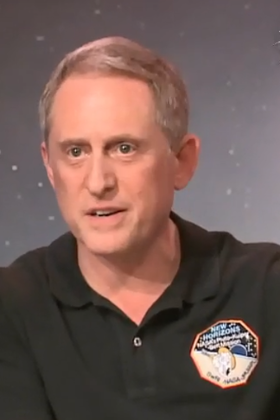
Alan Stern, New Horizons principal investigator, is up next. He says what has happened in the last few hours was “one small step for New Horizons and one giant leap for mankind”.
(I wonder where he got that from?)
He applauds all of those on the team.

John Grunsfeld, astronaut, and associate administrator of Nasa, speaks now.
He says this is really the beginning of the mission – the equivalent of the Mars rover landing.
He says tomorrow will bring further amazing revelations, including new images.
We have opened up a new realm of space discovery.
But he says it is a human achievement:
The spacecraft just did what you [the team] said.
He says the team should now go home and get some sleep.
In the audience are some children who were born when New Horizons began its journey, on 19 January 2006 – now aged nine-and-a-half.
Bolden says to the Nasa team:
You have inspired the next generation unbelievably … You have made Pluto almost human.
We are going to be further mesmerised by this planet.
Nasa administrator Charles Bolden says today is “an incredible milestone”.
Bolden is wearing a sling; he says before surgery last week, all his doctor wanted to talk about was New Horizons.
It’s not over, he reminds us.
The United States is the first nation to reach Pluto … We have visited every single planet in our solar system.
You really need to stop and think about that.
We did it. It has been a long time coming.
A sneak peek of news from New Horizons: that beautiful Pluto heart, Semmel says, turns out to be two-toned.

Dr. Ralph D. Semmel, director of the Johns Hopkins applied physics lab, says New Horizons demonstrates what the world can achieve when people work together.
He says the team behind the mission are rock stars.
But as I’ve seen the global excitement grow … it’s a point of pride in the world.
Now the cool science just continues to roll on.
The team looks pretty happy. They haven’t actually begun speaking yet, because the audience WILL NOT STOP APPLAUDING.
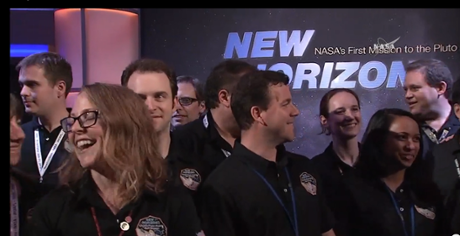
New Horizons team briefing: live
The New Horizons team is now at Johns Hopkins University applied physics lab, outside Baltimore, to talk about their good day at the office.
I’ll have live updates here as they talk about the Pluto flyby.
Summary
Reuters has filed this take on the confirmation of New Horizons’ survival:
A US spacecraft sailed past the tiny planet Pluto in the distant reaches of the solar system on Tuesday, capping a journey of 3bn miles (4.88bn km) that began nine-and-a-half years ago.
Nasa’s New Horizons spacecraft passed by the ice-and-rock planetoid and its entourage of five moons at 7.49am EDT (11.49am GMT/12.49pm BST/9.49pm AEST). The event culminated an initiative to survey the solar system that the space agency embarked upon more than 50 years ago.
About 13 hours after its closest approach to Pluto, the last major unexplored body in the solar system, New Horizons phoned home, signaling that it had survived its 31,000 miles per hour (49,000 km/hour) blitz through the Pluto system.
Managers had estimated there was a one-in-10,000 chance a debris strike could destroy New Horizons as it soared just 7,750 miles (12,472 km) –about the distance from New York to Mumbai – from Pluto.
But right on time, New Horizons made radio contact with flight controllers at the Johns Hopkins University Applied Physics Lab outside Baltimore, sparking a wave of shouts and applause from an overflow crowd gathered to watch the drama unfold.
With 99% of the data gathered during the encounter still on the spaceship, New Horizons’ survival was critical to the mission.
“This is truly a hallmark in human history,” said John Grunsfeld, Nasa’s associate administrator for science.
Scientists have many questions about Pluto, which was still considered the solar system’s ninth planet when New Horizons was launched in 2006.
Pluto was reclassified as a “dwarf planet” after the discovery of other Pluto-like spheres orbiting in the Kuiper Belt, the region beyond the eighth planet, Neptune. The objects are believed to be remnants from the formation of the solar system 4.6bn years ago.
Could the successful flyby – and the huge wealth of information it now brings us about farflung Pluto – see the dwarf planet restored to full planetary status?
Charles Bolden, Nasa’s chief administrator, would like that to happen.
In a live interview on Nasa TV on Tuesday, he said he hoped scientists would reconsider its classification:
I call it a planet, but I’m not the rule maker.

The wonder of these space missions in the social media age is that we can all see – and in almost real time, too – images and details of things that previously might have been the preserve of only a few scientists at Nasa HQ:
438,306 miles past Pluto, trying a hard measurement to capture crescent Pluto at 9 miles per pixel res. #PlutoFlyby pic.twitter.com/A9VYuKVvIC
— NASA New Horizons (@NASANewHorizons) July 15, 2015
What data will New Horizons be sending back to Earth?
As the Guardian’s science editor Ian Sample explains here, it will take 16 months to beam all of New Horizon’s data back to Earth.
About 99% of the data it has collected on its journey is still on the spacecraft.
Already, Ian reports, sensors on New Horizons have detected Pluto’s thin nitrogen atmosphere extending far out into space. Scientists believe it may shed snow, with flakes tumbling down to the surface before vaporising back into the atmosphere.
Other measurements from the probe have found that Pluto is larger than previously thought, at 1,470 miles across. That means it contains more ice beneath its surface and less rock than scientists had anticipated.
Images beamed back from New Horizons have shown Pluto in shades of red and orange, with hints of valleys, mountains and craters.
We should also learn more about Pluto’s five small moons: Charon, Styx, Nix, Hydra and Kerberos.
What happens now?
New Horizons is heading away from Pluto. With contact established with Earth, Nasa scientists will now begin to download data from the probe, including even closer images than we have so far seen.
More immediately, very shortly, scientists from mission control will be on Nasa TV to talk through today’s successes. I’ll have live coverage of that here.
'We did it'
Alice Bowman, mission operation manager, makes this announcement:
We have a healthy spacecraft.
We’ve recorded data of Pluto’s system and we’re outbound from Pluto.
Just like we practised, just like we planned it. We did it.
Updated
LOCKED! We have confirmation of a successful #PlutoFlyby. pic.twitter.com/Krfo9qxxHw
— NASA New Horizons (@NASANewHorizons) July 15, 2015
All the hardware is healthy, the data lock has been achieved, the thrusters are in good order, and everyone at Nasa is looking extremely happy.
New Horizons makes contact!
We’re with mission control now, waiting for the signal.
It’s surprisingly tense.
And they’ve done it. Huge scenes of jubilation at Nasa.
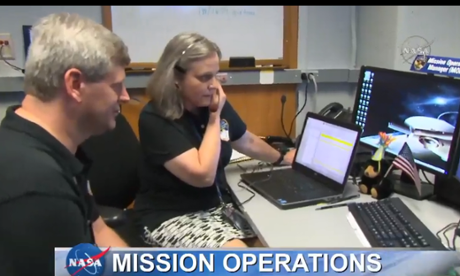
And for an even more breathtaking example of how the New Horizons mission has totally changed what we know about Pluto, this is hard to beat:
On the left: our best image of Pluto in May. On the right: our current best picture of Pluto. #NewHorizons #Pluto pic.twitter.com/qxmW7EnAWZ
— Andras Toth (@tothur) July 13, 2015
For a quick potted history of New Horizons and its incredible voyage, colleagues in Guardian graphics have put together this visual guide:
How likely is it that New Horizons will have managed its flyby successfully?
Nasa says the probe has been flying through the safest part of the Pluto system – but stresses that no one can be sure of its success until we receive that signal.
To give you an idea of how far this signal has to travel – it’s pretty mind-bending, whatever your level of knowledge – here’s how far away it was around 25 minutes ago: in the orbit of Jupiter.
The "phone home" signal is crossing Jupiter's orbit. Just 400 millions miles to go. #PlutoFlyby pic.twitter.com/62eflvs9yi
— NASA New Horizons (@NASANewHorizons) July 15, 2015
Here, courtesy of Nasa TV, is an image of Nasa mission control right now.
The scientists are eager to hear from New Horizons, they say, having been out of contact for “nearly a whole day”.
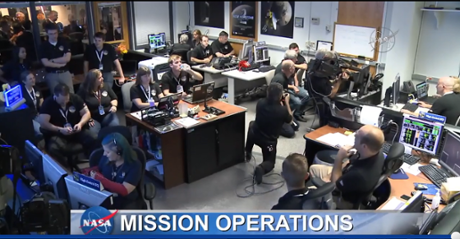
On its flight so far, New Horizons has travelled 3 billion miles (4.8bn km) in nine years.
Within the next half an hour, we hope to hear confirmation of its safe passage past Pluto – the first spacecraft to have achieved this incredible feat.
The signal from New Horizons would have been sent around four-and-a-half hours ago and is due to reach Earth at around 8.53pm ET (12.53am GMT/1.53am BST/10.53am AEST).
Updated
Opening summary
Welcome to live updates as Nasa scientists await the all-clear signal from the New Horizons probe – proof that Tuesday’s Pluto flyby took place successfully.
Cheers, whoops and flag waving broke out at Nasa’s New Horizons control centre as scientists celebrated the spacecraft’s dramatic flyby of Pluto, considered the last unexplored world in the solar system.
The probe shot past at more than 28,000mph (45,000 km/h) at 12.49pm BST (7.49am ET/9.49pm AEST) on a trajectory that brought the fastest spacecraft ever to leave Earth’s orbit within 7,770 miles of Pluto’s surface.
Mission scientists at Johns Hopkins University in Baltimore were out of contact with the spacecraft as it hurtled past the icy body 3bn miles (4.8bn km) from Earth. Instead the probe captured images and took measurements automatically and stored them on board to send back later.
Shortly we should hear if contact has been re-established. Stay tuned.













Alice and Ralph could also be a reference to their namesakes, the Kramdens, in the ancient-but-beloved The Honeymooners. "One of these days, Alice, POW! Right to ... Pluto!". (Time has caught up with its political [in]sensibilities.) https://en.wikipedia.org/wiki/The_Honeymooners