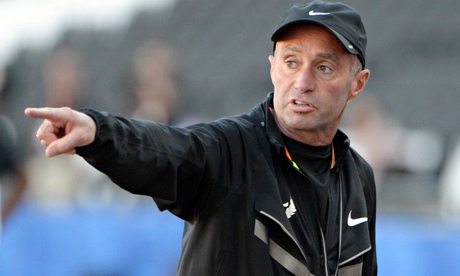
Whichever way you sway when you hear the accusations that have pecked away at Alberto Salazar’s name – and, judged on soundings here at Hayward Field, the majority are still inclined to give him the benefit of the doubt – this, at least, is clear. His punchy response to the BBC and ProPublica was not only an attempt to protect his reputation and achievements. It was a declaration of war. And wars force people to take sides.
Which brings us again to UK Athletics’ relationship with the legendary American coach. Of course it is close. Its best athlete, Mo Farah, trains with Salazar at the Nike Oregon Project. Its head of endurance, Barry Fudge, spends about a third of the year with Salazar. And Neil Black, the performance director, calls Salazar “absolutely brilliant‚ a genius‚ one of the best people to work with that I have ever come across.” But privately some wonder whether the special relationship has become too much of a love in.
Certainly Salazar’s 11,750-word letter, published on Wednesday, won’t dispel those notions. Indeed it contains a couple of intriguing nuggets that further hint how closely they have worked together. The first comes when Salazar addresses claims that he applied for a therapeutic use exemption on behalf of Galen Rupp during the 2011 World Championships in Daegu – something that Kara Goucher, a former member of the Oregon Project, has alleged.
After providing lengthy documentary evidence to dispute Goucher’s claims, Salazar adds: “Galen did not receive any vitamin shots in Daegu. The US team doctors did not have any needles and UK Athletics doctors could not treat a US athlete.”
This, perhaps inadvertently, refers to a rumour that has done laps round track and field circles: that after Salazar had his request for a TUE by a US doctor denied, he announced he would seek out a British one instead. The head of the UKA medical team in Daegu told the Guardian that Salazar never approached him and they would never have treated a US athlete, but even so – why does Salazar feel the need to mention UK Athletics doctors at all?
In his open letter, Salazar also makes several references to Ian Stewart, the former head of endurance for UK Athletics, when he sent Rupp medication while he was in Birmingham in February 2011. As he noted on the 12th of that month: “I notified Ian Stewart at UK Athletics that I have overnighted Galen his Z-Pak (Azithromycin-Pak 250mg tablets) but was concerned that it would get caught up in customs. To avoid that, I noted that I placed the pills in a magazine. I asked Ian to have Dr Thing prescribe the same medicine for Galen in the UK in case his prescription that I had sent does not arrive.”
True, Stewart was not only head of endurance at the time but the meet director in Birmingham. That meant he was in charge of logistics – including where athletes were staying. So, arguably, it was valid for him to be kept in the loop. Even so, it appears a little odd that one of the most senior figures in UK Athletics was getting a blow-by-blow account of a cross-Atlantic trip undertaken by a nasal spray. Stewart had not responded to phone calls at the time of writing.
Meanwhile, we are still waiting to hear more about the due diligence process that took place before Farah joined Salazar in 2011, under UK Athletics’ previous performance director, Charles van Commenee, and Stewart. Given the seriousness of the allegations it does not appear unreasonable to ask UK Athletics to show greater urgency, especially when it appears that Salazar was coaching the US athlete Mary Slaney when she tested positive for testosterone in 1996.
Some also believe that UK Athletics has been too quiet and pliant ever since the Panorama revelations were broadcast three weeks ago. It says it does not want to keep up a running commentary on the almost daily game of ping pong between Salazar’s supporters and the BBC and ProPublica.
It also says that it wants to wait until its performance oversight management group – which is investigating UK Athletics’ relationship with Salazar – reports back to them in early August before dispensing its verdict.
Even so, few expect a management group set up by UK Athletics – albeit an independent one – to do anything other than publish a vindication of UK Athletics, even if one of its three-person panel, Jason Gardener, has been a particularly vehement against doping in sport.
In the meantime, the almost daily ritual of accusation and rebuttal continues. But if this is turning into an increasingly messy war between Salazar and the BBC and ProPublica, shouldn’t UK Athletics try even harder to be scrupulously neutral?