It was, you might have thought, not possible to be among the millions who watched the World Cup final and not be thankful you were not the English referee Howard Webb, who took charge of the encounter between Spain and Holland. According to the Football Association, however, since that night of Dutch thuggery in Johannesburg there has been a dramatic increase in the numbers of football fans and players wanting to get into refereeing.
Tempting though it may be to put this down to an overwhelming desire on the part of the public to put a bunch of cheating, foul-mouthed and obscenely over-paid yahoos firmly in their place, for most aspiring new refs the appeal has nothing to do with a desire for retribution. "It's about pleasure, fresh air, exercise, social contact, a little pocket money and a genuine love of the game," said the FA's senior refereeing-manager Ian Blanchard. "As we all know, without a referee the sport doesn't go much further than a kickabout in the park.
"But it's also the case that officiating is increasingly being seen as a route to participation at a higher level. Last year the number of new referees coming into the game between the ages of 14 and 19 was 2,614. This year it's already over 4,400."
It is true that those on the National List of referees – those eligible to referee Premier and Football League games – are reasonably well paid. As well as a basic salary of between £45,000 and £65,000, determined by seniority and experience, referees receive a match fee (currently £350, whether you are at Old Trafford or Gigg Lane), and an annual bonus (based on performance assessments) of up to 20% of your salary.
Referees such as Webb, who are Fifa-rated and officiate European and international matches, receive additional match fees and expenses. With the education and development programmes now in place, Michael Oliver, who at 25 has become the youngest referee to officiate in the Premier League, is a good example of how quickly the new breed of career officials can hope to progress.
Whether it is enough to compensate for the pressure and abuse from supporters, players and managers is another matter. Or the shame when you get a decision wrong, and know you did.
Based on the embarrassment felt by this one-off assistant referee after awarding a throw-in to the wrong side when Daventry Town Under-12s met their counter-parts from Bugbrooke St Michaels in a pre-season friendly last month, how bad must Webb feel about not sending off Nigel de Jong for planting his studs in the rib cage of Xabi Alonso in the World Cup final?
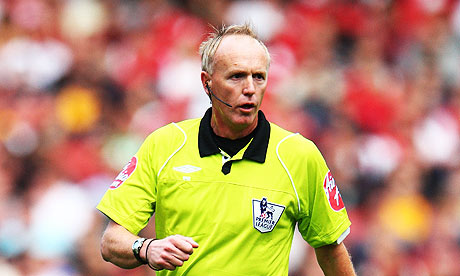
The problem, as I explained red-faced to the watching Premier League referee Peter Walton, was that I instinctively tried to stop the ball as it went past me to save someone having to go and get it. And then got flustered. "Lesson one; don't get distracted," said Walton, grinning.
Other than a couple of looks of disbelief, there is not the slightest hint of dissent from the boys, which if anything makes me feel worse. Nor (that I can hear) from the watching parents, which suggests the FA's ongoing Respect campaign is paying dividends.
According to Bugbrooke parent Nicki Kilshaw, problems at this level of the game are increasingly rare: "The clubs are very keen to make parents understand that they're there to support, not criticise, and that includes the officials as well as the players. In terms of quality, the younger refs tend to be better than the older ones. We had a 15-year-old girl recently and she was the best of the lot – brilliant, she was."
With a couple of hours of guidance and role-playing from Blanchard and Walton having served to emphasise the superficiality of my knowledge of the laws of the game, it is something of a relief when Walton describes my refereeing as "commendable".
"You were absorbed in the game, kept up with play – though you were maybe a bit too close to the ball sometimes – and made your decisions clear," he said. "In fact, your communication with the players was probably better than with your assistants."
For me, the constant involvement of refereeing makes it an infinitely more enjoyable – and therefore easier – experience than running the line. It certainly helps to be so wrapped up in the game that you become unaware of anything being said or shouted from the touchline. Walton – who contrary to the widespread belief that no referees can actually play the game was a semi-professional before training to become a referee – suggests this absorption also applies on the field.
"Believe it or not I don't suffer too much direct abuse from players as the game is played out so fast that you don't enter into many conversations," he said. "You might hear the crowd sometimes, but they are fans who see only one side, and judge accordingly. What does annoy me is when fans are ignorant of the law and do not [or don't want to] understand why I have to give certain decisions.
"Of course a natural empathy for the game is important, but like any job the key to enjoyment is competence. With the training programmes the FA are producing increasing numbers of competent, confident young referees, and that can only be good for the game."
The FA's Get Into Refereeing campaign in association with Carlsberg is part of the National Game strategy, a £200m investment in grassroots football. For more information about becoming a referee visit www.TheFA.com/referee