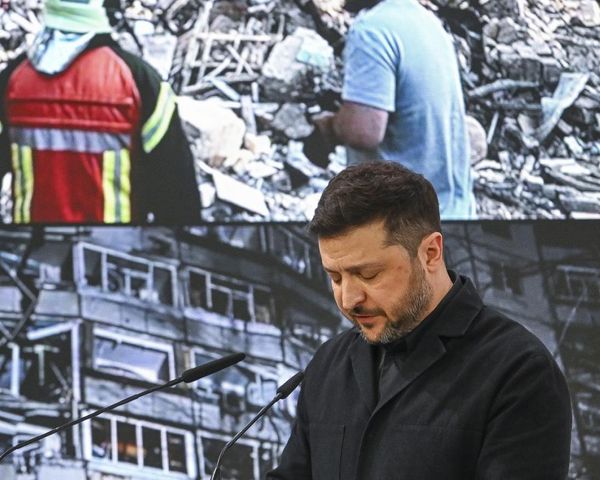
PASADENA, Calif. _ Although he's won almost every literary prize imaginable, playwright Terrence McNally's first big assignment threw him into deep trouble.
Still in high school, he worked part time at the local newspaper in his hometown of Corpus Christi, Texas.
"They trusted me to write stories," he says. "Not the biggest stories, but they'd say, 'There's a car accident, a robbery.' I interviewed Lyndon Johnson. He was Sen. Johnson then. He was in Corpus Christi talking about the oil depletion tax, which I have very little interest in.
"I could see his aides were very upset at my youth. While I was waiting for the senator to get off the phone with (his wife) Ladybird, he was looking through Playboy magazine. And I put that in the interview. And the __ hit the fan! They called the editor.
"He's looking at Miss September while he's talking to his wife, which I thought was very human. And I thought it made the piece memorable. Well, some people didn't think so."
As it turned out, it didn't matter what 'some people' thought because McNally went on to win four Tonys and author winning plays, "Frankie and Johnny in the Clair de Lune," "Master Class," the book for "Kiss of the Spider Woman," "Ragtime" and scores of other projects in his 79 years.
PBS will chronicle his accomplishments on its "American Masters" edition, "Terrence McNally: Every Act of Life" premiering June 14.
McNally believes the ability to write is a gift. "I'm a complete product of public school until I went to Columbia and I think you're trained," he says. " ... At Columbia I went to the theater or the opera or the ballet or Carnegie Hall almost every night. And I still graduated magna cum summa, whatever, at the top of my class," he says.
"And I think it's because I could write well ... . I think it's a skill that just came to me. And I said, 'I should develop this. I'm better at this than I am at sports. I can't sing. I don't want to be an actor.' The only other thing that interested me was being an architect."
He finds the goal of writing and architecture similar. "It's building, constructing something for other people to use," he says. "I feel like my plays are like blueprints, houses which actors and directors inhabit and decorate, coordinate."
While many are aware of his accolades, few know his struggles. He grew up in a divisive home, left at 17 to attend Columbia University, served as tutor to John Steinbeck's children, and launched his first play on Broadway when he was only 24. But McNally was also an alcoholic and an incorrigible cigarette smoker.
It was actress Angela Lansbury who took him aside at a party and remarked on his frequent imbibing. "She said, 'You're such a talented writer, why are you doing that to yourself?' When Angela Lansbury says that, you listen. She's kind, thoughtful ... And I went to an AA meeting and 'Frankie and Johnny' is the first play I wrote absolutely sober," he says.
"And of course, you think, 'Can I write anymore?' Of course, the cliche was if you were Irish and a playwright, you were an alcoholic _ you were Eugene O'Neill, you were Tennessee Williams. I think Arthur Miller is probably the only nonalcoholic American playwright practically," he shrugs.
"You can write when you're drinking to a point, but you don't write beyond 45. I wouldn't be alive if I'd kept drinking."
If sobriety was difficult, it was not nearly as onerous as putting out that cigarette, says McNally, who at 40, was up to three packs a day.
"Giving up smoking was very hard, because that's so easy to do. You wake up, you turn on the computer, and you start smoking right away. And it does affect you. You do feel withdrawal. It took a good year to stop smoking," he says.
It was another actress and another party that stymied that goal. "Elizabeth Taylor said, 'Would you like a cigarette?' And I said, 'Yes.' A year right down the drain.
"How can you say no to Elizabeth? She'll think you're a nerd."
A year later he quit for good, but subsequently developed lung cancer. "You get 20 years and you think you dodged that bullet. But I hadn't," he says.
"I'm dealing with lung cancer, so every day is a treat and a blessing ... My father died of lung cancer, and it used to be a diagnosis of lung cancer meant you were dead in six months. Now here I am 20 years later, managing it."
After a couple of liaisons (one with playwright Edward Albee), McNally has found love with his partner, lawyer and theater producer, Tom Kirdahy. They've been married for nine years, and McNally says meeting Kirdahy changed him.
"My husband (is) an ideal life partner," he says. "At 60 you think, 'Terrence, you've had your last cookie.' That's probably right. But we met," he smiles.
THOMPSON RUNS 'LATE' FOR COMEDY
Few may know that actress Emma Thompson actually began as a comedienne with Hugh Laurie in a sketch comedy shipped over from the U.K. called "There's Nothing to Worry About!" Although we've known her for her dramatic roles in "Howard's End," "The Remains of the Day" and "Angels in America," she's always wanted to specialize in comedy and has proven her rib-tickling expertise in several projects. The newest is the film "Late Night," premiering Friday. She plays a venomous talk show hostess who's worried about losing her job.
Whatever she's doing, Thompson says she's learned some valuable lessons from her accomplishments. "If you're successful and receive accolades, it's not very wise to listen to them because they may blind you to all kinds of imperfections," she says.
"Just because someone enjoyed your performance and said, 'That's great!' doesn't mean to say that someone else doesn't feel completely differently. You know that, if you've done comedy in theater. You can be standing up there and people will be laughing and you can hear laughter, then you look at the audience and see someone who's not laughing, but they're sitting next to somebody who is. So you understand you can't please everybody all time. You just can't. If you haven't got the ability to withstand the knocks, then you can't survive in this profession."
LAURA LINNEY TELLING 'TALES' AGAIN
It's been 26 years, but Laura Linney is back as the sweet Mary Ann Singleton in the newest incarnation of "Armistead Maupin's Tales of the City," premiering on Netflix Friday. The daughter of a playwright, she says, "When I knew I was going to study and pursue the theater, I didn't think about film or television. It didn't enter my consciousness. Really, I just didn't think about it. When I started doing small parts in movies, when I did the first 'Tales of the City,' I thought, 'Oh, I get it. This is good too. I'm enjoying this a lot.' That's the first time I thought I could maybe be involved in (television) as well," she recalls.
"Originally I auditioned for another role in 'Tales' and the casting director remembered me from the other audition and knew my work from New York. And I read for it and got it. I never took steps to make it happen ... For me the question was: Would I be any good at film or TV? They're wildly different from stage. I think I knew I could do it. With 'Tales,' I said, 'OK, I can be comfortable in this.'"
TV JUDGE ESPOUSES THE CLASSICS
"So You Think You Can Dance" is back on Fox next Monday for another go at finding the best of the best dancers. Former dancer and choreographer Nigel Lythgoe will be back as one of the judges. A purist at heart, Lythgoe says he thinks training in classical dance is critical, no matter what kinds of dance you're executing.
"It doesn't just give you a good base to build your technique from, it gives you discipline," he says.
"It makes you realize that you have to do it every single day. Even if you're not dancing that day, you should do a class every day. It just keeps your body right for everything else, and it gives you a firm base to build up whatever _ whatever styles are required of you," he says.
"And nowadays the choreographers will tell you a dancer is required to do everything. It isn't just pinning something down now. The amazing thing for me ... is that the kids that have a full formal training are not as creative as the kids that have had no training. Kids _ and this is generalizing, so don't get me wrong _ but the kids that have had a formal training, link steps together, and the kids that haven't had a formal training, are much more creative, from my point of view, and feel their music better."


.png?w=600)