There was no such thing as a safe passage through Auschwitz, though a slender guarantee of survival was afforded to those capable of playing a musical instrument. Anita Lasker Wallfisch, a founder of the English Chamber Orchestra, now aged 89, recalled that her cello saved her life: “As long as they wanted an orchestra, they couldn’t put us in the gas chamber.”
Among the other survivors of the Auschwitz Women’s Orchestra was Fania Fénelon, a French-Jewish cabaret singer whose memoirs were adapted by Arthur Miller, first as a television movie in 1980, and then as a play. It remains one of Miller’s most contentious and least-produced works. (The cast is large, the musical component is demanding, and other surviving members of the orchestra disputed Fénelon’s slightly self-aggrandising version of events.) But as the centenary of the playwright’s birth coincides with the 70th anniversary of the liberation of Auschwitz, it is clearly an opportune time for the Crucible’s ambitious revival.
Playing for Time might seem to be the missing link between Miller’s other Holocaust dramas, Incident at Vichy (1964) and Broken Glass (1994). In truth, it merely indicates that made-for-television movies were not really where his heart lay, as the construction feels awkward and the workmanlike dialogue curiously lacking in subtext or ambiguity. Director Richard Beecham compensates for the inconsistencies in the text by presenting it as a memory play, in which Fénelon is depicted by the outstanding Siân Phillips as a frail, fallible figure surrounded by the youthful women of her remembrance.
It’s hard to pay sufficient tribute to an actor in her 80s prepared to be so physically and psychologically abused. Nor does it matter that Phillips rasps through selections from Madam Butterfly practically in a baritone register, as Fénelon couldn’t sing Puccini properly either. And the tension in her throat suggests the effects of agonised complicity with the camp commanders, who commend the orchestra for “strengthening us in this difficult work of ours”.
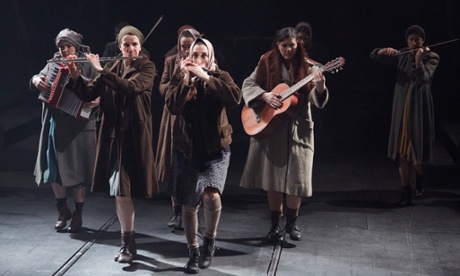
The band, under the musical direction of Sam Kenyon, play as well as they have to. It’s hard to imagine a more pitiful sound than their denuded rendition of Beethoven’s Fifth Symphony, with the horns replaced by a harmonica. A core of professional actors is augmented by members of Sheffield People’s theatre, creating a vivid sense of the inhumane chaos within the camp. And if one is left with the sense that Playing for Time may not be Miller’s greatest work of art, it makes a profound statement that art contains our greatest hope for redemption.
• Until 4 April. Box office: 0114-249 6000. Venue: Crucible, Sheffield