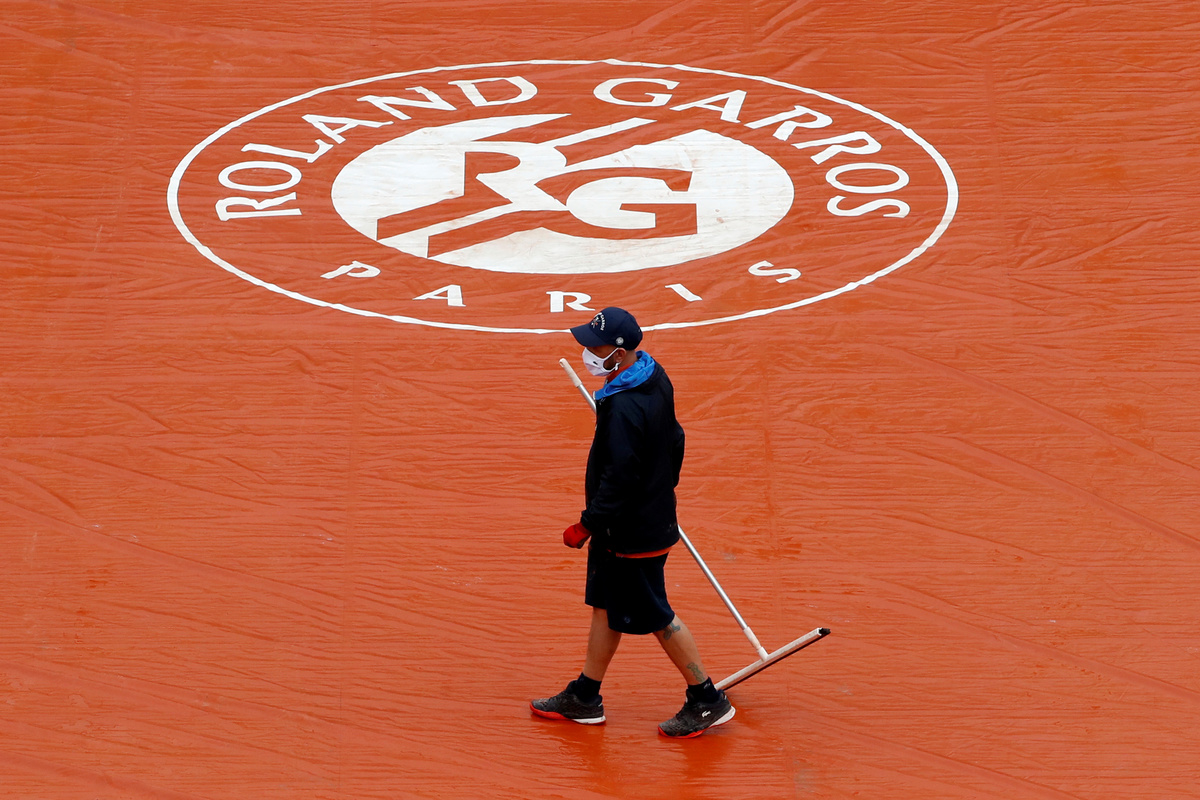
The balls are heavier, the air cooler, the clay damper and at this year's autumnal French Open the matches are going longer as players are forced to grind it out on the dirt.
Even in the balmy days of May and June, the tournament's usual date, the Parisian claycourts are the ultimate test of technique and mental and physical staying power.
But the switch to drizzly September because of the COVID-19 pandemic, plus a switch to a heavier ball, has given some players the impression that they are stuck in quicksand.
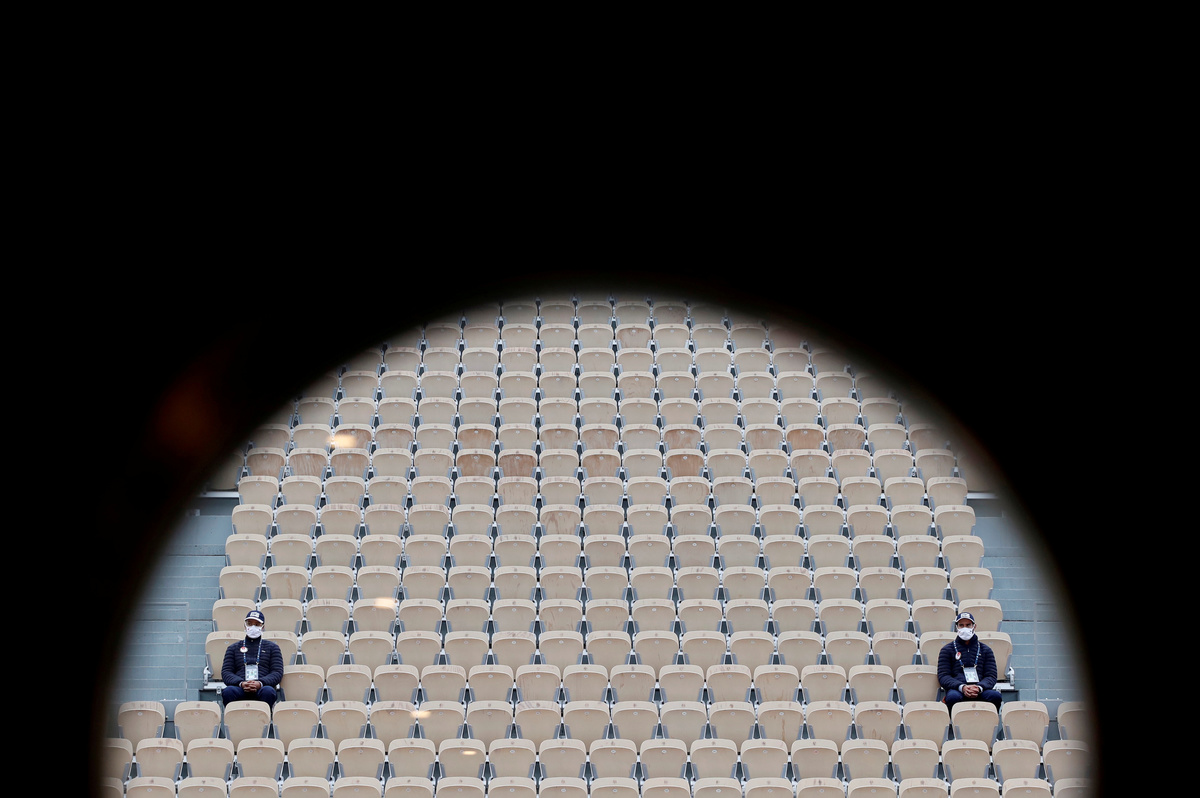
Six men's first-round matches have gone past the four-hour mark, including Lorenzo Giustino's six-hour epic against Frenchman Corentin Moutet which he won 18-16 in the fifth set.
Juan Ignacio Londero and Federico Delbonis spent nearly five hours settling their all-Argentine first round duel which Londero eventually won 14-12 in the decider.
In the women's first round four matches went longer than two and a half hours, with Spaniard Garbine Muguruza's 7-5 4-6 8-6 win over Tamara Zidansek stretching over three hours.
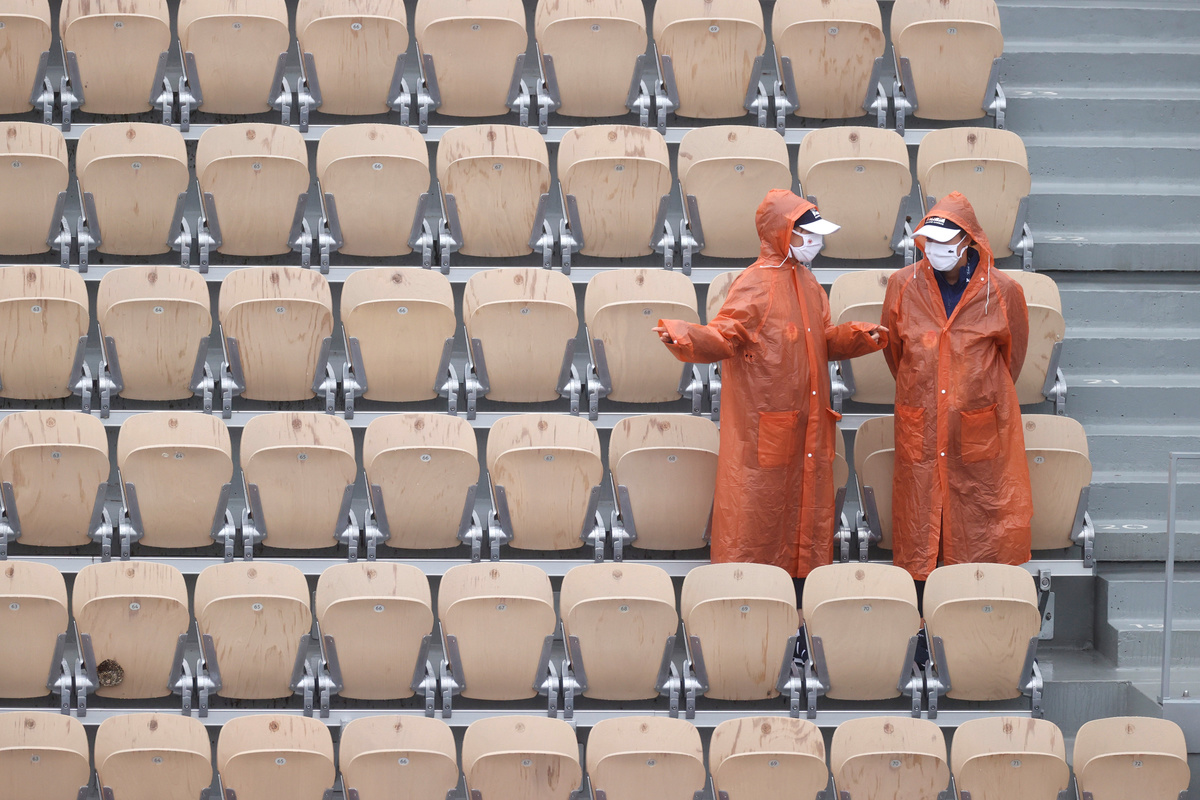
With drizzle and humidity making courts extra sticky, the choice of a heavier ball plus the athleticism of the players, the pattern of extended matches is likely to continue.
This raises questions as to why the French Open is the only one of the four Grand Slams not to use a tiebreak in the deciding set.
Wimbledon, scene of the world record 11-hour clash between Nicolas Mahut and John Isner in 2010, introduced a tiebreak at 12-12 in the fifth set in 2019. The U.S. Open paved the way when it brought in a final-set tiebreak at 6-6 in 1970.
The Australian Open, like the U.S. Open, has a tiebreak at 6-6 in the decider, but a first-to-10 version rather than the traditional first-to-seven employed in New York.
DIFFERENT RULES
The fact that the four Slams all have different ways to finish a match is a quirk many feel needs to change.
South African Kevin Anderson, whose 26-24 fifth set win over Isner in the 2018 Wimbledon semi-final prompted the All England Club to act, thinks the French Open should follow suit.
"I think it's good to have some sort of limit on it," he said after his first-round win over Laslo Djere on Tuesday.
"I would definitely encourage the French Open to do that."
Women's second seed Karolina Pliskova, who needed more than two hours to get past Egyptian Mayar Sherif on Tuesday, also thinks a tiebreak should be employed at the French.
"If it's 10-10, or something like that," she said. "I think tiebreaks would be brutal but, yeah, it's how it is."
Russian 13th seed Andrey Rublev slogged back from two sets down to beat Sam Querrey on Tuesday, the first time he had produced such a great escape in his career.
He said he relished long deciding sets.
"In my opinion, they shouldn't do tiebreak fifth," he told reporters. "These matches, it's something that you will remember, something that makes you understand why you worked so hard, doing all the tough exercises.
"They make you feel even more proud of yourself."
(Reporting by Martyn Herman; Editing by Ken Ferris)