The Tokyo 2020 Playbooks, which include strict novel coronavirus control guidelines for all participants of the Tokyo Olympics and Paralympics, were put in force Thursday for athletes and officials.
In response to a member of the Ugandan Olympic team testing positive at Narita Airport, the central government changed its plan so that team members suspected of having close contact with COVID-19 patients will travel from airports to their training camps by a separate bus.
-- Athletes streaming in
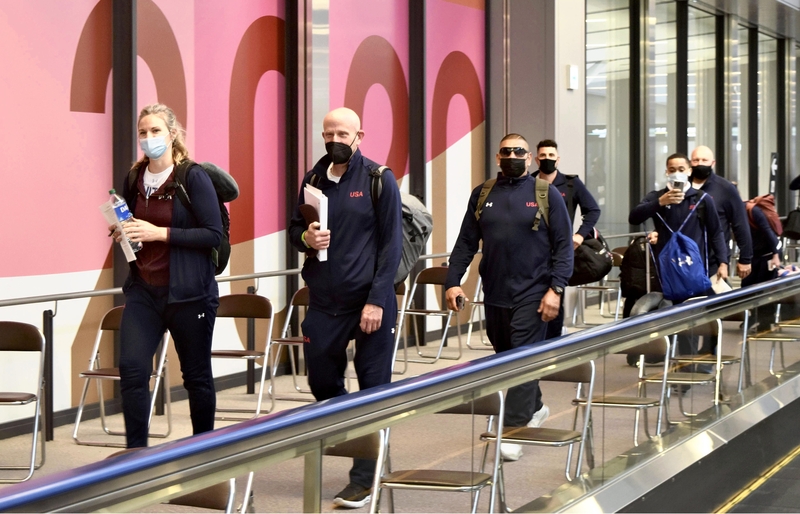
On Thursday afternoon, about 20 members of the U.S. boxing team arrived at Narita Airport.
Airport liaison officials -- a group sent from the Tokyo Games organizing committee to guide overseas teams and confirm whether anyone tested positive -- met and boarded the plane. After the general passengers had disembarked, the officials ushered the U.S. team to the virus testing area via a special lane. On the same day, the 40-member German rowing team arrived at Haneda Airport.
In all, more than 100 athletes entered Japan on the day. A smartphone app for athletes to record their body temperature each day has also been launched to make sure that no one becomes sick after entering Japan.
According to Tokyo Games sources, about 3,400 people are scheduled to come to Japan for preparatory training before the opening of the athletes village on July 13 in Chuo Ward, Tokyo. Private buses will be used in principle for their travel from airports, but 1,500 of them will have to use airplanes or Shinkansen trains as their destinations in Japan are far from Tokyo.
-- Lessons from Uganda's case
According to the third edition of the Playbooks released last month by the International Olympic Committee (IOC), athletes will undergo testing twice within 96 hours before departure from their home countries. Upon entering Japan, they will undergo a saliva test at the airport. They will proceed to their training camps if they test negative and will commute between their hotels and training grounds by special car.
When the Ugandan team arrived in Japan in June, one of the members tested positive at Narita Airport and was quarantined. However, the remaining eight people continued on to Izumi-Sano, Osaka Prefecture, by bus without officials identifying which of them had been in close contact with the patient. Later, another person was found to have been infected, and an Izumi-Sano city employee and a bus driver who accompanied the team were identified as close contacts.
"We didn't quite simulate a scenario in which team members tested positive at an airport quarantine," a senior Cabinet Secretariat official said Wednesday. A new government quarantine scheme was later announced.
-- Vehicles prepared by govt
From July 1, if a person tests positive at the airport, he or she will be taken to a clinic in the athletes village by a specially designated car prepared by the organizing committee, and get a PCR test with a swab sample. If they test positive again, the athlete will be sent to a nearby recuperation facility or a hospital.
Those who enter Japan together with the patient will be designated as "possible" high-risk contacts if their seat on the plane was within two rows of the patient, regardless of their test results. They will travel to their training camps separately from their teammates, in a vehicle prepared by the central government. Whether they are definitely high-risk contacts will be confirmed by a local public health center near the camp after their arrival. In that sense, they will continue being isolated from others at the "suspected" stage in order to prevent possible virus transmission during travel within Japan.
The spread of the coronavirus since this year has forced many foreign athletes to cancel their training in Japan. The IOC had planned to allow the athletes to enter the athletes village five days before their respective events, but the Tokyo organizing committee is preparing to open the village earlier than this rule so that athletes can prepare themselves for the Games there.
"Some teams that canceled their training camps want to come to Japan earlier in order to adjust to the time difference and physical conditions," a senior organizing committee member said. "We want to take thorough infection control measures and accept them."
Read more from The Japan News at https://japannews.yomiuri.co.jp/