Among accessibility features, platform doors at train stations directly benefit everyone's lives. In the run-up to the Tokyo Olympics and Paralympics, the construction of platform doors had been proceeding at a rapid pace, but only around one-tenth of all stations in Japan have them.
As of March 31, 2020, 858 stations had platform doors installed, an increase of more than 240 stations from 2015, but still only 9% of the 9,500 stations nationwide.
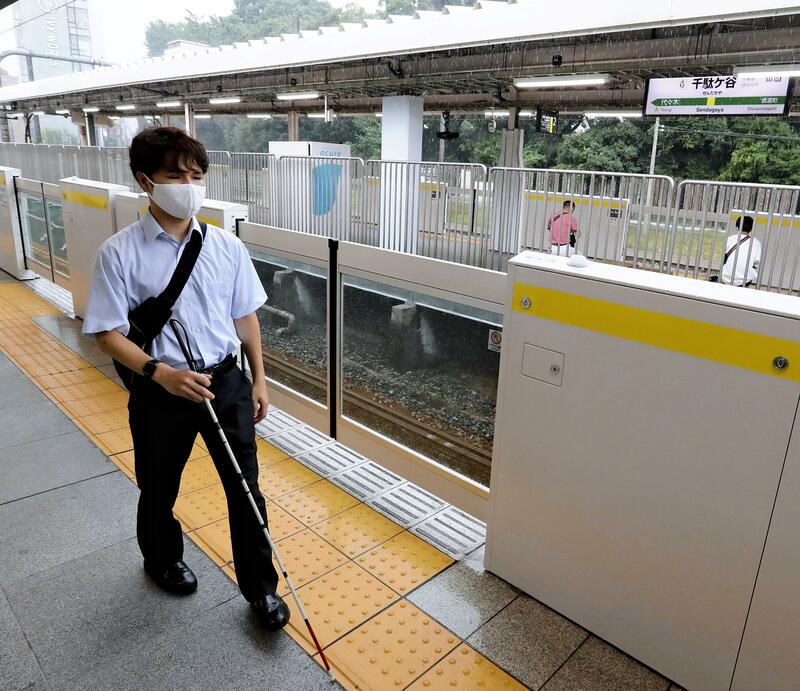
Platform doors are being installed mainly at stations in urban areas. JR Sendagaya Station, one of the closest stations to the National Stadium in Tokyo, installed them in June 2020.
-- Safeguard from falling
At the end of July, Kento Torii, 30, a blind man and a former member of the Japan national blind soccer team, walked through the platform doors at Sendagaya Station as they opened to a melodic sound.
"When I hear this sound, I feel very relieved that there are platform doors," he said.
On station platforms, Torii moves about using his white cane and braille blocks to guide him. At a station where he always transfers, however, he has fallen onto the tracks twice.
"I was careless," he said.
Each time, he was quickly rescued and able to escape trouble.
"I was just lucky," he said.
-- Training railroad workers
Railroad companies will continue to install platform doors after the Olympics and Paralympics. East Japan Railway Co. (JR East) plans to install the doors at all 243 stations on major lines in the Tokyo metropolitan area by the end of fiscal 2032, and Tokyo Metro Co. plans to complete the installation at all of its 180 stations by fiscal 2025.
JR East has been working on ways to accelerate the implementation of new platform doors introduced in 2020 that are 40% lighter than the conventional type. The construction time for these new doors is only six months, rather than the usual nine months, as the work to reinforce the platforms can be simplified.
The company has also enhanced training for station staff and engineers, with 16 training centers set up. At a training center in Chiba, training devices featuring the old and new doors are being used to teach emergency procedures in case a passenger is trapped.
"By conducting training before the installation of the platform doors, we are able to put them into operation immediately after they are installed," said the person in charge of training.
-- Help by speaking up
As improving the physical infrastructure will take more time, organizations for the visually impaired are strengthening measures to help people protect themselves.
In October last year, the Tokyo metropolitan welfare association for the blind held a workshop at Shinagawa Station to teach people what to do in the event someone falls onto the tracks. They reviewed such measures as seeking refuge in the space under the platform when it is difficult to climb back up.
"By actually experiencing situations, we can respond calmly in the event of an emergency," said Yoshihiko Sasagawa, the association's 87-year-old chairman. "It is necessary to expand training nationwide."
Kanji Yamashiro, 65, president of the National Council of Japan for the Visually Impaired, hopes that the accessibility environment will also be expanded in terms of person-to-person aspects.
"Cooperation among the people around us is essential to prevent accidents," he said. "If someone suddenly touches or pulls at a blind person's clothes, this might startle the person. It would be better to speak up and say, 'Can I give you a hand?'"
Read more from The Japan News at https://japannews.yomiuri.co.jp/