The koodai sits on a school corridor, a steel tiffin carrier seated snugly inside. Another is filled with vegetables as its owner grips it firmly by its braided handle. Yet another is slung across the shoulder: it is now a sling bag in sprightly colours.
Who would have thought that the humble basket, a school lunch bag staple of the 1980s, would evolve into something so chic? Hand-woven with colourful plastic wire, knot baskets are now tote bags, clutches, laptop bags, beach bags, mobile phone pouches, water bottle holders… why, there are even soap dishes featuring these intricate knots. The past couple of years have seen interesting experiments in knot baskets; partly driven by social media and partly by how versatile and practical the format is.
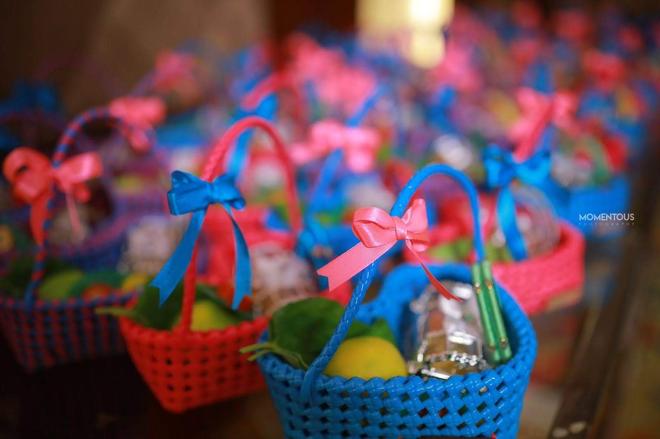
Coimbatore-based S Bhuvaneswari has been making baskets since she was 14 years old. The 44-year-old started trying out new shapes and designs as a lockdown experiment. “My daughters encouraged me to sell them on social media, and that is how Koodai Kalanjiyam took shape,” she says. Bhuvaneswari’s return gift baskets are among her bestsellers: these are tiny baskets shaped like hearts, squares, and circles. “People buy them for baby showers, weddings, and also for Navaratri,” she says.
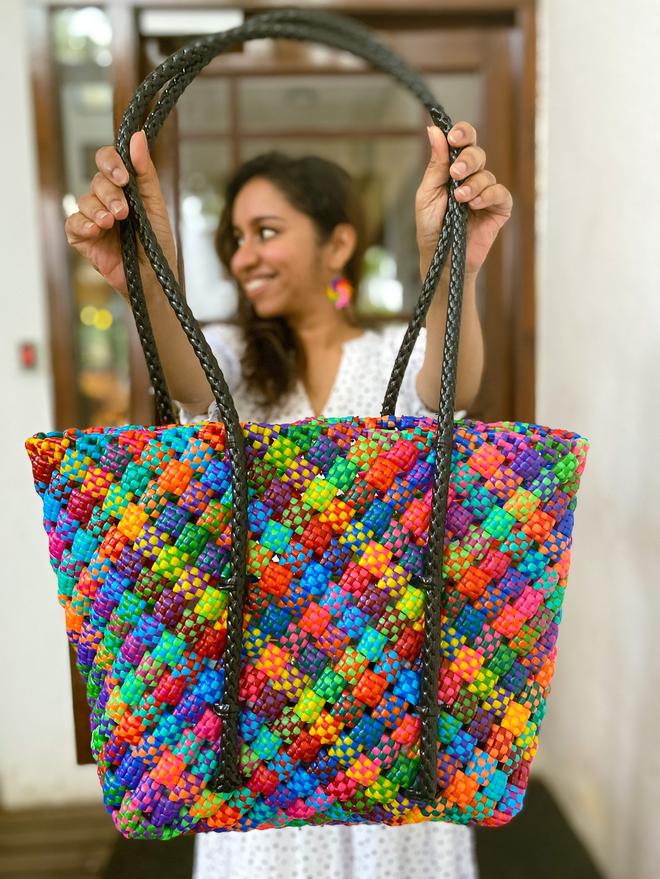
With the Government-imposed ban on single-use plastic, Bhuvaneswari says that wire baskets are environment and pocket-friendly alternatives to plastic bags. “A basket lasts up to 20 years,” she points out. “It is ideal to carry vegetables and steel containers and is sturdy.” She customises them based on colour, shape, and size. “Young women are now using them as handbags, for which I make longer handles,” she says, adding that actor Nayanthara popularised it further when she sported koodais in the film Kaathuvaakula Rendu Kaadhal.
Bhuvaneswari is constantly trying out new shapes. She makes pen stands and organisers, and also weaves baskets featuring the ‘amla’ knot, in which the knot is hexagon-shaped unlike the commonly used square knot.
“There are so many variations one can try with the knots,” says Erode-based KS Shanmuga Priya, who also sells on Instagram through her page Thilaga Koodais. “There are star-shaped knots, those with beads woven into them, Sivan kann that resembles the eye, and the more intricate biscuit pattern,” she explains. The former looks like tiny squares of biscuits arranged row after row, and baskets of the pattern are among the most expensive. “They are time-consuming and labour intensive, which is why I take 20 to 25 days to ship an order once it is placed,” she says.
Shanmuga Priya works with three basket weavers in her neighbourhood. “A lot has changed for the koodai. It is not confined to senior artisans anymore; I am in my 30s and am starting to learn the craft as well,” she says, adding that customers look for trendy colour combinations. “We recently did one in black-and-white, and beach bags in pastel colours.”
Coimbatore-based S Abinaya started a venture and an Instagram page named after her mother-in-law Saraswathy, who is known as Saras, at home. “She raised her two children on her own by working multiple jobs, among them being weaving wire baskets,” says the 30-year-old, who is also an artist. She plans to collaborate with Chennai-based designer Sruthi Kannath to come up with a line of “premium clutches and small pouches made of wire and embellished with zardozi work and crystals”.
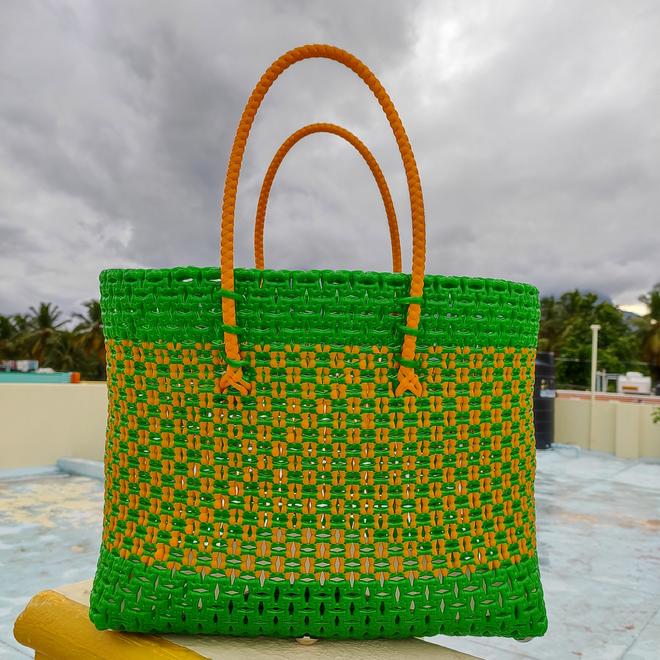
At Manjal, run by the M.Rm.Rm Cultural Foundation (an organisation that works towards the revival of rural crafts, textiles and architecture in the Chettinad region), plans are afoot to come up with knot baskets in angular shapes, incorporating leather and cloth into the design, according to Durga Gopalan, the project coordinator. “We are working with a design company on this, and the women who weave the baskets for us, all of them based in villages in Sivaganga district, are interested in trying out something new,” she adds.
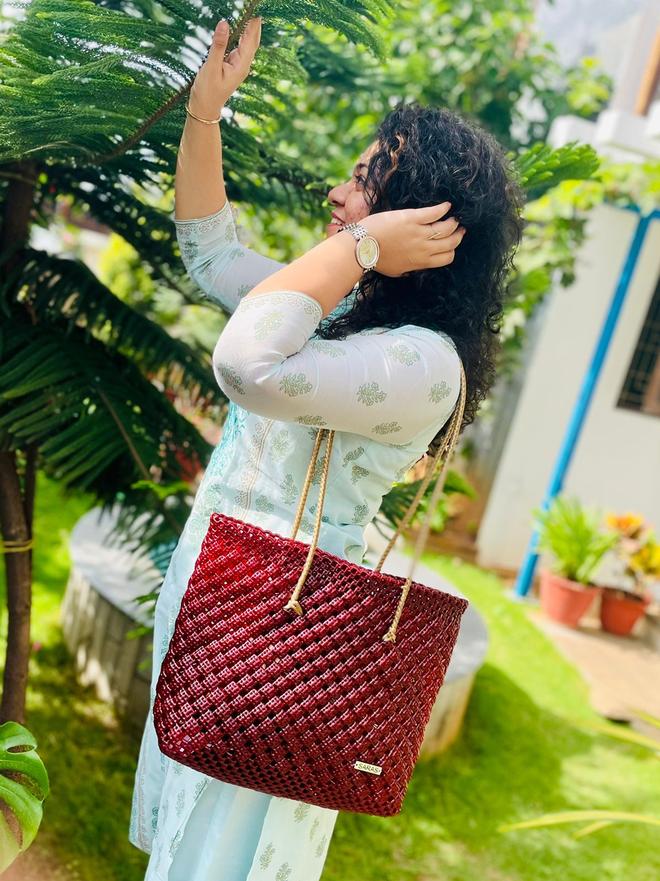
Durga says that there has been quite a “resurgence” in knot baskets in recent times. “In Chennai, they are popular among the Korean community. We have at least one Korean customer buying these bags from us every day,” she says, adding that they offer crossbody purses, sling bags, and beach baskets in the pattern.
There are some people who treasure koodais as vintage collectibles. Sixty-three-year-old T Padmavathi, who grew up in Thanjavur, says the first basket she ever wove, is still in good condition. “It is a combination of purple and pink. It must be over 50 years old.”