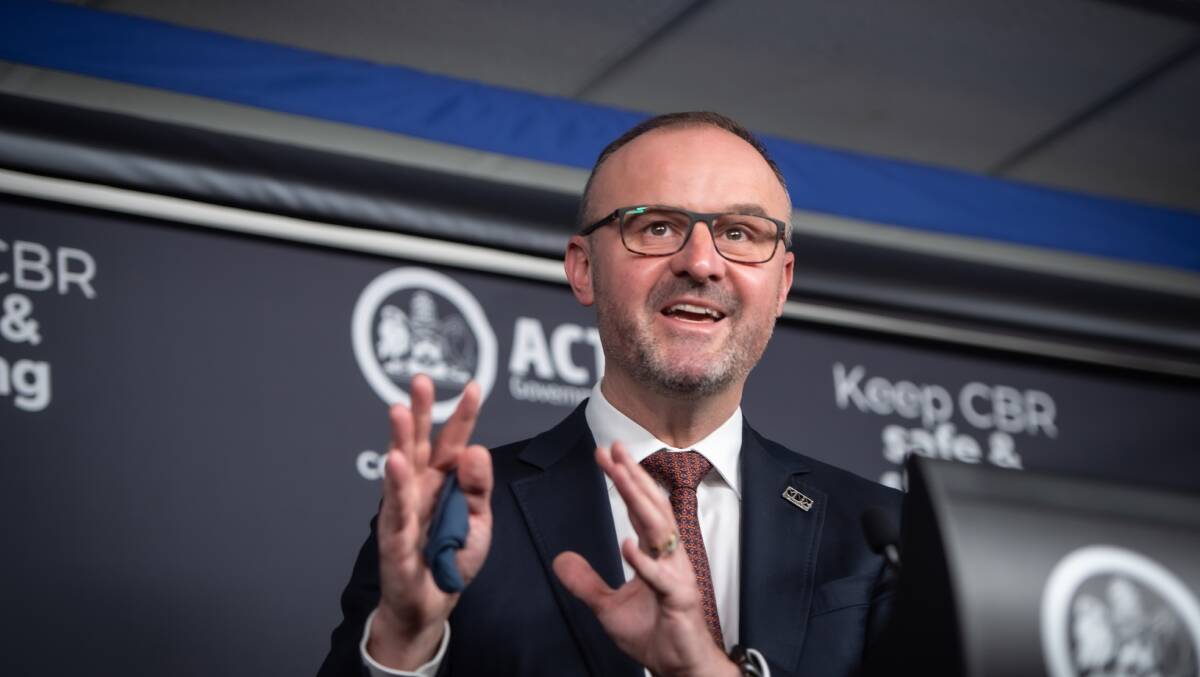
There are plans under way to vaccinate as many children as possible across Australia before the end of the year, the ACT's chief minister said.
Andrew Barr pressed national cabinet on Friday about childhood vaccinations, saying state and territory leaders needed to consider the safe rollout of a vaccine for children aged 12 to 15.
Mr Barr also confirmed the ACT was working to open vaccination registration for people aged 16 to 29 but said the announcement eligibility would be expanded nationally did not mean extra doses.
It came after Prime Minister Scott Morrison on Thursday announced eligibility for the Pfizer vaccine would be expanded nationally to people aged between 16 and 39.
Mr Barr said the prime minister's announcement, which he labelled a "captain's call", was intended to mean bookings could begin from August 30, "not that vaccinations would be able to be administered".
Before national cabinet on Friday, Mr Barr said one of his main priorities was to push for a vaccination program for children after Canberra's outbreak had disproportionately affected school-aged children.
"I'll take the opportunity to raise a series of concerns at that meeting. Most particularly about our nation's plans to protect and vaccinate children and young people from the virus," he said.
Following the meeting, Mr Barr confirmed all jurisdictions were working on vaccination plans for children aged 12 to 15, but this was dependent on supply.
"[This is] with a view to vaccinate as many children as possible before the end of the school year in December," he said.
Pfizer is the only vaccine that has been approved for this age group, and is currently only available to children with an underlying health condition.
Mr Barr also demanded clarity from his national cabinet colleagues about vaccination targets drawn from the Doherty Institute modelling. He said he wanted to ensure the targets referred to the point at which vaccines became effective, rather than when they were administered.
"We know, and every chief health officer around the nation has been saying this repeatedly, but maybe not enough politicians have been saying this: the vaccine is not immediately effective once it's jabbed into your arm," he said.
"It takes several weeks for it to reach effectiveness; that applies to both the first and the second dose. So when we talk about 70 or 80 per cent, we must talk about when the vaccines become effective, not just the moment the jab goes in your arm. Targets are not reached on the day of vaccination. It takes time.
"There are a range of very significant issues that need to be considered here. There won't be outcomes on this from today's meeting, but it is a very important issue that we know is on the minds of so many Canberrans and Australians."
Mr Barr said improved treatments for COVID-19 were an important factor in considering how restrictions would be used in the future.
"If we can treat people and avoid severe illness, combined with protecting them from getting the disease in the first place, that combination of factors can make a big difference to the public health settings you have in place," he said.
"But people do need to understand what the Doherty report says, and it doesn't say freedom day and no public health restrictions come into place at 70 or 80 per cent."