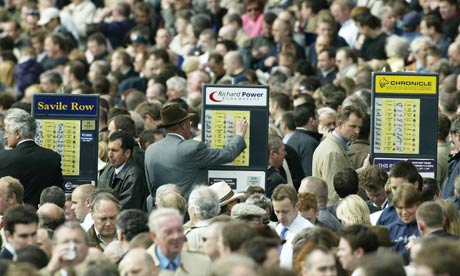
If you fancy a flutter over the summer months, Paddy Power is offering novelty bets on which candidate in local authority areas will win the Queen's Diamond Jubilee City Status competition. Last month's favourite, Reading, could be backed at 11/2, while outsiders Goole remained long shots at 40/1.
The competition, for which entries closed on 27 May 2011, has thrown up around 20 bids from English towns, and a smaller number of Scottish, Welsh and Northern Ireland candidates. An announcement of one award will be made in early 2012.
There are many reasons why Paddy Power might have labelled these bets as "novelty". Firstly, the criteria for winning the competition is clear only in its opacity. "The decisions made by Her Majesty will be final, and no reasons will be given. No details can be given of the assessment process," it said.
Secondly, the character of candidates makes comparability virtually impossible. Applicants have to be local authority areas. So large 250,000 populations plus unitary councils such as Bolton, Milton Keynes and Dudley are up against Goole and St Austell – town councils with populations of about 20,000.
Point and purpose?
It is also not clear that there is any real prize from winning the competition. City status confers neither additional powers nor resources. Previous winners (including Sunderland and Preston) have claimed both profile, attracting inward investment, and civic pride. Yet critics have also pointed to the cost of entry campaigns, and of implementing the new designation. A number of prominent, large towns including Swindon, Blackpool and Cheltenham decided not to bid this year, fearing the distraction in chasing titles and carrying out a PR exercise.
However, there can be serious purpose to achieving city status, dimensions that vary according to the character of the applicant. Luton, Reading and Southend, for instance, are under-bounded urban councils. Their conurbation extends well beyond the local authority, and their growth and development has often been opposed by their neighbours. A city status bid, supported on a conurbation basis, could assist the process of building consensus on measures necessary for the success of the real city in the future.
In an almost opposite sense, applicants such as Doncaster and Bolton are large metropolitan boroughs, where the urban core is less than 50% of the total population. Here, a process of building a common purpose across the town and surrounding villages may be a positive outcome of the bid. Medway is an extreme example of this case, where five major towns, including Rochester, which had previously lost city status, could create a new profile through the bidding process.
Identities
Other applicants such as Dudley, Stockport, Gateshead and Middlesbrough, all in proximity to major cities Birmingham, Manchester and Newcastle, may find their individual profile, image and reputations can be raised by a distinctive proposition. An extreme example of this phenomenon may be the submissions of Croydon and Tower Hamlets, both of whom aspire to stand alongside Westminster and City of London as "cities within a world city".
As a novelty bet, the Diamond Jubilee competition is completely frivolous. You can get odds on Guildford, Blackpool and Swindon, who have not made a submission, as well as a place called Dorset Town, which does not even exist. Yet as a serious approach to place-making, a city status campaign can be useful and catalytic in progressing our successful cities of the future.
Ultimately, cities are defined by their communities and the decisions their leaders take as strategic shapers of coherent, vibrant urban areas. In this respect, true city status is not in the gift of Her Majesty. It is a prize available to all ambitious towns and communities able to articulate and pursue their vision of their place. And the benefits of that prize are available today.
David Marlow is managing director of Third Life Economics and the former chief executive of the East of England Regional Development Agency.
This content is brought to you by Guardian Professional. Join the local government network for more like this direct to your inbox.