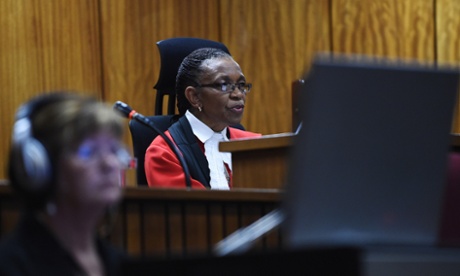
As Oscar Pistorius wilted in the witness box, she exuded calm authority in a courtroom where all deferred to her as “Ma’am”. One year on, however, it was the judge Thokozile Masipa who found herself under gruelling cross-examination during a job interview.
Masipa, 67, is among seven candidates vying for the new position of the judge president of Limpopo province in South Africa. On Monday night, the Judicial Service Commission (JSC) drew attention to a CV that includes one of the most eagerly watched trials in history – and one of the most contentious verdicts.
Masipa accepted Pistorius’s explanation last year that he shot dead his girlfriend, Reeva Steenkamp, after mistaking her for an intruder. She acquitted the Paralympian of murder and instead found him guilty of culpable homicide, the South African equivalent of manslaughter, and sentenced him to five years in prison. The verdict was criticised by Steenkamp’s family and campaigners against gender violence.
Mathole Motshekga, an MP for the governing African National Congress (ANC), suggested the controversy could result in a backlash against the new court. According to the Rand Daily Mail website, he asked Masipa: “What will you do to ensure that the new court doesn’t start to deal with the negative image … don’t you think that that stigma will challenge the image of the new court and if it does‚ what will you do to ensure that the image of that court doesn’t suffer?”
Masipa rejected the premise that she had a negative image. “I do not think the criticism was about me at all,” she replied. “It was about the outcome. Because people were expecting a different outcome, they were just expressing frustration. I don’t think I’m stigmatised … perhaps I am too naive about that.
“Since Pistorius I have been given other cases. The counsel that have appeared before me still give me the same respect before and after.”
Michael Masutha, South Africa’s justice minister, said Masipa, who grew up in Soweto township, was now “one of the most famous judges in the world” and Mogoeng Mogoeng, the chief justice, asked her to explain how she dealt with the attacks since she gained her unlikely celebrity status.
Masipa, a former journalist who suffered detention during the apartheid era, said: “A judge must respect criticism. It is not personal. When someone expressed their frustration you should just let them … judges have been attacked all over ... we are not on the bench to please people, we are not there to win a popularity contest. We are there to do a job and, once you know you’ve done your job, there really isn’t anything to worry about.”
However, Mike Hellens, a barrister who sits on the commission, asked how Masipa could be a judge president of a court when she could not control the lawyers in the Pistorius trial.
Meanwhile, another commissioner, Julius Malema, the firebrand who leads the Economic Freedom Fighters, grilled Masipa over why she was seeking the job when she was nearing retirement. He asked: “You are left with two years, and then after that we must go and get another judge. Don’t you think it is better for this commission to go for someone who can stay for a longer period?”
Masipa responded: “Two years is a very long time. When I leave there would be no instabilities.”
The commission sat until midnight on Monday. Of 23 candidates shortlisted for the various judge and judge president positions, only four are women. The prosecution in the Pistorius trial is appealing against Masipa’s ruling. It is expected to be reviewed by the supreme court of appeal later this year.