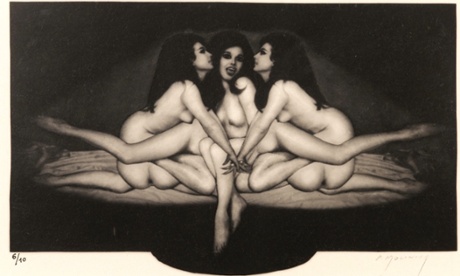
The photographs reveal things as though through a keyhole, spotlit vignettes rearing up from a forbidden world. They are small, black-and-white, home-developed silver gelatin prints, and they glower round the walls, not so much inviting as inciting you to look.
This small show at Richard Saltoun in London’s Fitzrovia is the first UK exhibition of Pierre Molinier’s work for over 20 years. Molinier, born in 1900, makes the spectator feel like a voyeur. But he wants us to witness what he himself wanted to see: these are episodes from a life in private, revealed to the world. His photographs have the repetitiveness of obsession and pornography. The same old things, again and again, the same focus, the same rooms, the same furniture and paraphernalia.
![Pierre MOLINIER 1900-1976Je rampe vers Gehamman, planche 25 du Chaman [I Crawl Towards Gehamman, plate 25 of The Shaman], 1965Vintage silver gelatin print](http://static.guim.co.uk/sys-images/Guardian/Pix/pictures/2015/8/25/1440514744030/f2372a11-0c88-4fc5-81b6-ebb006943bf7-460x324.jpeg)
And Molinier himself, again and again. These are more than selfies. He shows too much of himself, nevertheless. A man with a rose in his arse, corseted, masked, veiled, bewigged, high-heeled, impaled, laughing, giving us his rictus grin. Here’s his stockinged legs, bound at the ankles. Here’s his bum. Here it is again. There’s that stool, the chair, the out-of-focus wallpaper. It looks like nothing has changed here in decades.
Although many of the photographs date from the 1960s and 70s, they seem to come from an earlier age. There’s something musty and cloistered about them. They show a man alone, a man with mannequins, performing for himself and for the camera – and an invisible audience who might not be there at all.
Everything happens in an apartment at 7 Rue de Faussets in Bordeaux. Here, Molinier acted out his fantasy life and death before the camera. In 1950 he photographed himself as a lain-out corpse, and concocted a shot of his own imaginary grave. “He was a man without morals,” he wrote on the cross embedded in the earth. Finally, in 1976, he committed suicide.
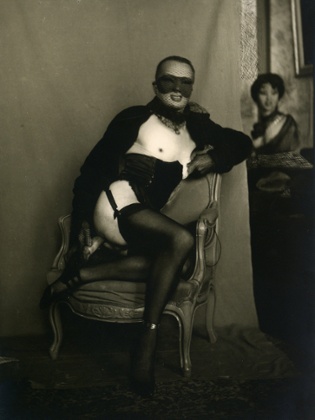
He left a note on the door: “I’m killing myself, the key is with Claude Fonsale, the lawyer.” Beside his corpse was a second note, railing against “all the bastards who have been a pain in the arse all my bloody life”. Molinier staged his death, just as he staged so much of his life. He found it amusing, he once wrote, that those who would come to dissect his corpse (which he had donated to science) would discover his toenails immaculately painted red. Molinier, who also had a thing about guns, shot himself in the mouth in front of a mirror. He wanted to watch. Throughout his work there is a quest for obliteration, losing himself in sex and in the merger with a fantasised feminine alter ego.
A housepainter by trade, Molinier became first a painter of surrealist, symbolist canvases. André Breton encouraged his paintings in the late 1950s, though later dropped the association. Breton may have been attracted to Molinier’s anti-clericism, but not to his sexuality or his photography; the homophobia of Breton’s circle was legendary. Yet Molinier’s art did eventually find its milieu, and he is recognised as a marker in an evolving queer sensibility, along with the wonderful Claude Cahun (whom Breton also supported, then dropped). For Cahun, six years older than Molinier, a kind of private performance photography was also central to her art.
Molinier’s paintings are forced, glutinous and airless, while his drawings are more interesting for what they represent than their style. Molinier drew things, I think, to show himself how they looked, their forms and perverse conjunctions already articulated in his mind, just as his photographs recorded events already premeditated – dressed for, lit, framed and staged.
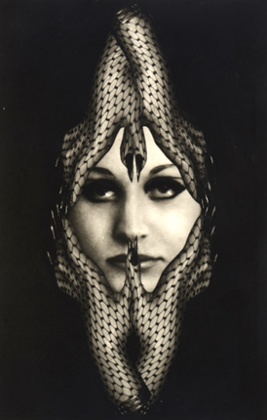
It was as a photographer and photomontagist that Molinier really found himself. The photograph became a mirror, a way of seeing and fixing himself as other. Presumably, he wanted to preserve the image of his display in female guise, as well as engaging in certain acts – some of which were only humanly possible through the artifice of photomontage. But his auto-fellatio images were real enough, performed with the assistance of a homemade yoke. Do not try this at home.
Molinier’s elaborate fantasy life and gender play became his art. His partners, for the most part, were his own photomontaged and duplicated selves. In his photographs he became both other and himself, man and woman, penetrator and penetrated. At the core of his art, his transvestism signalled the merging of sexes, a multiplication of organs and limbs and selves. He became the object of his own desire, a self that was other.
He photographed himself wearing a dildo, having sex with not one, but two montaged doubles over a stool. He made double and triple self-portraits – meeting his younger selves in the developing tray – and images of himself as a kind of devil-shaman, backlit, with both breasts and erection.
The impossible, too, is at the centre of his work: in one photomontage – possibly a perverse play on Velázquez – a figure lounges on a couch in the pose of The Toilet of Venus. Where Velázquez’s Venus is turned away from the viewer, seeing her own face in a mirror, Molinier’s montaged head is reversed on his own shoulders. The legs and female sex are also reversed. Front and back have been recombined, then given an extra pair of legs and an arm that gropes out of nowhere.
Other montages are kaleidoscopic Busby Berkeley mirrorings of multiple legs and faces and arses. These images unfold about themselves like flowers and mandalas, made up of body parts dismembered from his own photographs. What human anatomy won’t allow, photomontage and collage make possible. It is all a delirious, rapturous confusion.
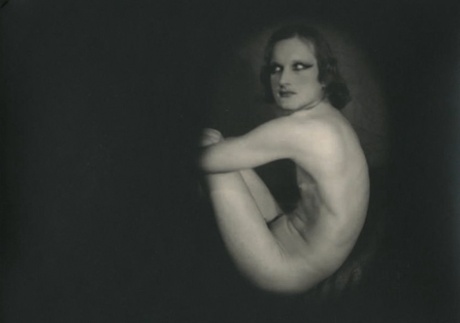
The repetition of Molinier’s images, the tiny circus of his performances to camera, reflects his desires and compulsions. In the photographs, not even Molinier changes much. His photographs try to stop time, smoothing out the signs of age in the darkroom and by careful lighting. Molinier is said to have been an influence, or at least a forerunner, of Cindy Sherman, Catherine Opie and Robert Mapplethorpe. In his later years he also used other artists – notably Swiss performer and painter Luciano Castelli and the French artist Thierry Agullo – to model for photographs in roles closely allied to his own. Maybe he saw them as body doubles as he grew older. Last year, a show of Molinier and Genesis Breyer P-Orridge (of Psychic TV and Throbbing Gristle fame, among much else) was held in New York. Posthumously, Molinier has become something of a cult figure. His art was a kind of extreme exposure. Molinier’s life and art are inextricable. It all writhes together.
- The Temptations of Pierre Molinier is at Richard Saltoun, London W1W, until 2 October 2015