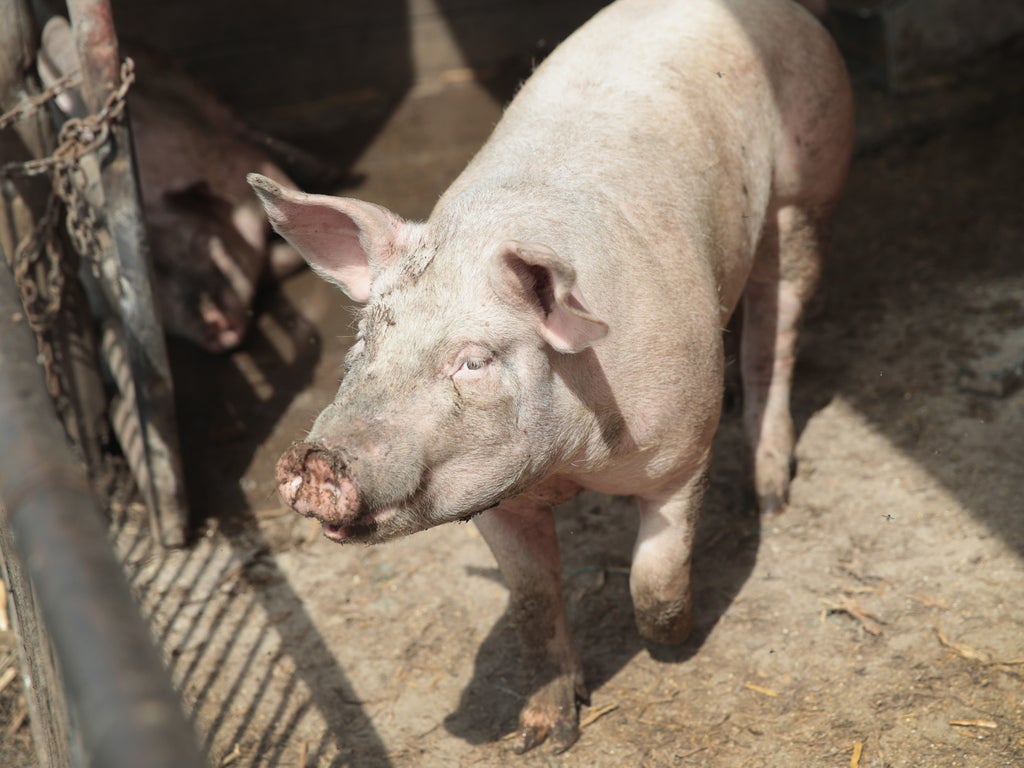
Pigs are noisy creatures, from their contented oinks to their terrified squeals.
But could those sounds contain clues to their emotions and welfare?
An international team of researchers say so. For a study in Scientific Reports, they created an algorithm to analyse thousands of pig sounds - and say it’s a tool that could one day be used by farmers.
If you’re wondering whether animals have emotions at all, you’re not alone. For centuries, researchers have been trying to determine if and how animals experience feelings.
In this case, the researchers looked at pigs’ emotional arousal - heightened activity associated with pleasant and unpleasant stimuli.
The scientists used a data set of over 7,000 vocalisations made across the life span of 411 pigs on commercial farms and in a variety of experimental scenarios.
They assigned positive or negative emotions to different situations; for example, a fight or imminent slaughter was categorised as "negative" and suckling was categorised as "positive."
To tease out other pig sounds, the researchers put pigs in a variety of situations: They introduced them to new objects, for example, or isolated them from the other pigs.
They analysed the data with the help of an algorithm. It revealed that short sounds without much fluctuation in volume - usually ones that go from a high to a lower frequency - are associated with positive emotions. Negative ones are associated with longer squeals and vocalisations at higher frequencies. Pigs made low-frequency grunts in both situations, however.
What’s the point of listening to pigs? Animal welfare, say the researchers.
Understanding the sounds pigs make when they’re stressed is "an important step toward improved animal welfare for livestock," Elodie Floriane Mandel-Briefer, an associate professor at the University of Copenhagen’s biology department who co-led the study, said in a news release.
The researchers say the algorithm could be used to better understand other animals - and could be developed into an app for farmers who want to improve their animals’ lives.