Los Angeles is a city with no border between reality and artifice. Images here have lives their own. It’s hard to think of a better city in which to encounter the art of Pierre Huyghe – an artist whose fiction gives rise to reality, whose sometimes baffling, always engaging art turns real life into a dream, and vice versa.
At the Los Angeles County Museum of Art, Huyghe has just opened his first American retrospective, a festive, unfathomable, profoundly ambitious exhibition that was first seen at the Centre Pompidou in Paris. In his hometown, it defied expectations to become one of the museum’s best attended shows of a living artist in years. It seduces, it beguiles, it obfuscates, it amazes. It challenges the most fundamental assumptions about what a museum show can be. By the end of my first visit I found myself unready to leave; I rushed back the next day, impatient to throw myself again into Huyghe’s universe of monkeys and marine life, ice rinks and steam machines, voyages to Antarctica or the moon. This is a show that rewards, perhaps even requires, repeat visits. It earns them.
Huyghe, born in Paris in 1962, is one of the most significant artists of the last quarter-century. He’s a polymath, and his art ranges from dystopian films infused with science fiction elements to gardens full of poisonous plants. But the strength of his art did not guarantee the strength of this retrospective. On the contrary, a Huyghe retrospective is almost a contradiction in terms.
One of the critical moves he and his fellow artists made in 1990s France was to shift their emphasis from making discrete artworks to fully composed exhibitions, or experiences in the real space of the gallery. Relational aesthetics, as this tendency was imprecisely christened, was an art of specific encounters and time-based interactions, much harder to preserve than a stable painting or sculpture. How do you re-present those without ossifying them?
The answer is through a total redeployment of Huyghe’s art, installed so that works bleed into one another, for an experience that’s partly choreographed and partly left to chance. All the strings are visible, yet it remains cloaked in mystery. There are funny emphases, like an early Super-8 travelogue never seen before, and intentionally gaping holes. Kate Bush’s Wuthering Heights might start blaring from one gallery while you’re contemplating a puppet show featuring a dancing Le Corbusier. Sounds chaotic? It is, in places. But the more accurate word might be alive.
Works familiar to those who’ve followed Huyghe’s career reappear here in new forms, or else slip off the screen into the gallery. In 2001, Huyghe turned the illuminated drop ceiling of France’s Venice Biennale pavilion into Atari Light, a giant game of Pong that visitors could play with joysticks. Here it is again, though one of the lights is broken, and tropical plants have sprouted beneath. (I lost, by the way.) A black ice rink that, fifteen years ago, hosted a figure skater carving tracks now has no skater, but globs of tar from the prehistoric La Brea pits outside the museum. A performer wearing a LED-covered mask might walk past you. If he looks familiar, it’s because you just saw him in one of Huyghe’s films, wearing the same getup.
There is one drawback to this show, though: it omits many of the videos from the late 1990s that brought the artists to international prominence. These sharp, cold inquiries looked at the effects of mass media on our personal autonomy, psychological character, and social relationships. They used Hollywood cinema as a medium to be refashioned at will, a primary material as basic as paint or clay. Blanche-Neige Lucie (1997) introduced the vocal artist who dubbed Snow White into French, then got sued by Disney for the rights to her own voice. Les Grands Ensembles (2001) depicted the tower blocks of the Parisian banlieue through a TV haze, articulating the moment they passed from utopian housing to periurban ghetto. The Third Memory, his masterpiece from 2000, remade the true-crime film Dog Day Afternoon – no longer starring Al Pacino, but the actual paroled bank robber whose caper inspired the movie. The robber, whom Huyghe placed on a Parisian soundstage, tries to tell us what really happened, but his recollections are hopelessly tainted by the Hollywood version. He is media now, and so are we.
To historians, the LACMA show’s leapfrogging of these key works and others will be a torment. These were the videos by which Huyghe, alongside his colleagues Philippe Parreno and Dominique Gonzalez-Foerster, reestablished France as a leader in contemporary art after decades in the shadow of first Germany, then the UK. Huyghe, however – working with the young curator Jarrett Gregory, one of many talented New Yorkers who have skipped town for LA in recent years – is playing a bigger game than just a historical recap. The exhibition is itself a medium for the artist. It’s a fractal reproduction of the works it contains. It unfolds in every direction at once, and changes everyday, thanks to performers both human and animal. Videos and light works are on timers: they flicker on and off, stop and restart. It’s as if the exhibition were itself a film that progresses through time, with plot twists and shifts in intensity.
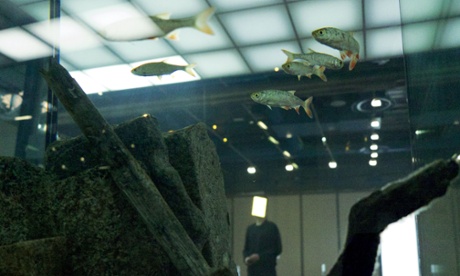
Animals, especially, play a central role in Huyghe’s art, and have for decades. They’re on screen (deer, rabbits, a mythical white penguin in Antarctica) and in the galleries (ants crawling on the gallery walls, a hermit crab in a fish tank), no doubt to the delight of the Los Angeles animal welfare authorities. Why the menagerie? Perhaps because, more than human performers, animals fit into Huyghe’s technique of only partially choreographing a situation, and then letting it develop however it may. With no knowledge that they form part of an artwork, the fish in Huyghe’s tanks or the ants tracing lines on the walls allow Huyghe to relax his grip. They’re indifferent to the artist’s desires, and to our gazes too. Perhaps, too, because in Huyghe’s science fictions can sometimes tip into the apocalyptic, and the animals stand a better chance of surviving than us. When we’re gone, the ants and the hermit crabs will still be here, crawling through our ruined museums.
At intervals the lights from the Atari game click off, the Le Corbusier video and others go dead, and a single large-format video plays in the largest gallery. Another animal, a monkey this time. We’re in Japan, not far from devastated Fukushima, in a restaurant that might be closed for the night, or might be abandoned forever. It soon becomes clear that the monkey, who’s wearing a mask familiar from Noh drama, works at the restaurant as a waitress – and though she appears at first to be a high-def simulation she’s a real monkey, who really serves drinks at a Tokyo bar. Just like in his Dog Day Afternoon remake, here the performer is real but the setting is a fiction: a grungy, forsaken place, devoid of other life perhaps forever. Only the monkey survives, waiting for customers, her mask never slipping.
Then there is Human, the adorable white dog with one pink leg who saunters through the galleries of this exhibition. She might come up to you while you’re gazing at Huyghe’s fish tanks, or lie down by your side as you watch footage from his Antarctic expedition. On my first visit to the show she was making friends with a young girl, who broke the no-petting-allowed rule. Human is a bona fide Hollywood celebrity now, trailed by museumgoers snapping cameraphone shots – including me, I’m ashamed to say – and like any star she can be a little temperamental. Sometimes she’ll walk right out of the show and into the sunlight.
Like everything and everyone else in this stunning exhibition, Human the dog slips between herself and a sign of herself, or between life and media. She trots through the galleries, stretching her forelegs or reclining against the white walls. And she is blissfully unaware of any distinction between the gallery and the spaces beyond it: between Pierre Huyghe’s art and the world he knows it cannot contain.

.jpg?w=600)