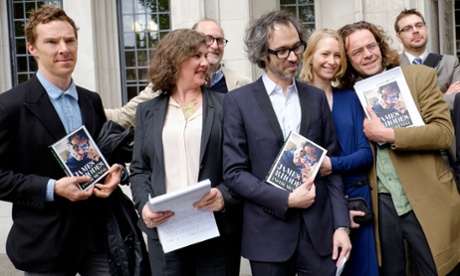
A British performing artist who had been prevented from publishing his autobiography can now be named after the UK supreme court lifted the injunction that had banned him from publishing a full account of his own life.
The man who could be identified only as MLA during a year-long series of battles in the English courts is James Rhodes, the internationally-renowned classical pianist.
The publishers of the book, who have been anonymised in previous court reports as STL, are in fact Canongate.
Rhodes’s autobiography details sexual abuse suffered as a child, and the way in which his art had helped him to cope with the trauma of his past.
He and Canongate were banned from publishing the book after lawyers obtained an injunction arguing that revealing the story would cause family distress.
Their case hinged on an obscure piece of Victorian case law, known as Wilkinson v Downton, in which a man who played a practical joke on an east London pub landlady in 1897 was found to be guilty of the “intentional infliction of mental distress”.
Rhodes, 40, was in court to hear that the injunction was being lifted, accompanied by his friend Benedict Cumberbatch, the actor. Rhodes has said he believes it is particularly important that the voices of survivors of sexual abuse are not stifled. “Imagine someone from Rotherham being told they can’t come forward and talk about what happened to them as a result of legal action.”
He was supported by human rights groups and a leading writers’ organisation, which feared that the injunction presented a serious risk to the right to freedom of expression.
The writers’ association English PEN, Article 19 and Index on Censorship, which defend and promote free speech, argued that an earlier judgment by the court of appeal – which had ruled that there should be a high court trial to decide the dispute – could have had a chilling effect on other writers tackling difficult subjects, should it have been allowed to stand.
Last year 20 leading writers, including David Hare, Michael Frayn, William Boyd and Tom Stoppard wrote to the Daily Telegraph to say they were “gravely concerned about the impact of this judgment on the freedom to read and write in Britain”.
Delivering Wednesday’s judgment, Lord Toulson said: “Freedom to report the truth is a basic right to which the court gives a high level of protection, and the author’s right to his story includes the right to tell it as he wishes.”
Rhodes’s autobiography, entitled Instrumental, will be published next week.
Outside the court he said: “Clearly this is a victory for freedom of speech. Much more importantly it is a powerful message to survivors of sexual abuse.
“There is already too much stigma and shame surrounding mental health and sexual abuse. I’m relieved that our justice system has finally seen sense and not only allowed me to tell my story but affirmed in the strongest possible way that speaking up about one’s own life is a basic human right.”
.